Exercise Anatomy - Small Round Muscle, Large Round Muscle (Part 2)
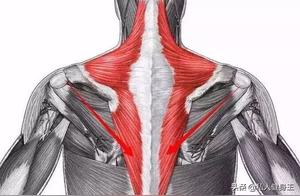
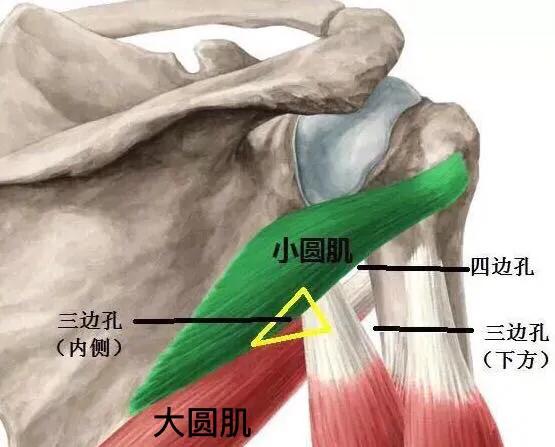
Minor Round Muscle Location and Structure:Located below the Subscapularis, mostly covered by the Scapula Triangle as a cylindrical muscle.
Originates from:The posterior upper 2/3 of the acromial border of the scapula, muscle fibers migrate outwards to the conjoined tendon.
Ends at:The lower prominence of the humerus greater tuberosity and the glenohumeral capsule.
The minor round muscle is enclosed within the subscapular articular fibrous sheath, but separated from the subscapularis by a thin fibrous membrane, the loosely honeycomb tissue on the front of the subscapular space is well-developed at the shoulder neck, allowing for interspace above, the muscle’s rear honeycomb tissue runs along the tendon on the outside, and can be connected to the subscapularis gap by a poorly developed subscapular tendon,
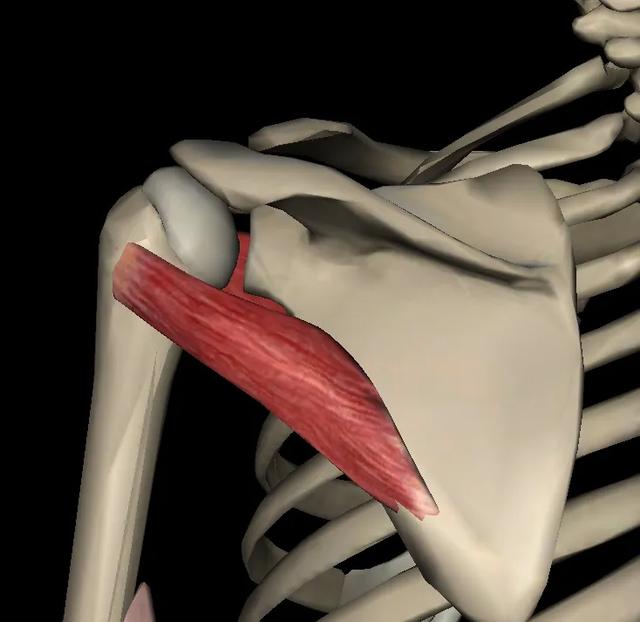
Nerve Supply:The minor round muscle is innervated by axillary nerve C5.
Function:
External rotation, humerus internal rotation.Presentation:
I. Difficulty with outward elevation (abduction) of the shoulder.
II. Numbness in the fingers when the shoulder moves.
III. Shoulder pain, especially on the posterior side of the shoulder.
IV. Feeling of coldness in the shoulder, commonly known as shoulder hemorrage syndrome.Triggering Factors:
Rotator cuff tendinopathy, Major Round Muscle Location and Structure:
The major round muscle sometimes combines with the latissimus dorsi as one muscle, located below the subscapularis and minor round muscle, its lower edge is covered by the lower edge of the latissimus dorsi, the whole muscle is columnar, stronger than the minor round muscle, it works together from the scapula to generate force. These two muscles form muscle bundles that enter the axilla from the scapula and connect to the humerus upper segment front, forming the back wall of the axilla, Originates from:
The posterior lower part and corner of the acromial border of the scapula and the subscapularis membrane, muscle fibers converge upwards and outwards through the conjoined tendon.Ends at:
The lower crest of the humerus, between the two tendons there is the latissimus dorsi pouch, and there is a latissimus dorsi tendon pouch below the humerus medial edge, the lower edge of the major round muscle forms the lower border of the axillary triangle and the quadrilateral hole, Function:
Humerus extension, internal rotation and adduction.
Nerve Supply:The major round muscle is innervated by shoulder nerve C5-C7.
Presentation:
I. Difficulty with outward elevation (abduction) of the shoulder.
II. Shoulder impingement syndrome.
III. Pain when the arm is raised above head height.
IV. Clamshell syndrome, difficulty with arm entrapment.
V. Static discomfort, pain when driving.
Major Round Muscle Strain: When placing the elbow on a table or stool, or when reaching for objects on a shelf above the head, causing sharp pain in the posterior triangle,