Feeling Lost and Bad Relationships? Change Your Life – Start by Learning to Ask Questions
When it comes to questions, everyone is familiar with them. Our daily communication is essentially based on questions and answers, even when we are alone, we often ask ourselves questions, such as: 'What materials do I need to bring to the meeting tomorrow?' It's natural for us to ask questions. From the endless 'why' questions of young children, we can see this innate tendency.
Perhaps it's because 'questions' are so easy to come by, few people actually pay attention to the fact that 'questioning' itself is a discipline.When we ask someone a question and don't get an answer, we often assume the other person is arrogant or impolite, without realizing that our questioning method might be wrong, or that the question itself isn't worth answering.
Therefore, questioning is not just an instinct, but also a skill.I learned this from the book 'Learn to Ask Questions' by.

The author's profession is quite interesting – he's a 'management coach,' specializing in guiding managers in major Japanese companies.Questioning. Since it's a profession, there's a fee involved, although is very busy, even with limited time to accept new commissions.
As one of the foremost questioners in Japan, has distilled his 15 years of experience into the book 'Learn to Ask Questions.' In the book, the author divides questions into four categories: substandard questions, casual questions, heavy questions and quality questions.
The author believesQuality questions have a tremendous power, not only transforming the lives of those who ask and those around them, pushing them towards better directions, but also improving interpersonal relationships.
So, what constitutes a 'quality question'? How should we formulate them?
If we don't want to sound self-serving, then we need to be clear that
A question's quality depends on the responder, not the questioner.As shown, based on whether the responder is willing to answer and whether they gain any new insights, questions can be divided into substandard questions, casual questions, heavy questions and quality questions.
Casual questions are questions to which the responder is willing to answer, but doesn't gain any new insights.
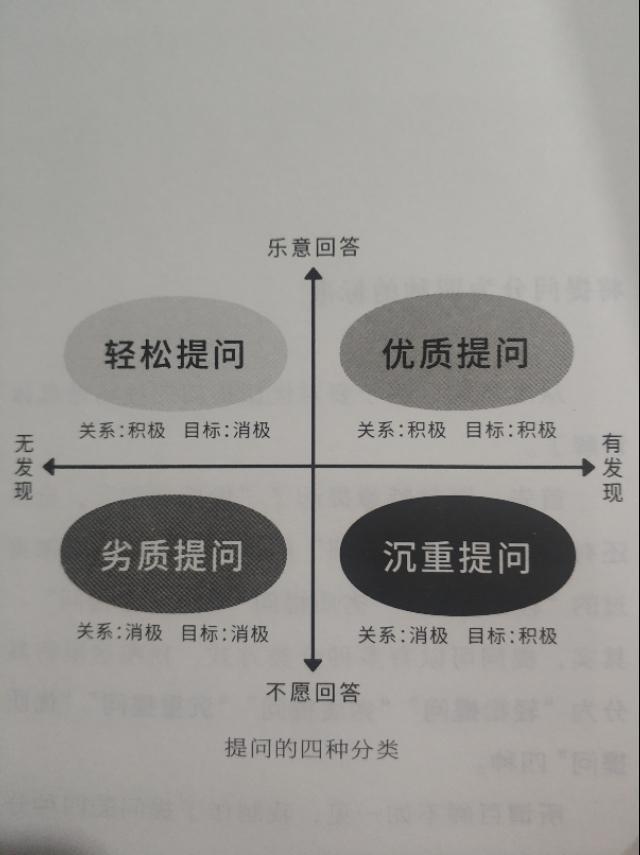
For example, in casual conversations with friends, we talk about our hobbies or chat about our lives. Once we're finished talking, the conversation ends. The main purpose of casual questions is to improve relationships.In a workplace setting, casual questions can also be a trial-and-error process. Starting with casual questions and gradually adjusting the conversation based on the recipient's receptiveness, getting to know their personality and narrowing the gap between them, so that more formal discussions can be conducted.
Substandard questions are questions to which the responder is unwilling to answer and doesn't have any new insights.
We often encounter such questions – for example, someone unexpectedly asks you, 'How much do you earn per month?' or 'Your nose is pretty good, are you getting a cosmetic surgery?'' Don't even think about whether to answer or not, it's simply impolite.Heavy questions are questions to which the responder is unwilling to answer, even deliberately avoiding them, but these questions can trigger new insights or actions in the responder.
Mr. Sen Chiren once asked a question: 'Why do our schools always fail to cultivate outstanding talents?' This question is extremely heavy, but it's a wake-up call for our education, prompting reforms.Quality questions combine the strengths of casual questions and heavy questions, eliminating their weaknesses: questions that encourage those who respond to think actively and offer new insights, accompanied by action.
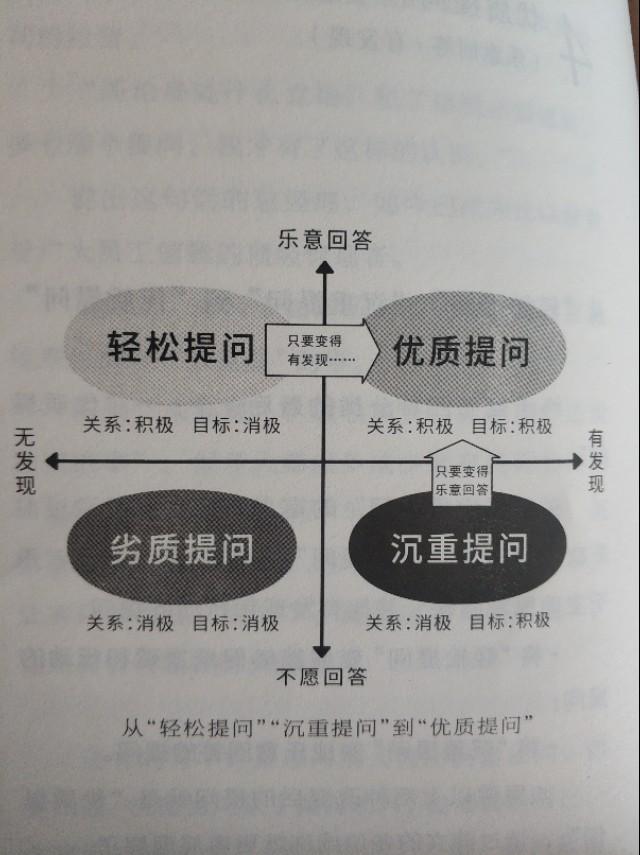
Therefore, turning casual questions into questions that promote discovery and action constitutes quality questions.
Turning heavy questions into questions that the responder is willing to answer also constitutes quality questions.
Given the differences in everyone's attention and goals, there's no one-size-fits-all 'quality question' template. However, quality questions always share certain characteristics:
Dig deep into the essence of the problem.This fundamental element can be summarized using 5W1H:Time (when)
- Location (where)
- People (who)
- Object (what)
- Cause (why)
- Method (how)
- Now that we know what quality questions are, how can we make our questions quality questions?
Let's explore the methods.
Before we discuss the methods, we need to clarify one thing: quality questions are not only applicable to communication with others, but also essential for our self-improvement. We also need to ask ourselves questions from time to time, and correct our actions in a timely manner.
The author believes
The method for creating quality questions is to find questions that are close to the questions already internalized by the person you're talking to, but are like blind spots that haven't been noticed.At the same time, the author proposes a '3V' theory:Vision (ideal)
- Value (value)
- Vocabulary (vocabulary)
- In 2005, Steve Jobs, the founder of Apple, said in his graduation speech at Stanford University: 'Every morning, I ask myself this question: If today is my last day, would I still do the things I'm doing today?' 'If, day after day, my answers are 'no,' then I know that I need to change something.'
If, over a long period of time, our answers are always 'no,' it means we are doing things that don't align with our aspirations.
Therefore, we must identify the things we truly want to do (Vision: ideal).The object can be ourselves or the object of our communication.
Look around us, how many people work hard but always fail to achieve results, eventually falling into a state of confusion – this is a classic case of not knowing what you truly want to do, and doing things 'out of obligation.'
When people discover what they really want to do, they will spontaneously think and take action.People's behavior is influenced by their different values. So
The second element of quality questions is to clarify the values (Value: value) of the person being questioned.
Some people may be puzzled: how do questions and values relate to each other?
We all know that people's values are not formed overnight, but are gradually developed over a long period of time. This will lead to internalization of values, and the person will not even realize that their actions are inappropriate, thinking it's just a natural thing to do.
In fact, some questions and answers are only separated by a thin paper. Once the paper is torn, a whole new world will be revealed. However, those who are in power are limited by their own values and cannot see things from outside.
As the saying goes: 'Those who are in power are blind, and those who are outsiders are clear.' A good questioner will pose questions that are close to the values of the responder, which can give the responder a sudden realization.
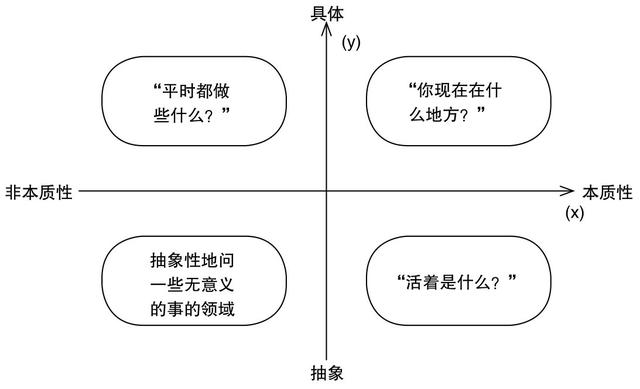
Quality questions' third element is to concretize abstract concepts (Vocabulary: vocabulary).
We often complain (or others) about unhappiness or failure, have we ever wondered, what standard do you use for happiness and success? Is it only becoming a billionaire that's considered success?
Or do you define success in other ways? In a company, if you think employees' performance is not good, what are the performance standards?
Happiness, success, and performance – these are just concepts that can be spoken about at will. They only become measurable standards with criteria that can be judged, which can drive action.
If it's difficult to concretize a concept, then there's a trick: ask the opposite question, and you'll quickly find the answer.
For example, you cannot concretize the standard of happiness, instead ask: What's not happiness? What's not success?
You can ask yourself what you most don't want to experience.
When communicating with others, try to collect the most commonly used terms from them, which can be used to concretize these concepts when asking questions, making the questions targeted.
When exploring the '3V' elements, we can also create more quality questions by combining the question words from 5W1H.
Deliberately using question words can form an open-ended question, continuously developing from one question into other angles of questions.