Home Fitness During Epidemic: Try These Exercises for Efficiency
New Year has just begun, due to special circumstances, many friends can only stay at home. For most friends, there are two common states: spending a long time bending over and playing computer games, or a cat watching TV on a sofa. The initial two or three days may not feel much, but over time, there will be a feeling of the body not being in a state, like the body reminding you to start exercising.
However, when outdoor sports are risky, how can we exercise indoors?
Many friends will think of yoga, Tai Chi and other indoor sports, but it is important to note that these types of sports require a lot of time to learn in the early stages, and some movements require professional personnel to guide, otherwise it is easy to practice incorrectly and injure the body.
For young friends, they often have a short-term mentality and are prone to give up when they practice complex yoga and Tai Chi. Simple, easy-to-learn, and efficient strength training exercises are more suitable. Here, we will recommend four simple and efficient muscle strength training exercises.
Push-ups
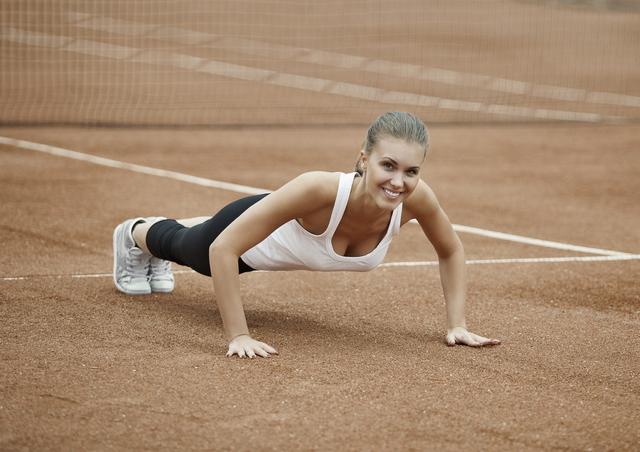
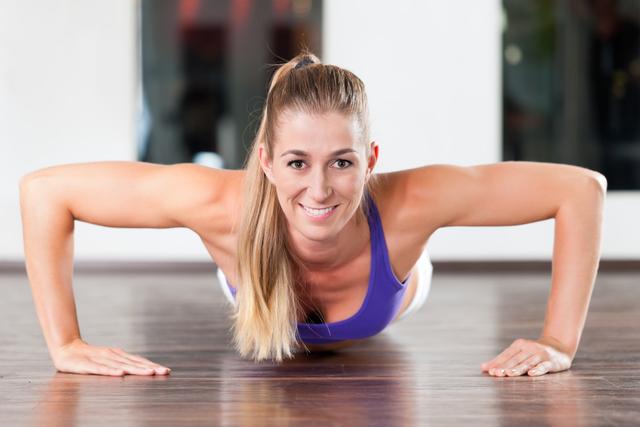
Push-ups are a popular movement that can be done by seniors and children alike, but most of the time they are not done correctly. Push-ups mainly exercise the chest muscles, while also exercising the anterior deltoid and triceps muscles. Improving the strength of the upper limbs, waist and abdomen.
However, it is not easy to do a standard push-up:
To do a standard push-up, the starting position must keep the body from shoulders to ankles in a straight line, the arms should be placed at the position of the chest, and the hands should be slightly wider than the shoulders. When doing push-ups, you should take 2 to 3 seconds to fully lower the body, and the chest distance from the ground should be about 2 to 3 cm. Then, exert force to return to the starting position.
At the same time, when doing push-ups, you should also coordinate with your breathing. In the downward stage, inhale for 2 to 3 seconds, and exhale for 1 to 2 seconds when rising. Many friends inhale quickly during the downward stage, which limits the stimulation of the muscles themselves. In the same amount of time, the slower ones can better exercise the muscles.
Of course, in addition to standard push-ups, push-ups also have many variations. Depending on the body posture, hand distance, preparatory position and training method, push-ups are different. We often see cool push-ups in TV series and movies, such as single-hand, clenched fists and two-finger push-ups, but these are not recommended for ordinary people to try. It is recommended to do the above standard push-ups, as long as they are done accurately, the muscle training effect is the same.
Another point is that many female friends are afraid that doing push-ups frequently will cause muscles to be separated one by one. In fact, with normal amounts, push-ups will not make the body become the kind of muscular people they imagine. Friends who have undergone long-term systematic fitness training are the ones who achieve this. At the same time, their diet and diet are also different.
Bent-arm raises
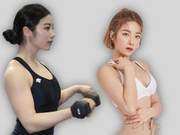
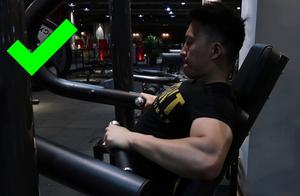
Bent-arm raises strengthen the biceps muscles and increase upper limb strength. For home-based friends who don't have a gym, they don't need to use dumbbells, as long as they have a plastic bottle, fill it with water, and start training. This is very simple and convenient.
When doing bent-arm raises, first sit on a stool, with your knees bent and separated to the sides, with your upper body slightly leaning forward, holding a dumbbell with one hand, with the elbow side resting against the inner side of your knee, and your knee supporting your other knee. Lower the dumbbell until the arm is lowered from the shoulder position, and the palm faces forward. Maintain the movement of the deltoid without turning the arm, and do not raise the upper body, do not hook the wrist, and then slowly lower the wrist to the starting position.
For seniors, as muscle mass decreases with age after 60, to prevent muscle atrophy, bent-arm raises are a good way to exercise at home. Choose lighter dumbbells or other items, and exercise twice or three times a week, each time one set, 15 to 20 times.
Glute Bridges
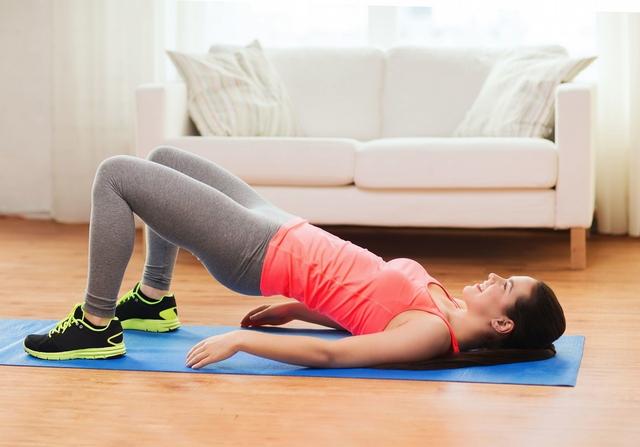
For people who often sit for a long time, the glute bridge can effectively tighten the abdominal muscles, stabilize the hip joints, and also help stretch the outer thigh. For women, the glute bridge can effectively massage the uterus, promote muscle elasticity around the uterus, and help relieve menstrual pain. The action of the glute bridge is as follows:
Bend your knees and lie on your back, with your feet hip-width apart and slightly to the sides. Keep your arms extended to the sides. Lift your hips upward, using your shoulder and upper back as a fulcrum, with your feet as another fulcrum, raising your hips upward until your torso is approximately in line with your shoulders and knees. During the entire process, your feet, shoulders and upper back, and your arms remain still, and your lower legs should not move actively. Use your hips to exert force, and slowly and controllably return to the starting position.
Note that when doing a glute bridge, do not place your feet too far forward, but should make it so that when you push up, use your hips instead of your spine to move, so that your shoulders, hips and knees are on the same line. From the side, the thigh and lower leg are at a 90-degree angle. At the same time, during the process, use abdominal breathing.
Squats
Squats are a top-tier exercise for building leg muscles. Like push-ups, squats are a compound, full-body exercise that can train the legs, hips, and back of the legs, and can also strengthen bones, ligaments, and the tendons that cross the lower half of the body. Squats can be done with or without weights. For beginners or people who exercise at home, we recommend bare squats here.
The starting position of the squat is standard, with your feet wider than your shoulders and slightly angled outwards, but not more than 12 degrees. Keep your upper body upright, maintaining a natural curve in your back. Pull your lower jaw in and look forward. Pay attention to the adjustment of the pelvis to the neutral position. Do not lean forward or backward. When lowering your body, move your hips backward and downward. When performing the action, pay attention to control the stability of the knee joint and do not buckle inwards. During the process of the action, the center of gravity should be under the arch of the foot, and avoid applying pressure to the forefoot, but try to push the pressure to the heel. When exerting force, push off with the heel to push yourself up.
A complete squat requires us to lower our legs beyond the horizontal plane, squat to a position where the hip joint is lower than the level of the knee joint, and then return to the starting position as much as possible, standing upright, which is the complete squat process.