The Basic Logic of Strength Training: What Every Trainer Should Know
Resistance training starts with a focus on resistance, but it’s not just about lifting weights randomly. It requires following certain principles.
Gong Ji Mao (Muscle Maker) divides resistance training into 6 levels of a pyramid.
Each level is a foundation for the one above it, and without a stable base, it’s difficult to develop the upper levels. This results in underdeveloped potential, plateaus, and injuries.
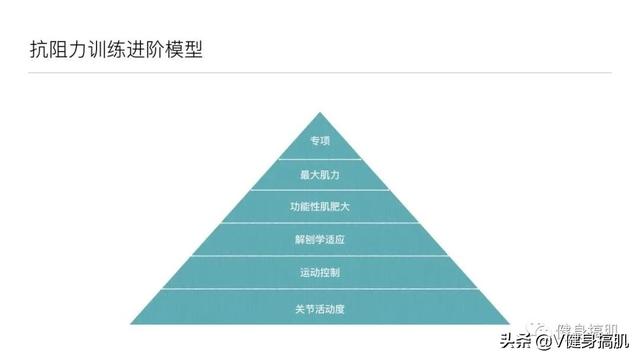
It’s like building a skyscraper – if the lower levels aren’t built properly, the upper levels become unstable and risk collapsing.
Let’s take a look at the significance of each section.
Joint mobilityis the foundation of resistance training. Non-pathological joint mobility is mainly limited by the constraints of fascia adhesions. Without adequate joint mobility, performing resistance training can actually damage the joints.
Joint mobility is aboveMovement controlwhich is controlled by the nervous system. Poor movement control ability cannot make correct and effective movement patterns.
Anatomical adaptationis the preparation stage for resistance training, mainly to prepare the joint capsule, ligaments, and tendons.
Maximal strengthmay be the most important variable, carrying the bridge for subsequent specialized movement. Maximal strength mainly comes from the development of the nervous system.
Specializedwhich refers to the burst and endurance required for movement performance, as well as the needs of the general public – fat reduction, muscle gain, and shaping. These are all the highest levels of resistance training.
From the model, we can see that the fat reduction, muscle gain, and shaping needed by the general public are the top content of the pyramid – specifically, muscle hypertrophy, which is the final step in shaping muscle morphology.
This also explains why so many people get little results or quickly plateau and get injured in resistance training. This is because they’ve overlooked the principles of resistance training.
In practice, the model is divided into three phases: decline, normal, and advance.
Declinerefers to joint mobility and movement control levels. Most people in this category haven’t been exercising for a long time, have a sedentary lifestyle, and repeat movements. They often have posture problems or chronic neck, shoulder, waist, and back/leg pain. Directly performing bodybuilding-style resistance training carries a high risk of injury. If you’re concerned about safety and insufficient loading, you might be stuck in place.
People in this category who want to reduce fat, gain muscle, and shape their bodies should first focus on restoring joint mobility and movement control. Restore the lowest level of the movement model, then excessively move to the normal stage.
Normalrefers to the ability to perform basic movements, through cyclical training to adapt the body’s tissues, and through functional strength training to develop the nervous system, preparing for subsequent advancement.
Advanceis the ultimate goal stage for everyone, and also the most difficult and complex stage. Therefore, very few people can truly enter this stage and train scientifically. The excess loading in this stage requires high requirements for muscle, nerves, fascia, ligaments, and joints. If you don’t have the 4 foundational levels, attempting this stage will be a form of self-harm.
The dangers here are also reflected in the training arrangement – a very important concept is ‘overload and cycling.’
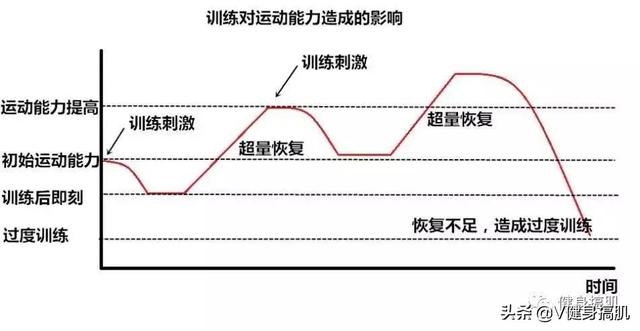
As shown, after stimulation, the body enters a fatigue period, so training has reduced immunity, making you susceptible to colds and illnesses. However, it will immediately enter a compensation period, exceeding the previous stimulation level, which we call ‘overcompensation.’ Then, it will enter a decline phase, returning to the original level before the decline phase, and a new stimulation will enter, your body will enter a second fatigue and overcompensation, and the body will continue to progress.
The difficulty here is twofold: firstly, many people will perform a larger intensity stimulation before entering the second phase of overcompensation, leading to overtraining and, consequently, a period of intense effort that ultimately leads to a lack of progress. Secondly, this stimulation needs to be precise, and one extra kilogram could ‘blow out,’ while one kilogram less could be ineffective. A few days ago, a team leader told me that a fitness coach is not a sports job, but a math job – it’s very rigorous and requires a lot of calculation.
Summary
Whether you want to improve your athletic performance or reduce fat and shape your body, you need to follow the scientific progression model of resistance training. For the general public, many people aren't in the normal stage initially, and you need to make up for the lack of abilities in your body. For people who really want to achieve a high level, muscle strength and cycling are crucial.