Mastering Rotations in Wushu: Not Far From Becoming a Martial Arts Master
The rotations in Wushu routines are very numerous. Mastering rotations has a significant impact on improving the quality of Wushu routines.Specifically, how can one accelerate the speed of Wushu rotations?
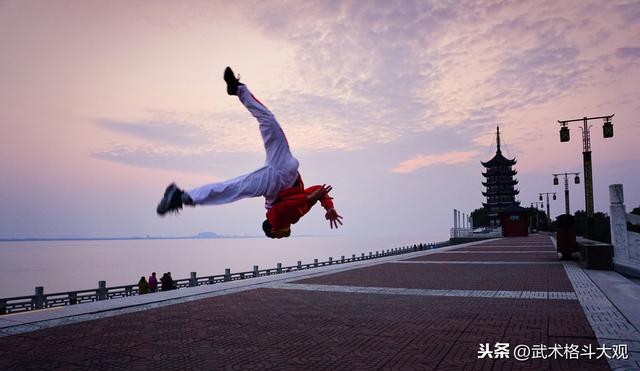
Generally, completing rotations involves two key methods:
1, forcefully turn the head.
Chinese ancient Wushu masters had a deep understanding of this. Such as Ming Dynasty Wushu master Cheng Chu Dong once said:The principle of turning involves the head, as the head is the master of the whole body. When you want to turn your body to the right, you must first turn your head to the right to see the enemy, and then your body follows. If you want to turn your body to the left, you must first turn your head to the left to see the enemy, then your body follows. This is the secret method of turning left and right.”
Practice proves that forcefully turning the head in the direction of rotation is the first source of power that causes the body to rotate along thevertical axis.The head rotation inevitably triggers the rotation of the trunk, because the relationship between the head's posture and the trunk's posture changes, resulting in a reflexive posture change. Therefore, forcefully turning the head in the direction of rotation is very important. At the same time, turning the head also carries a combat intent.
2, forcefully swing the arms.
Based on forcefully turning the head, forcefully swinging the arms to drive the shoulder rotation is the second source of power that accelerates the trunk along thevertical axis.The swing methodis different depending on the action. Practice proves that the greater the strength and speed of the arm swing, the faster the rotation speed. However, sometimes different methods need to be adopted.
Whirlwind footWhen you rise into the air, the reverse swing method is advantageous. The characteristics of the reverse swing action are: when turning to the right, the left arm swings to the right, and when striking in the air, the right arm goes in the opposite direction to strike the left foot, forming a moment of force around the central axis of gravity, further accelerating the rotation speed of the body around the vertical axis, thus constituting the 360-degree body rotation after rising into the air.
3, Inertia force cannot be ignored.Inertia force is an important factor in the rotation action. For example, when turning to the left, you should first slightly twist your waist to the right; when turning to the right, you should first slightly twist your waist to the left. The larger the rotation angle, the higher the requirements for inertia force. Side flips, in addition to the inertia force in the aerial action, also needto increase inertia force. Other actions such as the 360-degree spiral rotation and the 720-degree spiral rotation, all require the same conditions.
Fast rotations, in addition to the above points, also require
twisting the waist and expanding the feet
to play a very important role. Therefore, in practice, it is important to coordinate and combine them, and to improve the quality of the action by practicing, thinking, and observing.