Three Points Align - Like an Arrow
Use a long, powerful force to crack walnuts, and a short, sharp force to reverse the direction; if you reverse the direction, you'll be pushed like a jack-in-the-box riding a rabbit; the walnuts will also fall, either not cracked or cracked with the shell and kernel together. Short force refers to the short duration of the force's effect, while long force refers to the long duration of the force's effect.
Of the Eight Gates methods, some can be short or long. Methods like 'quick pull' (), 'grasp' (), and 'lean' () typically exhibit short force, while techniques such as punching, palm strikes, elbow strikes, knee strikes, and (hip) techniques are characterized by short force; conversely, methods like 'double push' () utilize long force. Because the force's effect time is long, it can transfer more energy to the opponent (proportional relationship), and it can throw a 100-pound man several yards.
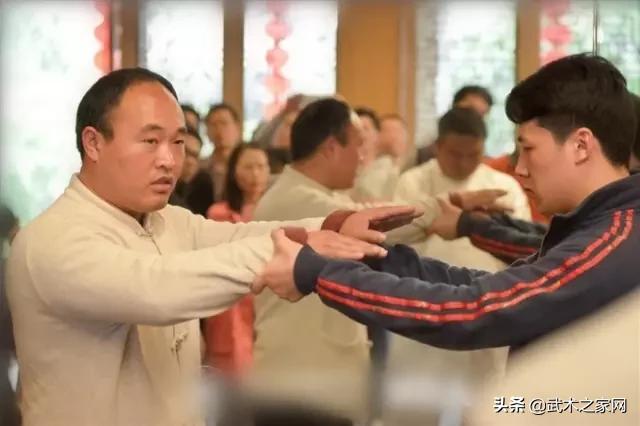
Having only long force is not enough; the timing, direction, and point of application when releasing the force are crucial. When releasing long force, timing is important. The three points – the first point is naturally the back of the foot; the second point is the point of contact with the opponent, typically the front of the forearm (or the small arm), which is where the force is applied; and the third point is a point set by the opponent's side, so that the force can become penetrating force.
'Can these three points work?' Of course not, there are also some conditions to meet:
Condition one,The second point needs to be selected appropriately. The best choice is on the opponent's chest and abdomen; if it is on the shoulder and arm, it must be in a situation where the shoulder and arm can transmit the force to the trunk. Secondly, when the two hands exert force, the second point should be on the line connecting the two hands, and slightly biased towards the hand with greater force. When selecting points, attention should be paid to this.
Condition two,The third point needs to be selected appropriately. The third point's line generally needs to pass through the opponent's midline. When the two hands exert force, the force should be one main and one sub, and the two forces should converge at the third point.
Note:
If the three points form a straight line, it's the most ideal, the force and transmission are on the line, achieving 'arrow-like launch', causing the person to jump off the ground. If the three points form a line, the situation is not allowed, and we can adjust our own force (adjust the force of the two hands), sometimes we can also adjust our own foot, to make it straight. Even if it's a line, as long as it's not too serious, the force will be slightly reduced, and the 'arrow-like launch' is still possible.
Do not artificially create a loss of force transmission. Some friends are used to pushing and squeezing flatly, even pushing downwards, which will cause a further loss of force transmission, unless it's necessary, it should be according to the three points line to transmit force diagonally upwards.
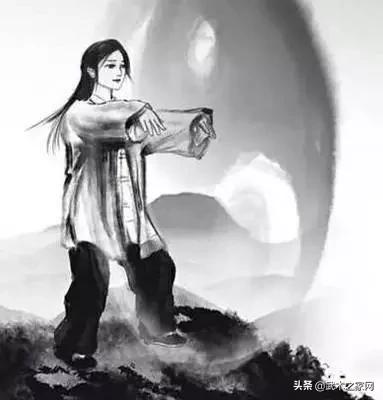
Before releasing the force, advance close to the opponent. Advancing means lengthening the first force, allowing us to be in a lower position, and avoiding extending the arm too far and maintaining a stable lower stance. Approaching the opponent for the purpose of ensuring that the arm can fully extend, and only when the arm is deeply bent and extended, the force's effect time can be long, and the lower stance helps us easily achieve the 'rooting' advantage.
Because the force's effect time is long, to ensure smooth release, control the opponent's two arms, or take advantage of the opponent's hands being restricted in their position and unable to interfere effectively, or take advantage of the opponent's slight imbalance, and then use long force to release it.
When releasing the force, the structure should be correct, and all related parts of the body should converge on the line; the more in accordance with the rules, the better the effect.
The principle can be flexibly applied. For example, if the opponent's front foot is too exposed, when setting the third point, you can adjust your own force so that the second and third points' lines not only pass through the opponent's midline, but also pass through its rear shoulder and hip axis, making it impossible for the opponent to defend, and the opponent will jump off the ground with both feet.
Haha… it's just one character 'Practice!', repeat experience, it will definitely feel infinitely fascinating, and it will feel that the more in accordance with the rules, the more guaranteed the push hand effect.