Wing Chun: Elbow Strength Training and Rattan Force Training
This article isStandard Posture and Mechanical Training Methods for Two-Character Clamp Sheep Horse in Wing Chun Kung FuBasic Foundation of Wing Chun: Principle of Hidden Strength in Small Head, Teach You How to Hit Lightning-Like Day-Zhi PunchThe sequel.
Elbow Strength Training
Elbow Strength Training refers to the elbow joint's elbow return to the middle positioning method, to promote the shoulder joint and elbow joint, to cultivate the whole body's complete force and rattan force.
The term 'elbow return to the middle' positioning refers to the practitioner standing in the two-character clamp sheep horse posture, with relaxed and lowered shoulders and elbows, with the elbows and two forearms coinciding and staying put in the heart position on the central line of the body.
At the same time, the elbows and forearms extending forward are straightened (Fig. 013). To facilitate practice, beginners can use a pen between their elbows to check the correctness and durability of their movements.
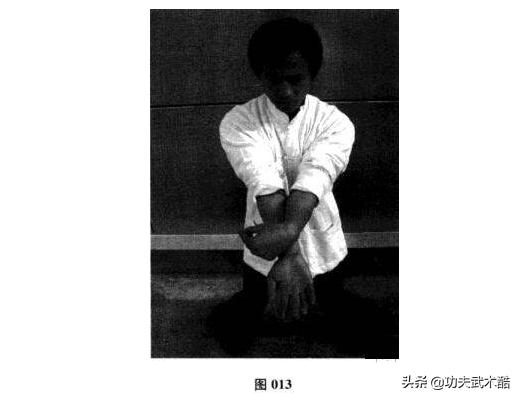
In fact, elbow strength is abstract, especially for beginners, it's often difficult to understand it. Elbow return to the middle is easy to achieve, the shoulders and forearms relax and sink, the elbows naturally relax and sink. Returning to the middle is difficult, the elbows and forearms need to be held together and extended forward. At this time, the shoulders and forearms muscles become sore and tense, it's difficult to persevere. At this time, don't raise your shoulders, you should always keep the shoulders relaxed and lowered. At the same time, feel the connection between the merging elbows, forward extension and the inner bend of the knees, feel the sense of unified force moving upwards. Beginners can train for 3 minutes with a short rest, to avoid excessive fatigue leading to deformation of actions, losing the training effect.
For beginners, how to quickly sense the existence of elbow strength?
Standing in the two-character clamp sheep horse posture, maintaining the right elbow return to the middle positioning shape (Fig. 014); let the lead hand stand to the right side, lift the right palm with short and quick movements, tapping down towards the right front forearm (Fig. 015).
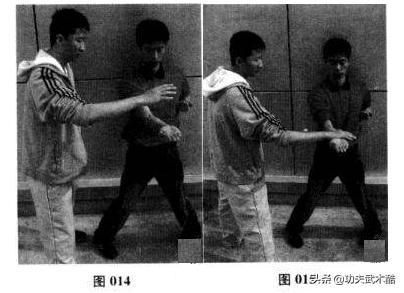
When the tapping force of the lead hand touches the elbow return to the middle and the overall structure of the movement is not scattered, you can clearly feel that the front bamboo slightly sinks along with the lead hand tapping downwards (Fig. 016). When the lead hand tapping force disappears, the front forearm quickly returns to the midline position automatically (Fig. 017).
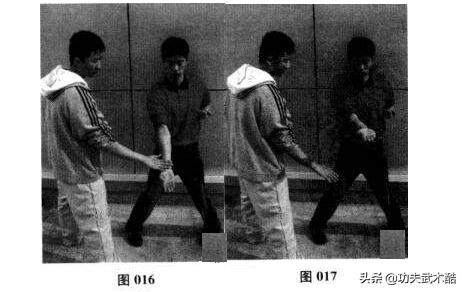
And the lead hand can also feel that the tapping force is like striking on a very elastic rattan. This is the force generated by the elbow return to the middle positioning.
The elbow strength training is conducive to quickly opening the shoulder joint, the whole body complete force and rattan force.
For over a hundred years, the most classic elbow strength training method of Wing Chun practitioners is the 'one clamp, three' technique in the 'small head' fist manual, which combines relaxed and gentle movements with breathing. To feel the driving force of the elbow joint, slowly move the arms forward and backward, so as to unite the thought with the elbow force, accumulate over time, naturally achieve 'intention walks the elbow force, force comes from the elbow strength'.
It takes time to cultivate elbow strength, beginners can train the elbow return to the middle positioning for 15 minutes every day, then recite nine 'small head' chants, generally within 4-8 weeks can deeply perceive the effect of elbow strength. After that, as the power increases and the understanding of Wing Chun Kung Fu deepens, they will gradually realize that every action in Wing Chun Kung Fu applies. Whether it's the long bridge force or the short bridge force, it's actually an extension of elbow strength, because through elbow positioning training, the upper limb shoulder, elbow, and wrist three joints are all opened, the transmission of upper limb force is naturally unobstructed, it's effortless to feel a relaxed movement with a heavy and elastic feeling. Make a complete force, not a fragile force.
Rattan Force Training
As the name suggests, rattan force refers to the long-term training of Wing Chun inner force, allowing the whole body of the shoulder, elbow, wrist, hip, knee, foot and other parts to have the instinctive force of like rattan, which can unload force and rebound force with force.
For the novice Wing Chun practitioners, what is often formed first is the force on the arm, which is rattan force. Because of the mechanical architecture of the two-character clamp sheep horse and the elbow return to the middle positioning, the whole arm is formed with the elbow as the pivot, and the front forearm rebounds when encountering force, so a rattan force is formed on the arm.
The principle of rattan force formation is as follows:
(1) The first party holds a flexible branch or rattan, pointing at the second party's face; the second party rushes out the right fist to attack the first party's face. The second party's right fist wrist part touches the front end of the branch (Fig. 018).
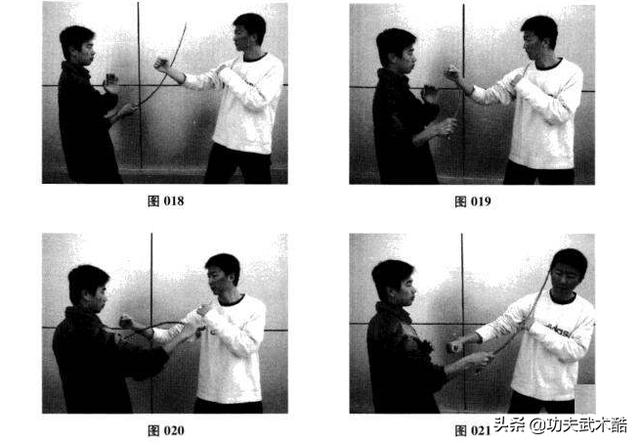
(2) The first party feels the tapping force of the branch front end by the second party's fist, the branch is bent and deformed by the force (Fig. 019).
(3) The branch is bent by the second party's fist, the first party feels that the second party's fist still goes straight into his body, so he turns the body and the branch he holds to the left side by one angle, using this to unload the second party's force (Fig. 020).
(4) The second party's force slips to the first party's side, the attack fails, the body does not move forward half a step (Fig. 021).
Through rattan force training, it's easy to see that the bending of the branch when encountering force is the unloading process, and the process of the branch returning to its original shape after unloading the force is the rebound process. The principle of rattan unloading and counterattack can be realized through Wing Chun training.
(2) Borrowing Force Rebound Training (Note: The diagram is a simulation of a real-life duel between the two parties).
(1) The first party attacks with the right fist to attack the second party's face, the second party also attacks with the right fist to attack the first party's face. The two arms cross each other at the wrist, the two forces stop and counteract each other (Fig. 022).
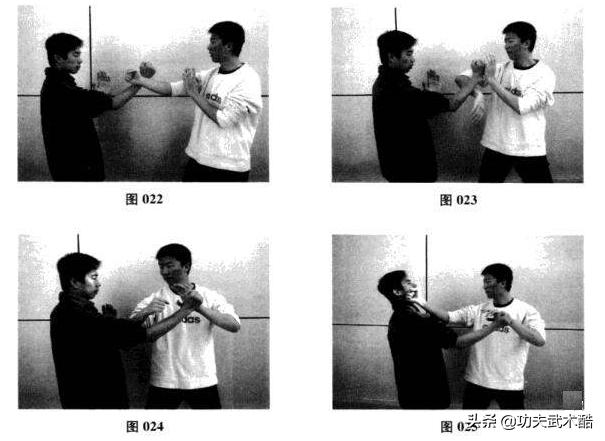
(2) The second party feels that the first party's force is difficult to resist, and then uses the right elbow as a pivot. Relaxing and bending the front forearm to seek unloading, at the same time turning the body 45 degrees to the left and placing the left hand on the chin to protect the face (Fig. 023).
(3) The first party's force slips to the second party's side, the attack fails, and the body does not move forward half a step (Fig. 024).
(4) At the same time, the second party bends the right arm like a rattan, quickly rebounding, and the right fist hits the first party's right side face (Fig. 025).
The above borrowing force rebound training is actually a practical case of the Wing Chun technique of 'flat hand counterattack straight punch'. In order to achieve borrowing force and counterattack in the distance, it is necessary to practice the two-character clamp sheep horse basics, to cultivate the elbow strength, so that rattan force can be formed.
Recommended articles with high read volume in this account:
Latest Chinese Martial Arts Ranking – Wing Chun First Level, You Can Also Learn Authentic Wing Chun at Home Good Videos
“”