Ancient Transmission · Eight Segment Waist Exercises
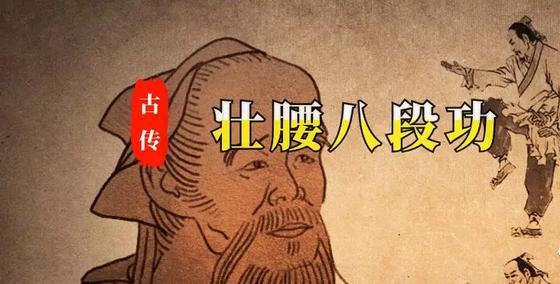
This practice originates from the pre-Qin Dynasty, dating back over 2000 years. The 8 traditional guiding formulas it employs all focus on concentrating power in the waist. They are designed to strengthen the waist and kidneys, promote the flow of vital energy, consolidate bones and marrow, sharpen hearing and improve brain function, lubricate the waist and spine, and enhance waist and abdominal strength. The selection of these formulas is ancient and rigorous, the layout is reasonable and well-considered, and the effects are significant while the methods are simple. The difficulty, intensity, and movement volume of the exercises can be large or small, and can be adjusted according to individual needs. The methods emphasize smooth and gentle movements, gradual progression, and primarily focus on refining essence, energy, and spirit, with auxiliary external practices involving the tendons, muscles, and bones. It does not emphasize achieving muscle and tendon soreness. It is particularly suitable for healthy middle-aged and elderly people.
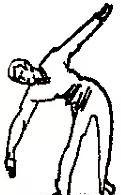
Large Peng Unfolding Wings
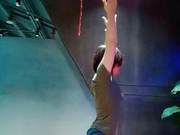
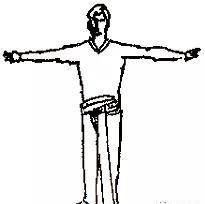
belongs to twisting waist exercise, known in ancient times as ‘Eagle North’. With two feet spread, using the waist as the axis, turning to the left rear, with arms turning with the waist, slowly rising sideways, like a large eagle unfolding its wings or a falcon flying north (while moving south, facing north, with the back facing north). The raising of arms and the twisting movement should start and stop together, and the upper body should turn as far back as possible without shifting the two feet, like tightening a towel. The eyes should follow the left hand (Figure 1). From ‘Master Wu’ WeChat official account · Redundancy, followed by the right formula.
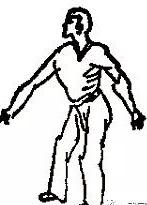
Eagle Cub Rolling
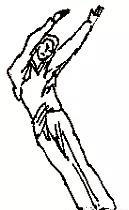
belongs to rolling waist exercise, known in ancient times as ‘Fox in the Ravine’. First, bend down and lower the body, lowering the arms, then raise the two arms with the waist, rolling and rotating with the waist, from bottom to left, up, and back, simultaneously tilting the neck to look back, then from top to right and down, returning to a bent position with lowered arms (Figure 2). This is equivalent to circling the hands in a circle once. Then, perform the right formula.
Ancient Pine Welcoming Guests
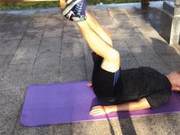
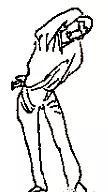
belongs to side waist exercise, known in ancient times as ‘Snake Bending’, as seen in the ‘Book of Changes’ by the Jin Dynasty’s Ge Hong. The right hand raises and bends the elbow, horizontally placing the arm behind the head, the palm facing forward, the fingers pointing left, and the left hand extends downward, bending the elbow horizontally and placing the arm behind the waist, the palm facing back, the fingers pointing right, and the fingers pointing towards the right (Figure 3). From ‘Master Wu’ WeChat official account · Simultaneously, the waist bends sideways to the left in a gentle and slow manner to the fullest extent, with the arms extending fully to the opposite side.
Descending Dragon Subduing Tiger
belongs to warping waist exercise, known in ancient times as ‘Dragon Guiding Tiger Leading’, as seen in the ‘Book of Changes’. First, assume a horse stance with a waist punch preparatory posture. The left fist extends from the side of the waist towards the abdomen, with the palm facing down, the fingers pointing inwards, with the distance between the fist and the navel being half a fist-length. The right fist extends from the side of the waist upwards to the forehead, with the palm facing downwards and outwards, also with the distance between the fist and the forehead being half a fist-length. The two fists move up and down in coordination, and the movements should be harmonious. Then, with both feet pressing the ground, the waist turns to the left, transforming from a horse stance to a left horse stance; simultaneously, the two fists gradually transform into palms, the left palm grasps to the back of the left hip, assuming a closed palm support posture, with the fingers pointing left, and the right palm extends outwards to the right forehead, with the palm facing outwards and the fingers pointing right. The two arms move forward and upward and downward in a coordinated manner, and the neck, waist, and both hands turn back to the maximum extent, focusing on the hand that is behind (Figure 4).
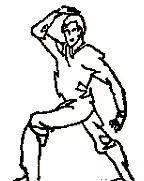
Wu Zong, WeChat official account · The formula requires coordinated action between upper and lower limbs, and the two hands should respond to each other. It is a complex section of the entire set of exercises, so it is necessary to achieve coordinated action between the upper and lower limbs, and the two hands should respond to each other.
Two Dragons Playing with Beads
belongs to folding waist exercise, also known as ‘Folding Waist Returning’, named because of the incompleteness of the original text, so it is named ‘Monkey Playing’. The two arms are held sideways with a flat palm, and as the body bends down, the right hand extends straight downwards along the outside of the left foot, moving in a rolling ball shape; at the same time, the left hand slowly raises upwards, and the two arms always maintain a one-arm-one-hand posture (Figure 5). Then, perform the right formula.
Cargo Trader Beating Drums
belongs to tapping waist exercise, similar to the ancient guiding exercise ‘Draw Eight Dimensions’, which is derived and developed from this. It can be seen in ‘The Drawing Diagram’ ‘Sitting to Draw Eight Dimensions’. Using the waist as the axis, with the two hands extending straight downwards and moving with the turning of the waist, the two hands beat outwards and inwards on the left and right fronts, and simultaneously, the hands move horizontally or laterally in a circular motion with a center point of about half a fist-length from the midline of the chest and abdomen. Then, perform the right formula.
Looking at the Sky and Tapping the Earth
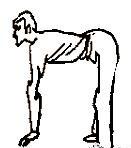
belongs to bending waist exercise, derived from the ancient guiding exercise ‘Bird Stretching’ as seen in the Warring States period’s ‘Book of Changes’ by Zhuang Zhou. The ‘Book of Changes’ depicts the ‘Bird Stretching’ as seen in various ancient books, including Zhuang Zhou’s ‘Zhuangzi’ ‘Intentionality Chapter’. In ‘The Drawing Diagram’, the figure and name of the exercise are all available. With two hands supporting the waist, the fingertips point downwards, first bend the body upwards, bending the waist backwards in a slight bow, looking up at the sky, while inhaling deeply, then immediately bend the body forward, with the two hands moving downwards with the bending of the waist, extending the arms straight, and the fingertips pointing forward, assuming a tapping palm posture. Simultaneously, excrete the turbid air in the abdomen. The two hands tap downwards, and the hands should not touch the ground; if the hands can reach the ground, they must shift forward. Simultaneously, do not lower the head to suppress the air, but must keep the head upright and look forward (Figure 7). This formula has no left or right formulas, ‘Looking at the Sky’ and ‘Tapping the Earth’ are performed alternately, each done 4 times.
Black Bear Shifting Body
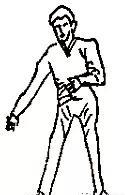
belongs to shifting waist exercise, known in ancient times as ‘Bear Journey’, as seen in ‘Zhuangzi’ and other ancient books; the figure and name of the exercise are available in ‘The Drawing Diagram’. Using the waist as the axis to shake the whole body, with two hands assuming a closed palm, alternately moving one bent and one extended in a circular or upright manner in the chest and abdomen; the two circles are linked together, and the center point should be about half a fist-length from the midline of the chest and abdomen. Simultaneously, the spine and neck move with the shaking of the body, turning left and right, and the two shoulders shrug and sink alternately, and the heels of the feet lift and fall together (Figure 8).
In summary, consciously make the whole body's limbs be in a state of contradiction between rigidity and softness, reality and illusion, movement and stillness, bending and extension, opening and closing, internal and external, low and high, moving and stopping, swaying, rotating, looking back and forth, and various contradictory unities. And in the shaking, try to remain steady while showing agility. In terms of mind, naturally show the relaxed and happy state of a bear playing.