Running Bottleneck? Learn Slow Running, and You'll Run Faster
There is a group of runners on the track, and each month they can run 3-400 kilometers, or even more. They always thought they would have a high level of marathon, but they never realized that their marathon results always hovered around 4 hours.
They run such a high mileage, but their marathon breakthrough is always unsuccessful. Many people attribute this to running too much 'junk mileage'
So-called 'junk mileage' refers to running mileage without any training effect. The characteristics are that the running time is long, the speed is slow, and it feels very easy when running.For serious runners, this is a waste of time, because such running training will not bring any improvement, it is a failed training.

So, is all slow running 'junk mileage'? Does it have no use for marathon improvement?
In fact, it doesn't, on the contrary,Slow running is the essence of running, only by slowing down, you can eventually run faster.
What is slow running?
In the eyes of many people, slow running is to run very slowly, faster than walking by a little bit, and the pace is generally maintained at 7-8 minutes,
Indeed, such a speed is slow running. However, slow running is relative, different people's slow running speeds are different.
Taking 6 minutes per kilometer as an example, this speed is slow running for most runners. However, for some novice runners or those who have not run before, this speed may already be at the mixing oxygen zone,
In fact, as long as the heart rate during running is maintained between 60%-70% of the maximum heart rate, it is considered slow running.
For Kipchoge and Beckley, a pace of around 4 minutes per kilometer is considered slow running. However, this speed for general runners may be mixing oxygen or even intermittent running.
Slow running is relative, there is no fixed pace.

To improve marathon level, slow running is very important, it is an indispensable part of daily training.
Many runners always pursue speed, thinking that as long as today's speed is slower than yesterday, it is an invalid training. So their training is always at a relatively high intensity, making them run very tired, but their marathon results are always in a bottleneck, and they cannot break through, and they often injure themselves,
People like this training are not in the minority, they mainly train with moderate intensity, and rarely train high intensity training, ignoring low intensity training, which is like 'high but not low', making themselves very tired, but their marathon results are always in a bottleneck, and they cannot break through,
In fact, the scientific training method should be based on low intensity training, with medium-high intensity training as auxiliary. World long-distance running champion Farah once posted his weekly training plan, of which 80% of the mileage is low intensity aerobic running, which we call slow running.
Slow running helps build our aerobic base endurance, and long-term aerobic slow running can improve the ability of cells to carry oxygen, which is a solid foundation for future speed increases.
For example, when there are many people waiting at a station, a small car comes, it can only carry five people. Then a bus comes, it can carry 50 people. After long-term aerobic slow running, the ability of cells to carry oxygen can evolve from a small car that can only carry 5 people to a bus that can carry 50 people, which greatly improves the running efficiency.

How to run slow running
Slow running is not just about running slower, it also has a method. There are two very effective running methods: MAF180 running method and cell division running method.
MAF180 running method
MAF180 running method simply means maximum aerobic heart rate running method. When running, use 180-age as the target heart ratedo not exceed this heart rate during running.
If you often exercise and have recently participated in a marathon, your heart rate can be increased by 5.
If you are recently recovering from a serious illness or a beginner, your heart rate should be reduced by 5.
For example, Xiao Ming is 30 years old this year, healthy, recently participated in a marathon, so he can control his heart rate during running at 180-30+5=155 beats per minute
If Xiao Ming just recovered from a serious illness, his heart rate during running should be controlled at 180-30-10=140 beats per minute.
Such a running speed may be very slow, but after long-term practice, you will find that the speed you could run at 6 minutes per kilometer will reach 140 beats per minute, and it may take more effort to reach 5 minutes per kilometer heart rate, which greatly improves your heart rate zone.

Cell division running method
In Japan, many professional athletes train with this method, which is why their marathon level is better than ours.
The core of the cell division method is to use the native speed to run. What is native running speed? When we first start running, we breathe with our nose. As speed increases or intensity increases, we transition to breathing with our mouth and nose. At the point where we are about to open our mouths to breathe, this is your native running speed.
Simply put, it's the maximum speed you can run while breathing with your nose.
Generally, this speed corresponds to 50% of the maximum oxygen uptake, which is equivalent to 50% of the maximum reserve heart rate.
How to calculate this heart rate? Xiao Ming is 30 years old this year, his static heart rate is 50 beats per minute, his maximum heart rate = 220-30=190 beats per minute, reserve heart rate = 190-50=140 beats per minute, 50% reserve heart rate = 140 x 50%+50=120 beats per minute.
This speed is very slow, it's known that it's almost walking speed.
After long-term practice, you will find that when you run at this heart rate, you will become faster and faster.
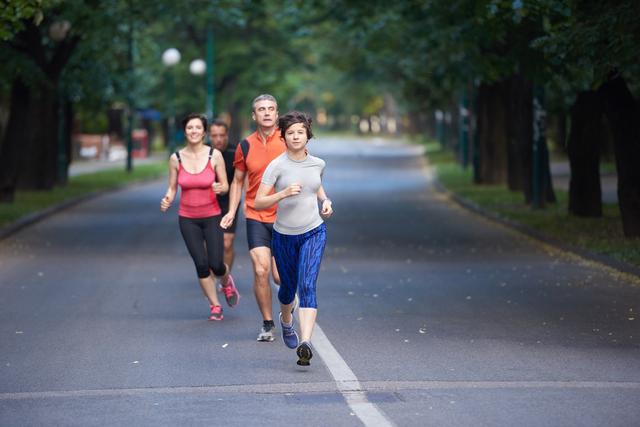
In other words, when you eventually run at this heart rate, you will become faster and faster.
Summary
Whether it's the MAF180 running method or the cell division running method, they all run at low heart rates. In this low-intensity slow running, your aerobic base endurance will become solid, and it is very helpful for developing your specialized endurance.
Many runners like to pursue speed, and to do so, they need to build a solid aerobic base endurance. Just like building a tall building, if the foundation is not strong, even if the building is tall, it will be unstable. Running is the same, if the base endurance is not solid, even if you pursue speed, it's easy to get stuck in a bottleneck and injure yourself.