Find the ‘Goldilocks Zone’ and Say Goodbye to Overtraining
…
xx

The Goldilocks Zone
Here we introduce a concept from economics/astronomy: the Goldilocks principle. It refers to doing things to a certain extent, acting within limits, not exceeding the limits, and the effect of doing things in this way is 'the Goldilocks effect.' In practical applications, we can use the Goldilocks Zone to present it more.
The reason why it is called 'Goldilocks principle' is because of the fairy tale 'Goldilocks and the Three Bears.' The lost Goldilocks entered the bear's house, she tasted the porridge in three bowls, tried three chairs, and lay down on three beds. Finally, she decided that the porridge in the small bowl was the most delicious, the small chair was the most comfortable, and the small bed was the most comfortable, because they were just right, not too big and not too small.
Returning to our fitness training.
The Goldilocks Zone lower limit may be the minimum training volume that produces sufficient yield, and the upper limit is the maximum yield that can be recovered. As shown below.
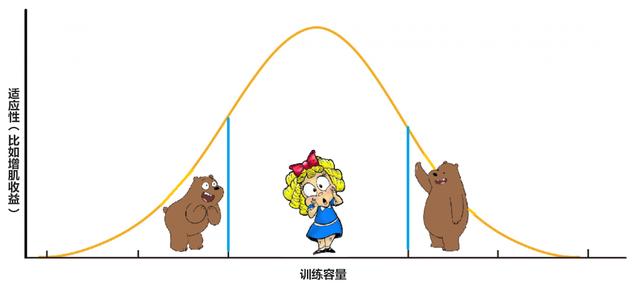
Generally speaking, training volume often has a linear relationship with muscle growth, that is, the larger the training volume, the more yield. Therefore, after a period of time, whether it is several months or several years, the training volume should increase. So most people think that as long as you keep training, you will become bigger and bigger.
At a certain point, you will start to see diminishing returns. This will depend on many factors, such as training history, current training volume, nutrition, and other recovery interventions.
As the training volume increases, adaptation (such as muscle growth) will also increase. The area between the blue lines represents 'the Goldilocks Zone,' which is the training volume that is sufficient to promote growth but not too much affecting recovery. The peak of the yellow line is the maximum yield that can be recovered. Beyond this point, the yield will decrease, that is, more training volume will produce the same or less adaptation.

Simple training-fatigue model
The 'training-fatigue model' is a pressure mechanism naturally formed by the body, which involves some complex physiological processes. We will not delve too deeply into the 'training-fatigue model,' but it essentially shows how different degrees of training and fatigue interact, and the resulting training effect. The purpose is to determine:
- How much to do to ensure progress
- Overtraining can lead to fatigue, affect training performance, but how much is considered overtraining?
- When to end training to reduce fatigue, so that fitness training does not damage normal health, and does not affect your training performance?
We can use the following four-cycle plan to clearly sort out this idea.

Four-cycle plan
1, Gradually increase the training volume (4-6 weeks). Use a suitable increase program to gradually increase the training volume until it has been continuous for 2 weeks or more, or every 4 weeks to reach a progressive plateau phase.
2, Functional overreaction (1-2 weeks). In the first week before reducing training volume, you can further increase the training volume and enter the 'functional overreaction' period.
3, Reduction training (1-2 weeks). In the next week, or possibly two weeks, use reduction training. During the reduction training, you will see a decrease of about 50% in the training volume. Reduction training is relatively simple, for example, reduce half the number of sets. Or, reduce 2-3 repetitions per training session, reduce 1-2 sets per exercise.
4, Continue to increase the training volume (4-6 weeks). Return to normal training and start to increase the load again.

What is overtraining (non-functional overreaction)?
Non-functional overreaction refers to actually performing more work than your ability range. Returning to the training-fatigue model, fatigue has reached the point of negatively affecting fitness and training performance. Because of functional overreaction, the increased training volume plus reduction training may lead to overcompensation, which can increase training yield. However, if you do not eliminate fatigue from the reduction training, you may enter a non-functional overreaction state. If you continue beyond this stage without recovery, you may enter overtraining (but this is unlikely for most ordinary fitness enthusiasts).
Some symptoms of non-functional overreaction:
Lack of motivation for training
- Decreased performance (e.g., repetitions, sets, and loads are smaller than before)
- Reduced 'pump' during training
- Easy to get injured or sick
- Feeling very heavy or very tired after each training session
- However, it is important to note that some of these symptoms may be due to a bad day in the gym, poor nutrition the previous day, or lack of sleep. However, if these symptoms persist, you should consider reducing training.
Following reduction training, if you continue to feel fatigued, drag it for another week, and then in the next week, reduce your normal daily training volume. Then re-evaluate. Over a period of time, you may need to maintain the same training volume until you reach the level that allows you to follow the four-cycle plan.
Recommended training volume
The starting point of training volume, generally recommended is to perform 40-70 repetitions per training session for each muscle group, or to train each muscle group 80-210 times per week. Start from a lower starting point, maintain good mood, and then follow the four-cycle plan.

Finally, the Fitness Cave believes that for most people, if it is just to achieve the purpose of physical activity, the probability of overtraining is very small. For high-level trainers, under appropriate energy supplementation and training arrangements, they will generally find a comfortable 'Goldilocks zone.'
40-7080-210
“”