A Group of Rare Oriental White Storks Arrive in Beijing, ‘Had a Feast’ and Departed After 5 Hours

At around 2 p.m. on March 2nd, a flock of white birds flew across the line of sight, causing the two members of the Black Leopard Wildlife Conservation Station, who were conducting migratory bird monitoring at the Guanting Reservoir, to exclaim excitedly, ‘Beijing Welcomes You, White Stork!’
White Stork, a national Grade I protected animal, with the world’s wild population of only more than 3,000, typically migrates along the coast and is extremely rare in Beijing.
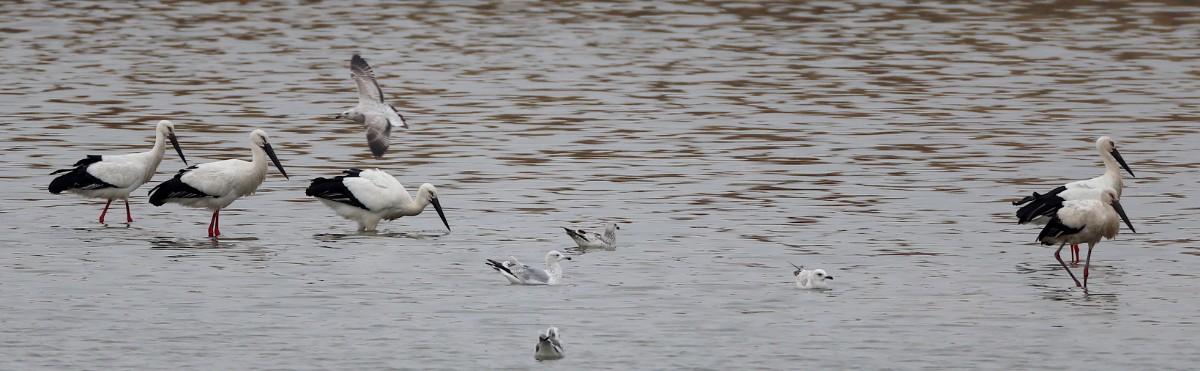
However, the birds flew quickly and landed behind the bushes in front of the shelter, too far away. The two members excitedly rushed out of the shelter, dispelling days of fatigue monitoring, wanting to observe them up close. But with the rising temperatures, the surrounding tidal flats were melting into muddy ponds, and two steps would stick to thick mud, and the two people stumbled and struggled, took 40 minutes to finally find the observation position in the bushes.
‘The most similar bird to the White Stork is the White Crane. Their feathers are all black and white, but only the tips of the wings are black; this is called the primary flight feather; the White Stork’s wings are entirely black along the lower edge, which is equivalent to the primary and secondary flight feathers. When flying in the air, they can only rely on this point to distinguish. Besides, their beaks also have some differences.’ Black Leopard Wildlife Conservation Station Director Li Li introduced.
The take-off posture can also be judged. White Cranes take off in family groups, while White Storks fly independently along rising currents, which is a difference between storks and cranes.
Unlike cranes, storks rarely call out in the wild, and the sound is small and not pleasing. They only make dense ‘da da da’ sounds during courtship, which makes it even more difficult to find.
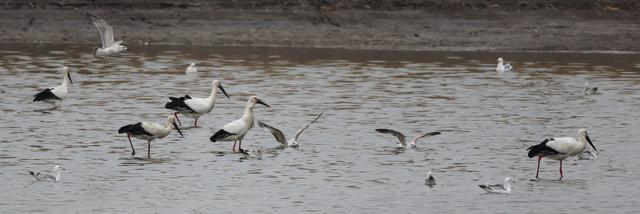
The two members carefully observed with binoculars, and it was indeed a White Stork. They came in family groups. After landing, they began to forage.
Due to the rapid rise in temperature, the ice was melting quickly, and more and more migratory birds, such as Grey Gulls and Mallards, were landing. Grey Gulls have a characteristic of ‘robbery’. So Grey Gulls surrounded the White Storks and hunted together. When the White Stork caught fish, the Grey Gulls would still snatch them. This is a phenomenon of mutual benefit in nature. ” Li Li introduced.

About two hours later, the White Storks finished eating and groomed their feathers.
The two counted a total of 12, which should be three families, and the little birds had grown up. They looked at their posture, body language, sensitivity, fishing movements, and feather colors, which were all very healthy.
‘White Storks, White Cranes, and Red-crowned Cranes and White Cranes all belong to migratory birds that migrate along the coast and rarely appear in Beijing. Beijing and Tianjin are very close, and sometimes they may accidentally land in Beijing.’ Li Li smiled.
The fundamental reason is that in recent years, including Beijing’s wetlands have been restored effectively, the migration and transit areas have become more and more ecologically sound, and more and more birds have appeared. Especially Beijing’s Guanting Reservoir and Miyun Reservoir, the area of the reservoir is very large, which is equivalent to a super-large airport, more runways, more flights. In recent years, Black Leopard has observed White Cranes, White Cranes, and Wild Geese in Beijing, which is rarely seen, due to the equipment not keeping up, and no imaging materials were left. To this end, Black Leopard purchased high-end monitoring and shooting equipment, and finally used it.
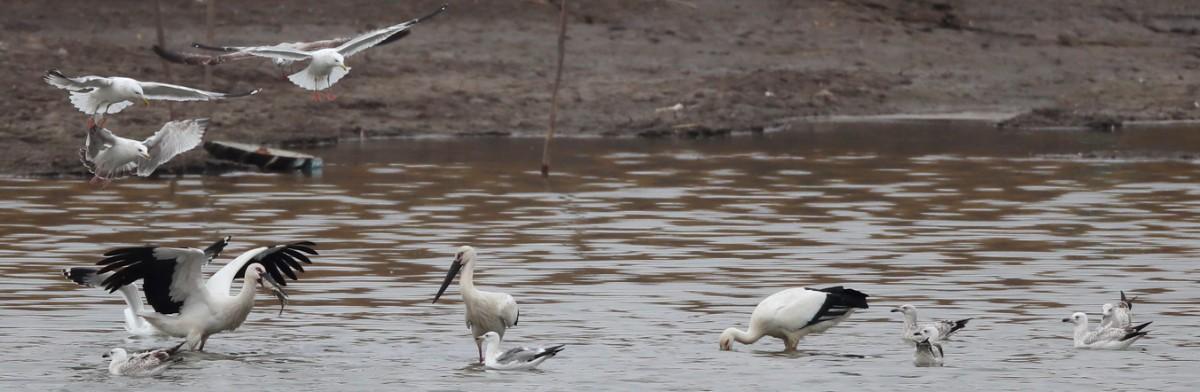
As dusk fell, a large group of Red Duck and a large group of Bean Geese landed. The White Storks are proud birds, probably annoyed by the noise, they collectively took off and flew towards Northeast. They should be rushing back to Inner Mongolia and the Far East to breed. In Beijing, they only stayed for about 5 hours.
Source: Beijing Daily Client | Reporter Yu Lishuang
Editor: Kuang Feng
Process Editing: Guo Dan