Extinct Animals – Tasmanian Devil
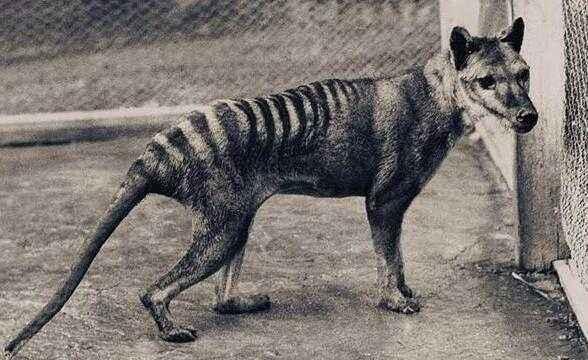
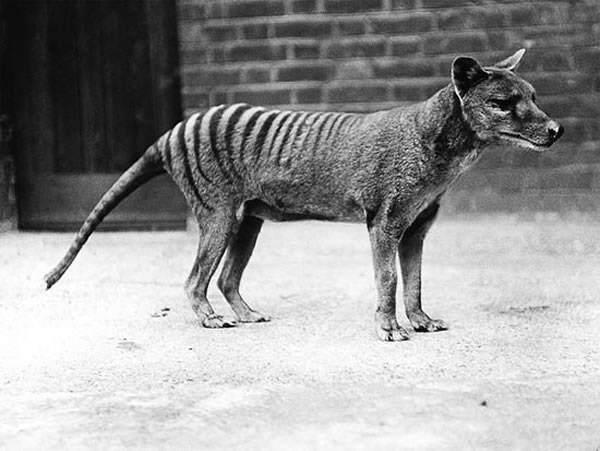
Tasmanian Devil (Scientific name: Thylacinus cynocephalus): Shoulder height approximately 58cm; body length approximately 180cm, which includes a 48-61cm tail; weight 30kg. The body is slender and fox-like in appearance, with a mouth that can open to 180 degrees. The Tasmanian Devil frequently lurks in trees and then suddenly jumps onto the backs of its prey, biting through the prey’s skull with one bite. The Tasmanian Devil has stripes all over its back, resembling a tiger, and is commonly known as the Tasmanian Tiger. The Tasmanian Devil is the largest extant carnivorous marsupial in modern times, and like other marsupials, it has a pouch for carrying its young, giving birth to immature young, which develop in the pouch, and it is a nocturnal animal.
It was once widely distributed in the tropical rainforests of New Guinea and the Australian grasslands, and after human activity, it was only distributed on the island of Tasmania. It is now completely extinct, and the last Tasmanian Devil, Benjamin, died on September 7, 1936, at the Hobart Animal Park on Tasmania Island.
The Tasmanian Devil is a symbol of the state of Tasmania in Australia, and the two animals on its coat of arms are Tasmanian Devils.
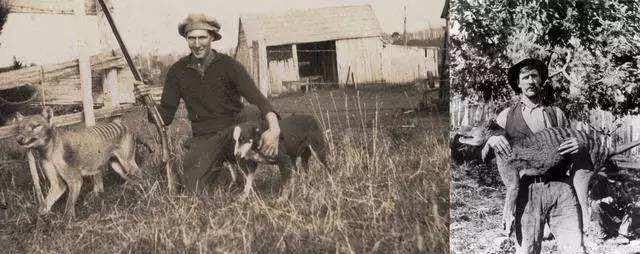
The first appearance of the Tasmanian Devil was about 400,000 years ago. The Tasmanian Devil once lived in Australia and New Guinea, and 5,000 years ago, Australian dogs entered Australia with humans, and clashed with the Tasmanian Devils with the same diet. The Tasmanian Devils subsequently disappeared from New Guinea and the Australian grasslands and only existed on the island of Tasmania in Oceania. The Aboriginal Australians first contacted the Tasmanian Devil, which can be traced back to at least 1000 BC. But since 1770, when British explorer Cook arrived in Australia, the Tasmanian Devil was suspected of attacking sheep, so it was hated by shepherds. Immigrants considered the Tasmanian Devil a ‘sheep killer’ and, under the encouragement of reward systems, it was slaughtered extensively. Coupled with the introduction of dogs and the occupation of its habitat, it almost disappeared. When the government wanted to stop the extinction of the Tasmanian Devil, it was already too late. In 1933, a Tasmanian Devil was captured and named Benjamin, and was raised in Hobart Animal Park. In 1936, it died due to negligence by the administrator, and there have been no more live Tasmanian Devils after that.
After 1936, there were continuously reports of similar animals to Tasmanian Devils attacking livestock in New Guinea, and many witnesses claimed to have seen Tasmanian Devils, but it could not be proven that Tasmanian Devils still existed. In 1967, an animal corpse was discovered in a cave, which was confirmed by experts to be a Tasmanian Devil corpse, but scientists had different opinions on whether it was a fresh corpse or a corpse left many years ago.
After 1936, six similar specimens were found in museums in other countries, which made the gene library more complete. Michael Achey, the museum director of the Australian Museum, said that the Tasmanian Devil will reappear in the world through cloning technology within 50 years.
Morphological Features
The Tasmanian Devil’s shoulder height is approximately 58cm; the body length is approximately 180cm, which includes a 48-61cm tail; and the weight is 30kg. The body is slender and fox-like in appearance, with a mouth that can open to 180 degrees. The Tasmanian Devil frequently lurks in trees and then suddenly jumps onto the backs of its prey, biting through the prey’s skull with one bite. The Tasmanian Devil has stripes all over its back, resembling a tiger, and is commonly known as the Tasmanian Tiger.
In terms of quadruped carnivorous animals, the Tasmanian Devil’s mouth is said to be able to open to 180 degrees, so the biting range is larger. At the same time, the ancient carnivorous marsupial has many primitive characteristics, compared with later cats and dogs, its color is brown and beige, and its back, waist, and buttocks have 15-16 brown-black horizontal stripes. Its bones are slender, its muscle power is not large, but the large jawbone structure shows that its biting force is weak.
It has five toes on the front feet and four toes on the back feet. It has a backward-opening pouch in its abdomen, with two pairs of nipples inside the pouch. The tail is thin and long. The Tasmanian Devil is gray or yellowish-brown.
Habitat
The Tasmanian Devil lives in open woodlands and grasslands. It lives in places where the forests are relatively sparse, or on grasslands. However, when settlers came to the land where the Tasmanian Devils lived, they would hide in the deep forests.
Lifestyle
It hunts at night and rests during the day in gravel beds. It preys on kangaroos, small mammals, and birds in family or solitary forms. Because of its large mouth, when hunting, the Tasmanian Devil often breaks the skull of the prey with one bite. It often targets kangaroos, pouch kangaroos, or non-flying birds. It doesn't run very fast, but it chases relentlessly until the prey is exhausted. It usually ends the life of the prey by biting its head.
Reproduction