Entomology Encyclopedia: Yellow Star Locust – The Dual Nature of Gentle and Violent ‘Twin Insect Life’
Today, we will introduce you toGrasshopper Locusts · Yellow Star Locust.
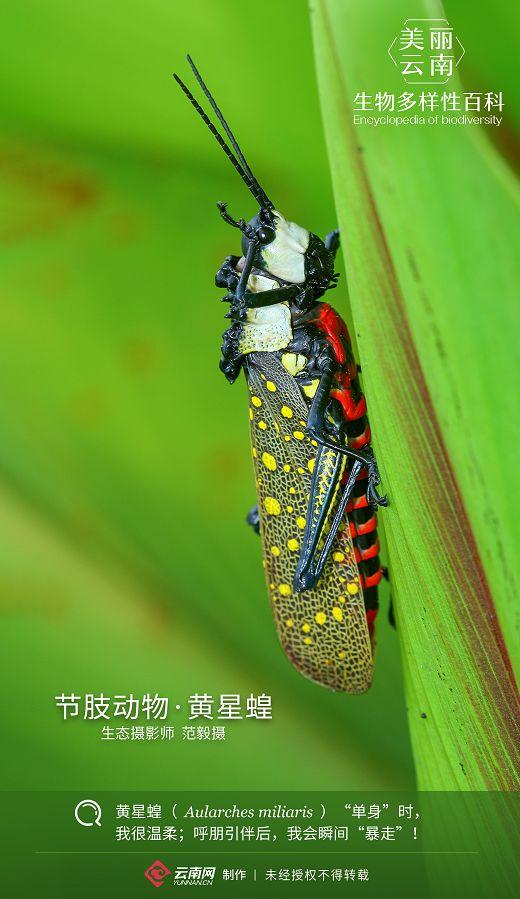
Yellow Star Locust Aularches miliaris
Arthropods, Insect class, Order Orthoptera, Suborder Ensifera, Family Acrididae. Also known as Spinetail Yellow Star Locust, it mainly lives in areas with higher temperatures and warmer climates. It is distributed domestically in Guangdong, Hainan, Guangxi, Guizhou, Yunnan, Sichuan provinces and regions. Photo taken in Pu'er.
Yellow Star Locust is an incomplete metamorphosing insect, with three stages in its life: egg, nymph and adult. Among them, the nymphs and adults look much the same, the difference being that the adults have wings and their color has changed after feathering. Their mouthparts are chewing mouthparts, consisting of five main parts, including upper lip, upper jaw, lower jaw, lower lip and tongue. When feeding on plants, they open their upper and lower lips, exposing their upper and lower jaws.
Yellow Star Locust is a beautiful locust in the locust family, with a rich and beautiful color. However, the Yellow Star Locust's beautiful 'dressing' is not for 'talent show', but a real warning, through 'vibrant' colors warning potential predators 'I am poisonous', thereby achieving self-preservation. However, this is only a bluff, in fact, the Yellow Star Locust does not have poison inside.
Yellow Star Locust is an agricultural pest, mainly damaging corn, rice, sugarcane, grass forage, mangoes, betel nuts, coconuts, Chinese Chestnuts, Chinese Fir, Tolu Balsam, Camellia, Oak, Yew, Chinese Pine, Cypress, Maple, Eucalyptus, Burnt Apricot, Beech, Pine, Spruce, Acacia, Lychee, Sichuan Cypress, Bubble Tree. Various crops, fruit trees and forests.
Research shows that a single locust is docile, but when the locust density in a region reaches a certain level, locusts collide and rub against each other, which will trigger the release of a 'grouping signal' (a chemical substance secreted by locusts), when 'grouping signal' attracts more and more locusts to gather, locust plagues will occur.
Locust plagues have always been one of the most important natural disasters in the world, because of their large number and destructive power to crops, like the 'B17 bomber squadron' during World War II, wherever they go, there is no grass.
The recent most attention-grabbing desert locust plague started in Africa and swept through the Middle East and South Asia. Desert locusts are also considered one of the most destructive migratory pests in the world, and can fly 150 kilometers with the wind and survive for about 3 months. Some studies show that a locust group occupying one square kilometer can eat the daily rations of 35,000 people.
China's northern main agricultural areas suffer from the attacks of East Asian Flying Locusts every year. To prevent the threat of desert locusts, from the central to the local levels, all parties pay close attention. Only Yunnan has set up 110-120 desert locust monitoring points, and has launched desert locust monitoring to prevent desert locusts from invading, colonizing and further spreading to other areas of China.

Fan Yi, ecological photographer. Has won the International Garden Photographer Annual Competition for 4 consecutive years and won the first prize of the 2018 China Ecological Photography Competition for wild plants and animals. Dedicated to shooting the human landscape and biodiversity beauty in western China, especially in Yunnan.
Coordination: Lian Hui Ling
Text compilation: Tian Yuan
Poster design: Zheng Bin Yun