How to Prevent Knee Inward Collapse During Squats? Quickly Learn These 5 Exercises, Say Goodbye to Knee Discomfort, and Strengthen Your Lower Limbs
As people say, knees and legs age first, and when the knees age, the knees will also age first. Taking care of the knees can make it easier to grow old.
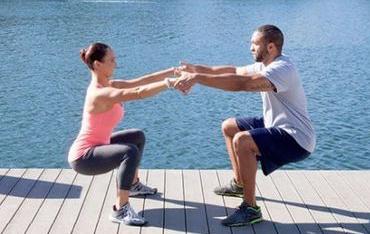
The knee joint constantly bears our entire weight, and because of its large range of motion, its structure makes it more fragile than the ankle and hip joints. So we need to practice leg exercises regularly to strengthen them. However, many people often experience knee inward collapse when doing bodyweight squats.
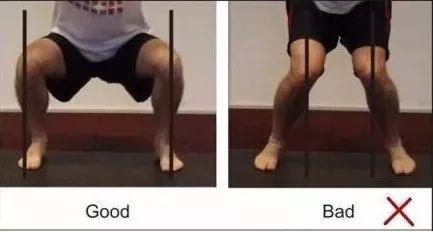
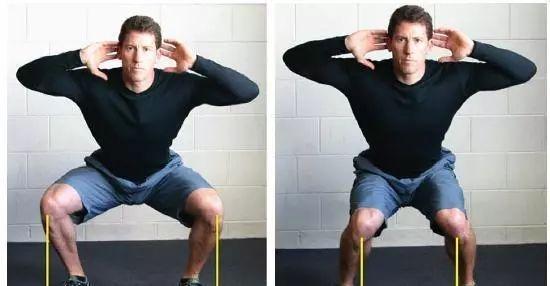
Standard Squat (left) VS Knee Inward Squat (right)
Don't worry, Xiao Feng classmate is about to provide the key information, guiding you to solve the problem of knee inward collapse during bodyweight squats, say goodbye to knee discomfort, and strengthen your lower limbs.
The main content of this article is composed of 4 parts in total.
1. Standard Bodyweight Squat Action
2. Analysis of the Causes of Knee Inward Collapse During Bodyweight Squat
3. The Harm of Knee Inward Collapse During Bodyweight Squat
4. Rehabilitation Methods for Knee Inward Collapse
5. Personal Suggestions
Bodyweight Squat Standard Action
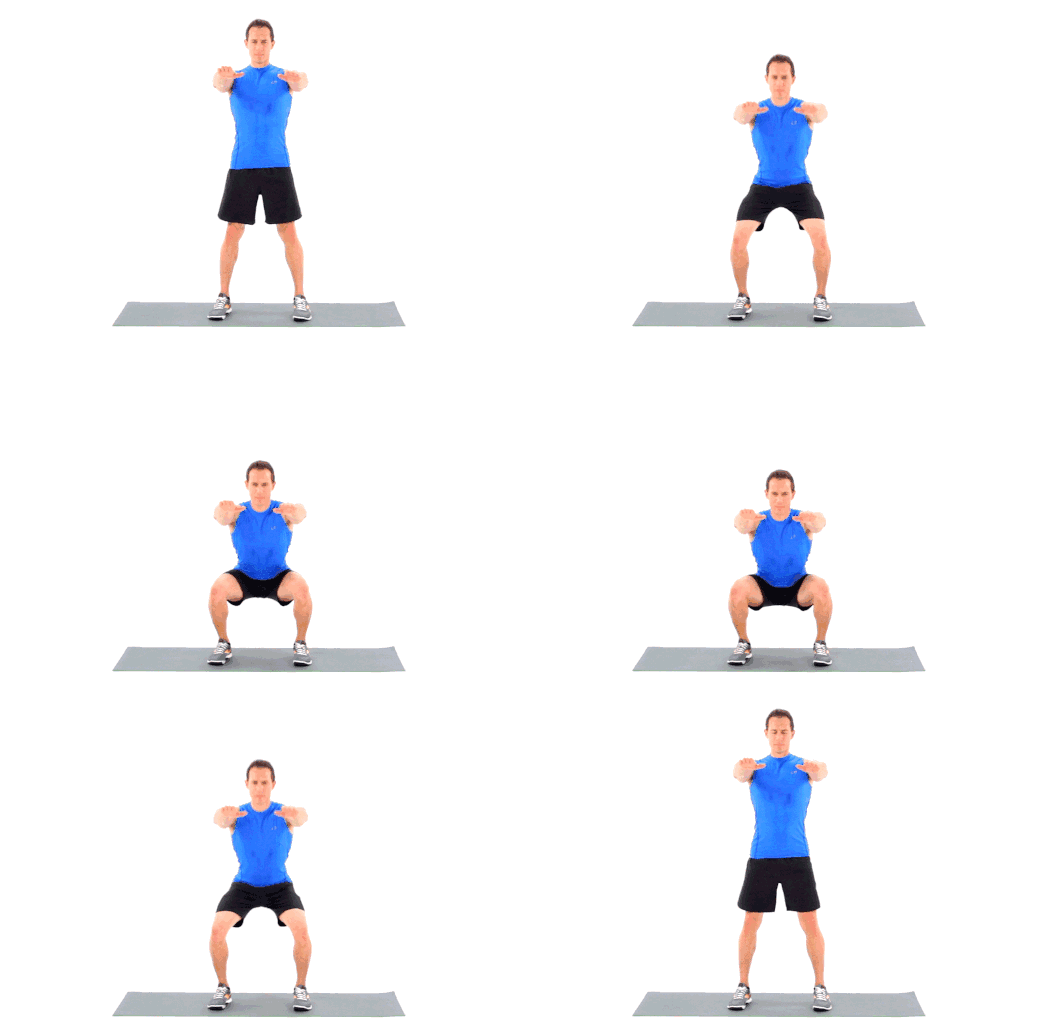
Bodyweight Squat Front Picture
Action Guidelines
- Stand upright, with both feet shoulder-width apart, with the toes pointing forward, arms extended straight ahead and held at shoulder level, inhale and prepare with your nose;
- Maintain an arched waist with the upper body, while bending your knees and hips to move down, hold for 3 to 4 seconds;
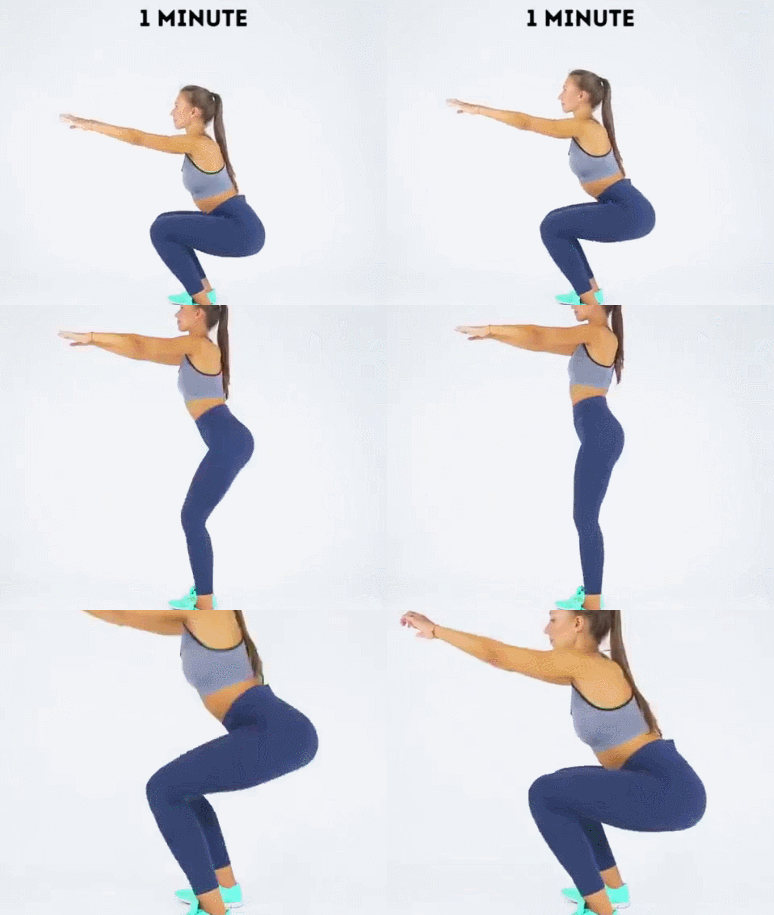
Bodyweight Squat Side Picture
- Pause for 0.5 seconds when the thigh back touches the little toe;
- Exhale and slowly return to the starting position, when the body is about to stand straight, say goodbye to the air with your mouth, hold for 1 to 2 seconds;
Precautions
The whole squatting process is a vertical upward and downward movement, and the knee joint should move in the direction of the second toe, the center of gravity is on the hip, the weight is on the heel instead of the forefoot.
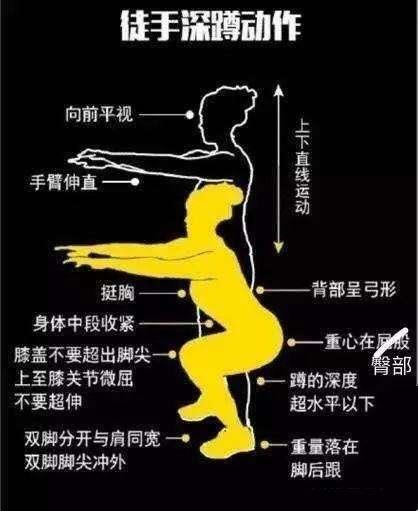
Bodyweight Squat Anatomical Picture
It is more important to pay attention to whether the knee exceeds the toes during squatting.
To squat, it is inevitable that the knees will exceed the toes, which can also effectively stretch the hamstring and gluteus maximus muscles, and the knees will reduce the pressure because of squatting very low.
Analysis of the Causes of Knee Inward Collapse During Bodyweight Squat
From a biomechanical perspective, the transfer of the center of gravity at the hip joint will drive the femur inward and rotate inward, so most people lack the ability to adjust their bodies to make the knee joint point to the second toe, so knee deviation from the midline occurs.
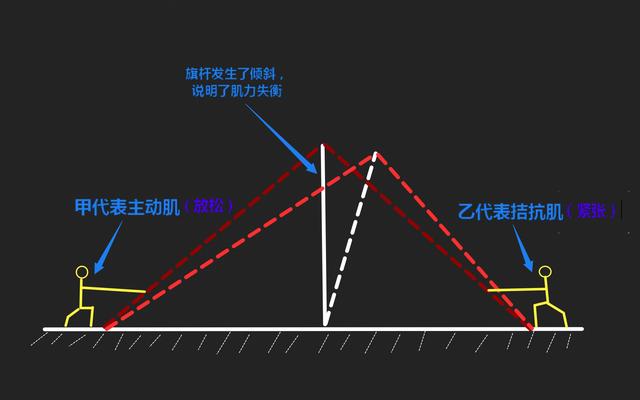
In short, it is one muscle in a pair of antagonistic muscles, one muscle is too tense while the other muscle is relaxed, which leads to the knee joint deviating from its original direction (pointing to the second toe).
An Easy-to-Understand Diagram of Antagonistic Muscles
Finally, understand the gluteal muscles, hip external rotators, and hip internal rotators.
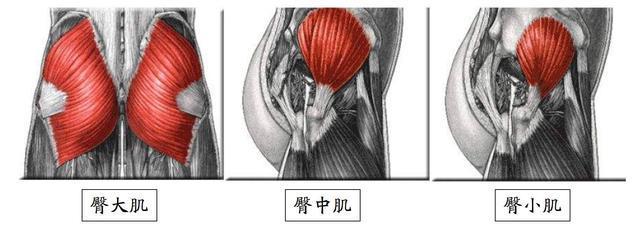
Anatomical Diagram of Gluteal Muscles
The gluteal muscle group consists of three muscles: the gluteus maximus, the gluteus medius, and the gluteus minimus.
The gluteus maximus is the largest muscle in the glutes and has the functions of abduction, extension, and external rotation of the hip joint.
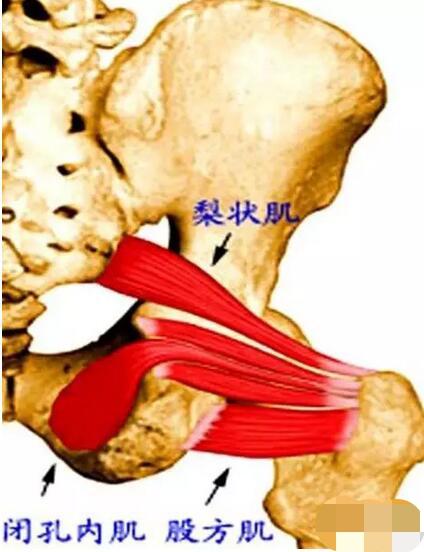
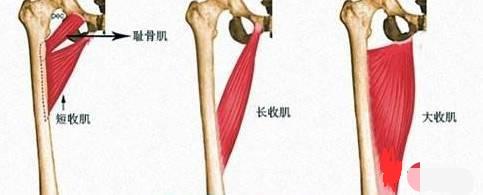
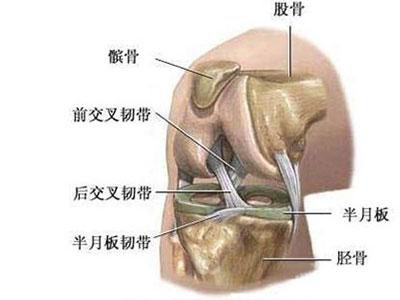
The gluteus medius is smaller than the gluteus maximus and larger than the gluteus minimus, and has the functions of abduction, rotation of the hip joint, and stabilization of the hip.The gluteus minimus is the smallest muscle in the glutes and is located below the gluteus medius and is invisible to the naked eye, and has the functions of abduction, rotation, and stabilization of the hip.Anatomical Diagram of Hip External RotatorsThe deep external rotators (iliopsoas, quadratus femoris, obturator internus and externus, and quadratus lumborum) are the stabilizers of the hip joint. They are also called the 'shoulder sleeve muscle group' when bearing weight, the deep rotating muscle has a shorter lever arm, is more focused on pressing the joint face close, and more importantly, creates hip joint stability during movement.Anatomical Diagram of Hip Internal RotatorsThe hip internal rotation group refers to the muscle group that causes the hip joint to inward rotate. The hip internal rotation group includes the adductor magnus, the long adductor, the short adductor, the obturator internus, the gluteus minimus, and the quadratus lumborum, which have the functions of making the thigh inward and inward rotate.)The Harm of Knee Inward Collapse During Bodyweight SquatAnatomical Picture of the Knee Joint1. It may lead to cartilage damageThe outer side of the knee meniscus is subjected to excessive pressure, which will accelerate the wear and tear of the meniscus.2. It may lead to muscle imbalance between the active and antagonistic muscles
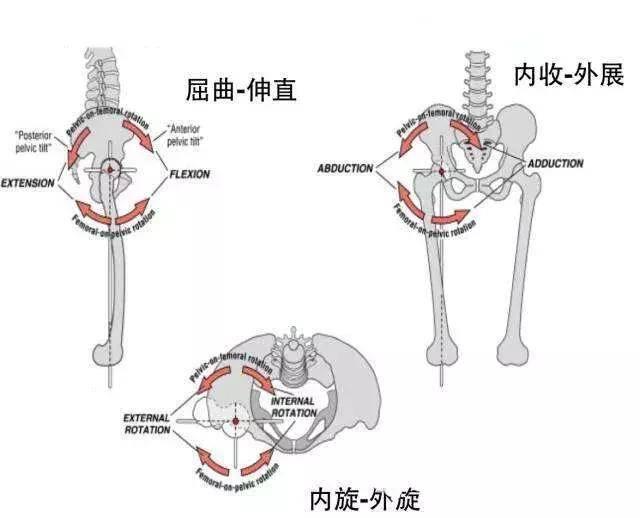
During squatting, when the hip is inward and outward rotated, the imbalance between the active and antagonistic muscles may lead to the imbalance of the muscles responsible for hip external rotation and the continuous tension of the muscles responsible for internal rotation.
3. It may cause the tendons to become loose
The medial collateral ligament of the knee is long-term under the effect of traction and will become loose. While the fibular collateral ligament of the knee is still tight, so that the knee inward rotation.
4. Patella displacement
- Because of long-term knee inward collapse, the outer thigh muscle is stronger than the inner thigh muscle, thus disrupting the original balance, making the patella move outward, and further aggravating the wear and tear of the outer side of the patella.
- Rehabilitation Methods for Knee Inward Collapse
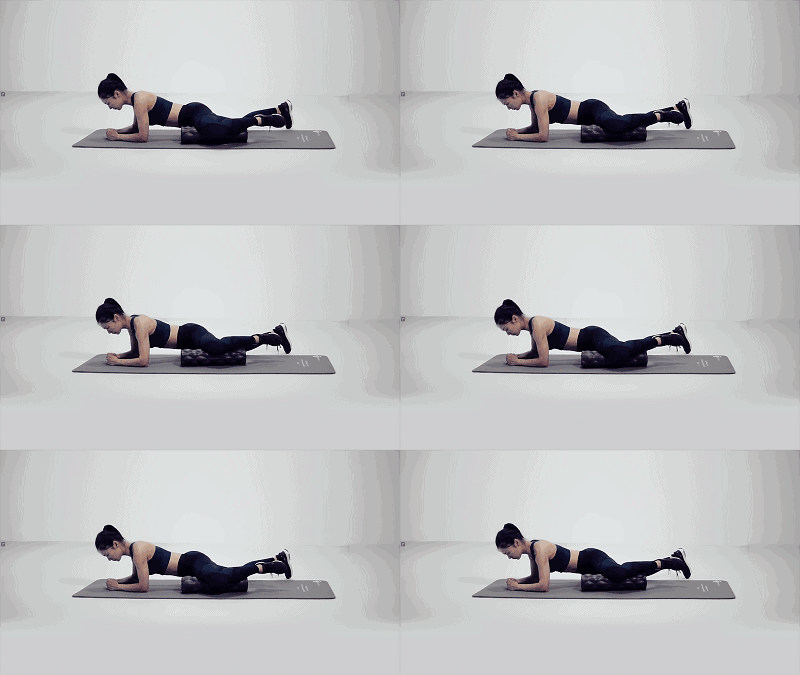
- Action One: Roll the inner thigh with foam roller
Action Guidelines
Support your elbows on a yoga mat, place the foam roller on one side of your thigh, bend one knee at a 90-degree angle, and press the middle of your thigh on the foam roller, then move the foam roller left and right to roll and press the inner thigh muscle group, hold for 30 seconds; roll one side and switch to the other side, also 30 seconds; a total of two sets, with 45 seconds between sets.
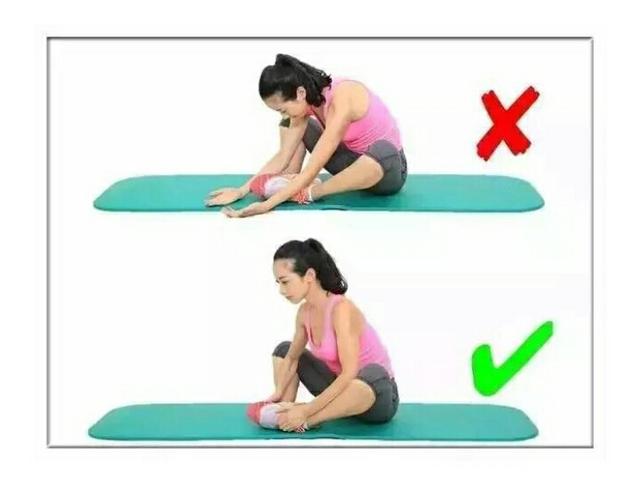
Action Two: Hamstring Stretch
Action Guidelines
Sit on a yoga mat with your feet hip-width apart, and keep your back straight, slowly lean down and press with your hands when you feel the inner thigh stretch or feel slightly uncomfortable, maintain a static stretch for 15 seconds, and do one set.
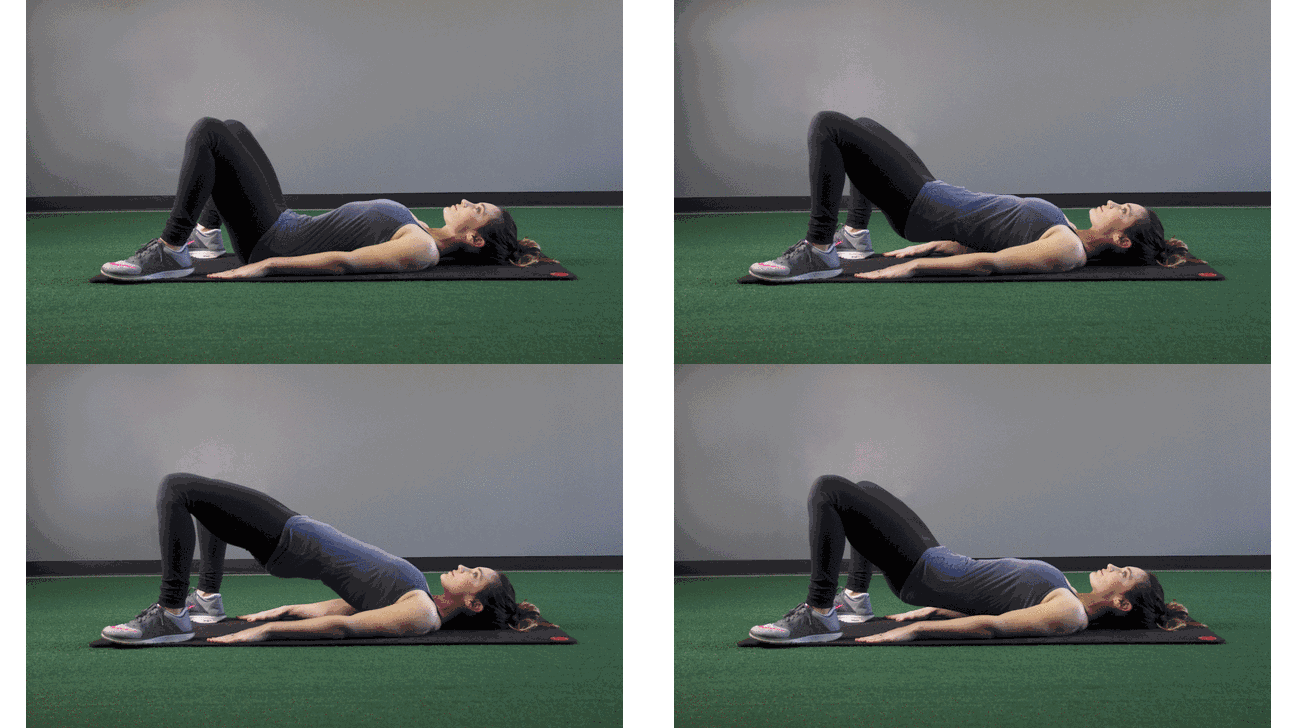
Action Three: Glute Bridge
Action Guidelines
Lie flat on a yoga mat, with your feet shoulder-width apart and your knees bent at a 90-degree angle, the hip is separated from the back of the foot by one foot, and the mouth exhales, the hips lift off the ground, the back of the hip is on the same line, then exhale and return to the starting position.
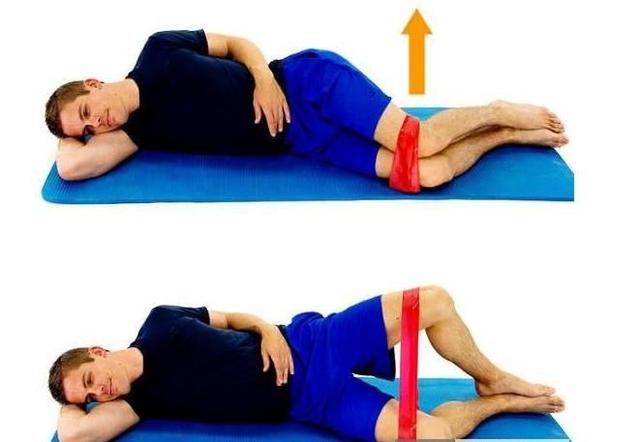
Action Four: Band Hip Abduction
Action Guidelines
Wrap a resistance band around the ankles, lie sideways on a yoga mat, support your head on your arms, bend your knees at a 90-degree angle, and keep your thighs in a straight line, exhale and lift your hips off the ground, and hold the band elastic.
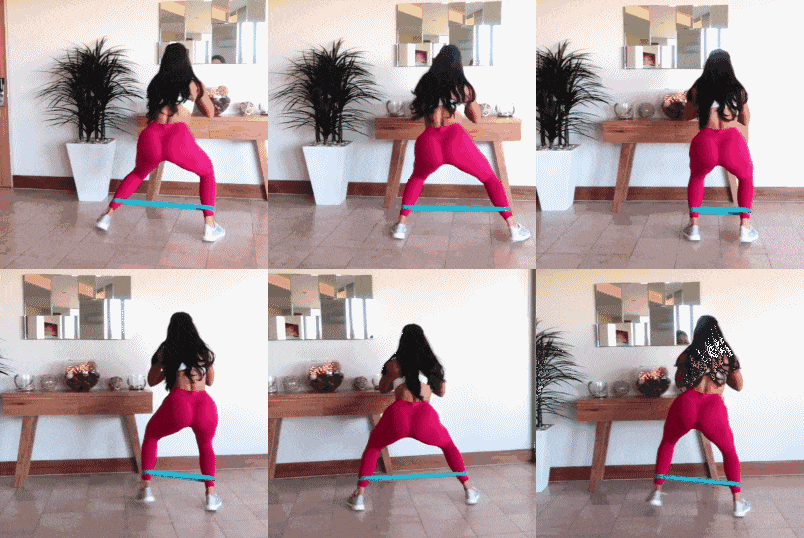
Action Five: Band Squat Walking
Action Guidelines
Wrap a resistance band around your ankles and then perform a half-squat with your feet apart in parallel, 30 seconds for one set, a total of four sets, with 45 seconds between sets. Pay attention to keep the band squat walking while the knee joint direction is always consistent with the direction of the toes.
Personal Suggestions
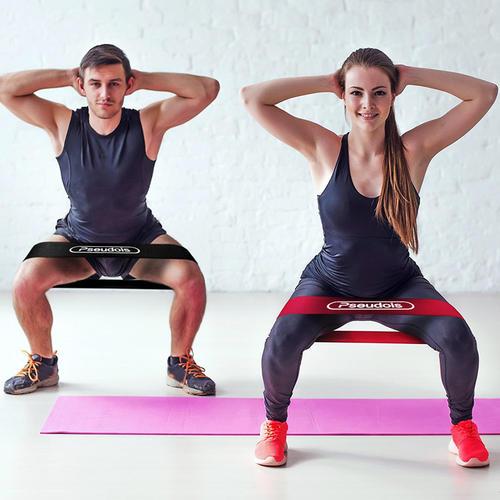
If you only experience knee inward collapse when squatting, these actions can effectively improve your problem, but before performing bodyweight squats, it is best to tie the resistance band to the bottom of your thigh to perform squats for about one to two weeks, then perform bodyweight squats.
Band Squat Diagram
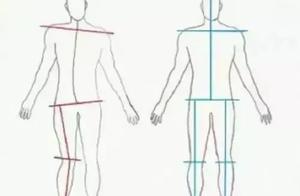
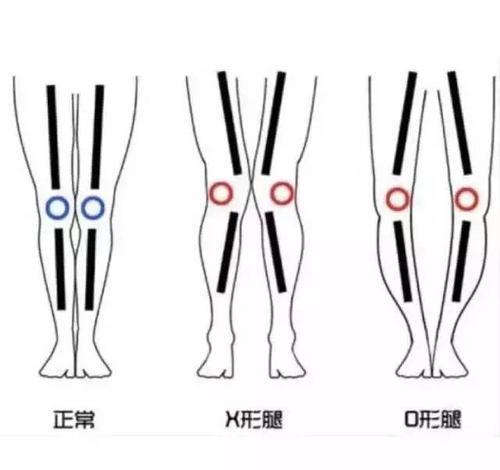
If you don't squat and your knees are still inward, it means that your posture is 'X-shaped legs' and you need to correct your posture!
The middle leg is the 'X-shaped leg'
To conclude, people have long believed that squatting will cause great damage to the knees. In fact, squatting can effectively strengthen the lower limbs, and it is because our lower limbs are weak in strength, so that knee inward collapse and other posture problems occur. Hope this article can help you solve the problem of knee inward collapse during squatting, say goodbye to knee discomfort, and strengthen your lower limbs.
Today we share it here, жители также занимаются спортом, if you want to join the discussion and exchange ideas, we will see you in the next issue! #WarriorsWin #HomeGym
9015445
901545
3045
“X”
“X”
~
!