Three-Step Tai Chi Internal Power Practice – Waist Conditioning
Tai Chi Internal Power Three-Step Practice – Waist Conditioning
1. Waist Conditioning Training Methods
Waist conditioning, is the first step in Yang Style Internal Tai Chi Three-Step Work, 'refining essence and condensing qi.' It's the beginning of 'hand changes driven by the waist,' and the starting point for 'hand changes driven by the waist.' Only by properly conditioning the waist, like a ball, can one truly achieve movements initiated by the waist. The concept of 'hand changes driven by the waist' is frequently discussed in the writings of Tai Chi masters, and remains a key guiding principle for practitioners of internal Tai Chi and Paichu. Wang Zongyue in his 'Thirteen Form Songs' points out: 'Do not lightly disregard the thirteen total forms, the source of intention is in the waist; pay attention to the waist at every step, let the internal energy be relaxed and the qi rises.' Wu Yu Xiang in 'Brief Commentary on the Thirteen Forms' says: 'Its roots are in the feet, its origin is in the legs, and its control is in the waist,' and 'Qi like a car wheel, waist like a car axle.' These statements demonstrate 'the waist's' importance in internal Tai Chi. Without properly conditioning 'the waist,' the concept of internal Tai Chi has no foundation. Only by conditioning the waist can one truly talk about the power and force of internal Tai Chi. If one neglects or bypasses waist conditioning, one will not be able to develop 'sticking, connecting, clinging, and following' movements with true understanding of force, and consequently, cannot pursue other aspects of internal Tai Chi. Therefore, to learn internal power, one must first properly condition the waist. The primary training methods for waist conditioning are: (1) Waist Rolling (2) Solo Waist Conditioning (3) Assisted Waist Conditioning (4) Waist Conditioning Through Punching and Blocking
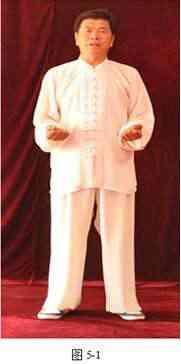
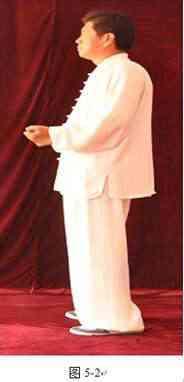
Internal Tai Chi, as practiced, refers to the 'waist' – specifically the two muscles running along the back, also known as the '' ( –) or 'life gate'. Through exercising these two muscles outside the kidneys, one can strengthen kidney function, and also expand the qi potential in the dantian. The center point is on the parallel line of the elbow bend (as shown in figures 5-1, 5-2). It is essential to properly condition the waist, enabling the two muscles to move up and down, left and right, and also forward and backward. During punching and blocking, any movement of the hands and feet must be guided by the waist. The more the waist moves, the more the hands and feet move; either excess or deficiency is unacceptable. Initially, when practicing with the waist hanging, one may not be able to hang the waist as much; this is not a problem; instead, one should slowly experience whether the waist is engaged. Gradually, this will increase, and when the entire form can be performed using the waist to guide the movements, one will achieve the internal and external movement requirements of Tai Chi internal power.
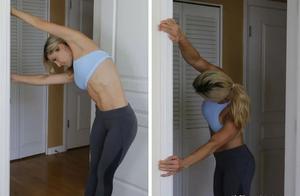
(1) Waist Rolling: The practitioner stands with feet shoulder-width apart, slightly bent knees, upper body lowered slightly, arms hanging naturally, with a relaxed body and mind, focusing intently on the two muscles along the back. When the waist rises on the left side, the left knee lifts slightly, the right knee bends, and the arms naturally move, guided by the intention to move the waist. (Figures 5-3, 5-4, 5-5). This sequence is repeated 20-30 times.
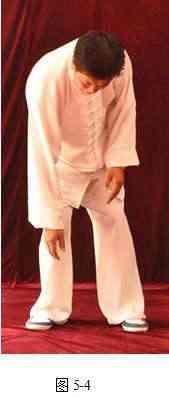
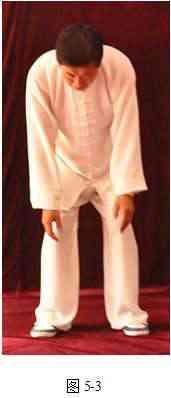
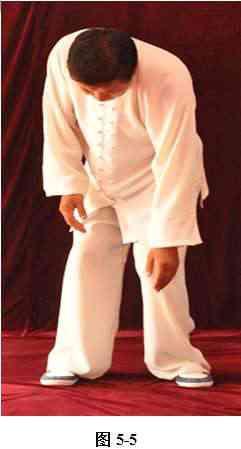
Note: During waist rolling, the shoulders, hips, and knees should be relaxed, with the forehead slightly raised, the tailbone centered, and the intention to guide the waist to follow a curved line; do not raise the chest. It is important to pay attention to the conversion of the legs' real and unreal states.
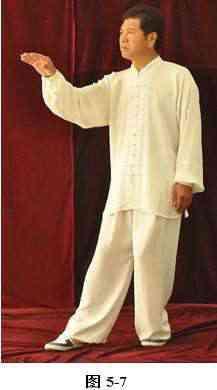
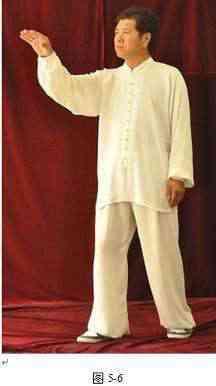
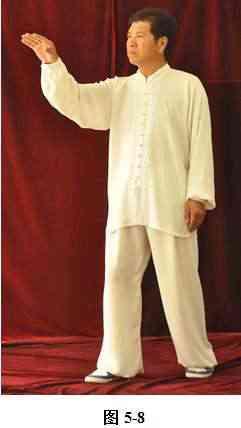
(2) Solo Waist Conditioning: This refers to the practice of repeatedly performing a single movement. Solo practice, also known as solo conditioning, involves repeatedly performing a single movement. The practitioner stands with feet shoulder-width apart, slightly lowered, steps forward with the right foot, forming a right-angle stance, with the toes of both feet approximately 1.2 feet apart. The right arm rises above the head, shifting the shoulders, bending the elbows, resembling a straight line or a bent line, with the palms facing outwards and the fingers pointing upwards, approximately level with the forehead. The left arm hangs naturally downwards. The eyes are level with the horizon. Simultaneously, the intention is focused on the waist. When the waist moves backward, sinks, and curves, the left knee bends, and the weight is shifted to the left leg, while the right leg is in a supporting position. As the waist rises, the movement is continued, with the intention of reaching the target and exchanging real and unreal states (Figures 5-6, 5-7, 5-8). This sequence is repeated 20-30 times.
Note: During solo waist conditioning, the entire body should be relaxed, the forehead slightly raised, the tailbone centered, and the intention to guide the waist should follow a curved line; do not raise the chest. It is important to pay attention to the conversion of the legs' real and unreal states.
(3) Assisted Waist Conditioning: This refers to the use of tools to assist in waist conditioning. Examples include chairs and bicycles. Using these tools to condition the waist, the intention must be focused on the waist.
(4) Waist Conditioning Through Punching and Blocking: This refers to performing each movement and transitioning between forms using the waist as the guiding force. Using the waist to condition the waist allows one to understand the feelings of 'joining four corners' and 'using the waist as the hand.' This can quickly improve the speed of waist conditioning and is a valuable preparation for push-hands. Waist conditioning is the most effective pathway to mastering push-hands; therefore, waist conditioning through punching and blocking is the most effective preparation for push-hands.
(4):“”“”