American Bison
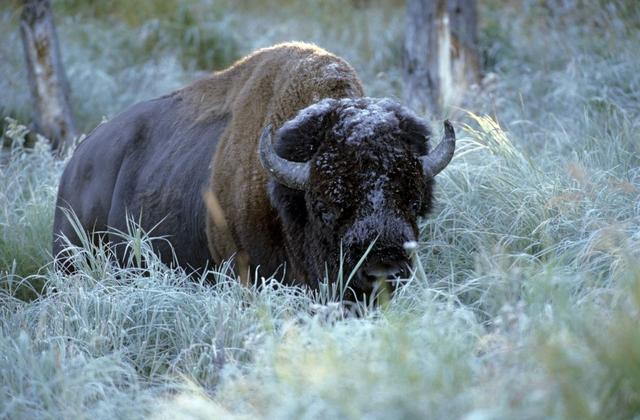
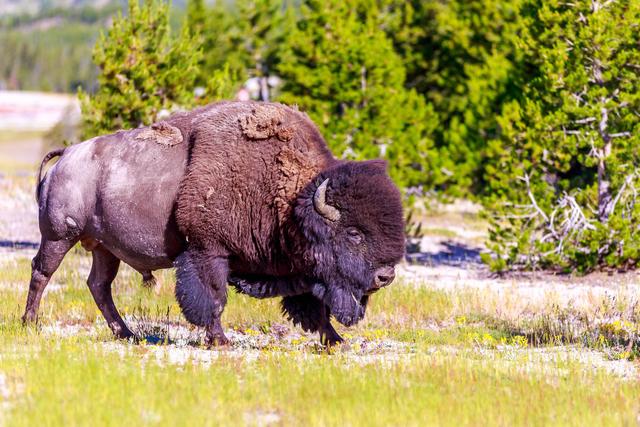
American bison (Scientific name: Bison bison; English name: American bison): Also known as American buffalo or buffalo, it is the largest mammal in North America and one of the largest wild buffalo in the world. It is also a relatively fierce animal, with a weight of up to 1000 kg, with a pair of upward-curved sharp horns on its head, it will not retreat even when facing the most aggressive predators. They have dark brown-gray fur and large shoulders like small hills. Within the population, each bull forms a collective and defends the herd's cows, and the breeding period of American bison is from 6-9 months. Each cow can give birth to one calf a year.
Despite its huge size, it can maintain a speed of 60 kilometers per hour. The main group is composed of cows and calves; males form solitary herds, only gathering together for mating. Herbivores, they mainly feed on young stems of grass, without territoriality. They live in large groups in the United States and Canada's vast prairies, from Canada's far north's Great Slave Lake to the south of Mexico, and from Oregon's east to the Atlantic coast.
In 2016, the 44th President of the United States, Obama, signed a bill, thereby officially establishing the American bison as the national animal of the United States.
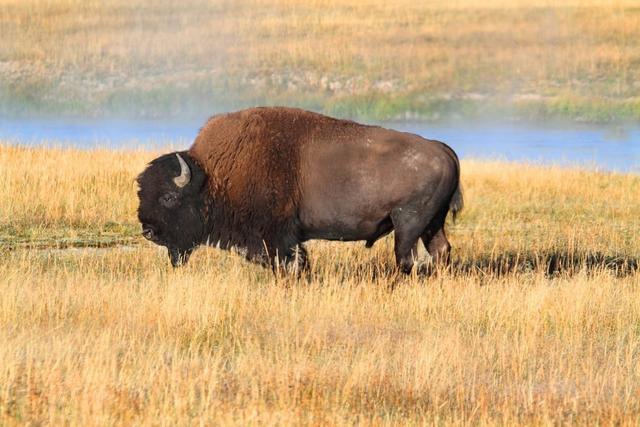
The American bison is a new immigrant in North America, it originated from the European bison on the Eurasian continent, and later migrated to the Bering Sea, White. During the Ice Age, a large amount of water was frozen into glaciers, leading to a decrease in sea level, exposing the seabed between Asia and America, the Bering Strait. Many animals on the Eurasian continent passed through this seabed bridge to America, and bison was one of them. About 10,000 years ago, the temperature began to rise, the ice melted, and the Bering Strait was flooded again by seawater. About 10,000 years ago, the American bison replaced the vast number of Siberian bison. The extinction of the longhorn bison is considered to be caused by changes in the ecosystem, the development of Clovis stone tools and related technology, and the hunting skills. At the same time, other giant animals disappeared and were replaced by more adaptable animals from the Eurasian continent. American bison is one of these animals.
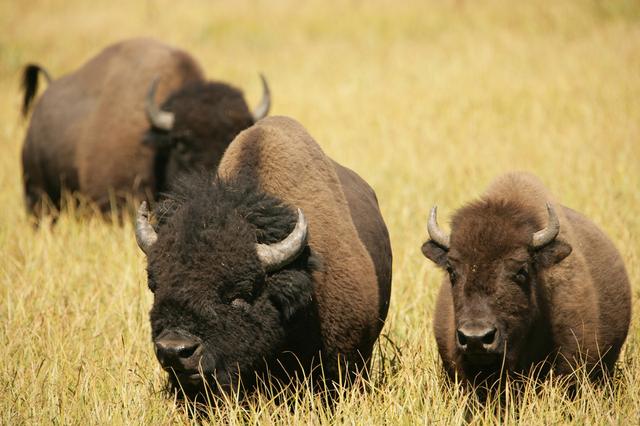
The American bison's body length is 2.1-3.5 meters, shoulder height is 1.5-2.0 meters, and adult weight is 350-1000 kg. Its head and forebody are huge, the shoulders are like tall humps, the neck is short and strong, the head is large and has a wide forehead, both male and female bison have short and curved horns, which can be used for fighting and defense. The American bison looks a bit like a domestic dairy cow, with long and fluffy coarse hair on its shoulders, along its head, neck, shoulder and forelimb covered with a full body. In winter, the fur is dark brown, and in summer it is lighter and paler. In spring, the soft down hair on the body's back and lower part falls off.
The American bison's head, neck and forebody hair is longer and denser than that of the European bison, its body is shorter and its pelvis is smaller, and its hindquarters are not as developed as the European bison. Overall, the American bison's body is thicker and stouter than the European bison, and its body and limbs are not as long as the European bison. They have good smell and poor vision.
Female bison are smaller than males, and have smaller humps, a thinner neck, and more slender horns.
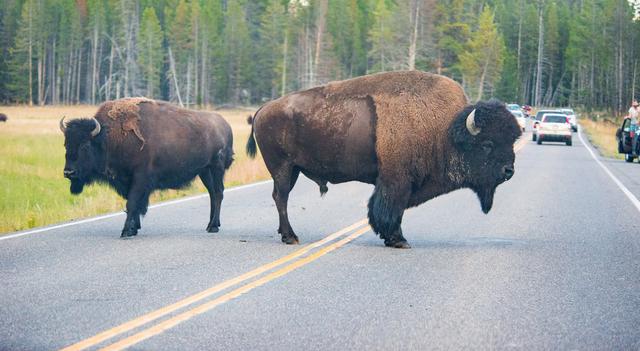
The American bison lives in large groups in the vast prairies of the United States and Canada, such as Canada's far north's Great Slave Lake to the south of Mexico, and from Oregon's east to the Atlantic coast. Large groups of American bison roam in the Great Plains. They migrate south in winter and return to the north in summer. They travel along the traditional routes known as 'bison trails'.
The American bison is very similar to the European bison in appearance, but their habits have changed to some extent. European bison lives in the forest, feeds on young branches and small shrubs, while the American bison's prairie subspecies lives on the prairie as a herbivore.
The American bison lives in groups, they often wander in the mud, like to take mud baths. They rub their bodies on stones and tree trunks to remove external parasites. They mostly feed in the morning and evening, and rest the rest of the time. When attacked by a pack of wolves, they can run at a speed of 60 kilometers per hour. Grass and sedge are the main food of the species, such as flowering plants, woody plants leaves, and even lichens. In winter, bison dig through the thick snow to find plants buried underneath.
In the population of American bison, each bull forms a collective and defends the herd's cows, and they disperse all other bulls challenging them. The breeding season is from June to September, the peak is in July and August. During the breeding season, the two adult male American bison fight for the right to mate with the cows, shouting loudly, rolling in the dust, and then moving their heads to show off their posture. Usually, one bull will step back, if not, the two bulls will fight, head to head, colliding with a large pile of hair flying in the air, then they will circle around each other, and suddenly turn and charge forward, trying to stab their opponent with their horns.
The female's gestation period is about 9 months and more (270-285 days), and each female gives birth to only one calf. The calf is born in the spring of the second year, the newborn calf is light brown or reddish brown, and within three hours, the newborn calf can walk, the calf will be taken care of by its mother for about one year. Generally, it is mature at 3 years old, and the lifespan of wild bison is 18-22 years, and the lifespan of raised bison is 35-40 years.