Every Day Bringing You to Understand a Bird – Black-throated Sunbird
International Tourism Photography Network reminds: Protect wildlife, prohibit bushmeat, they do not belong to the table.
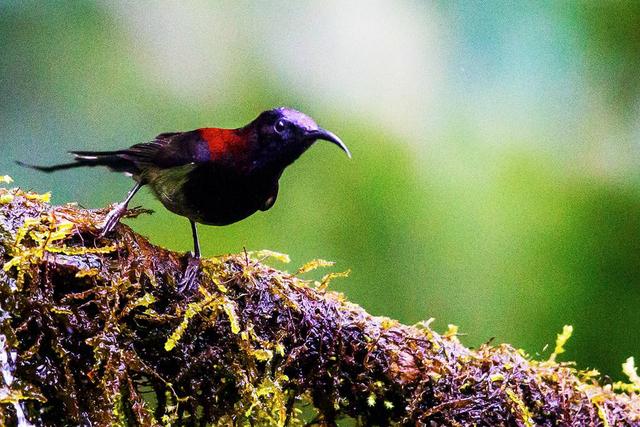
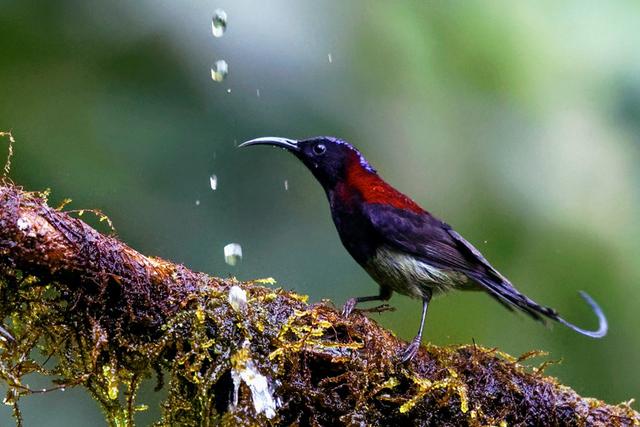
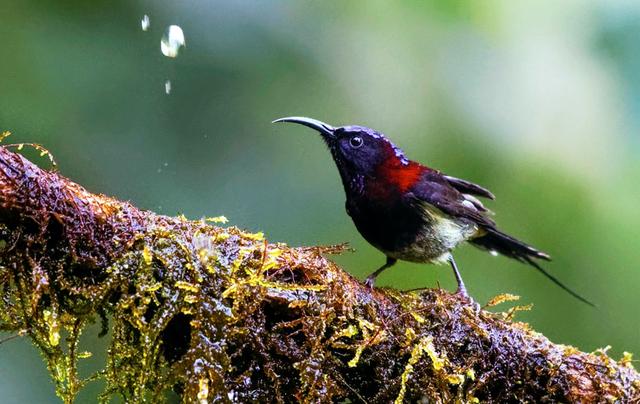
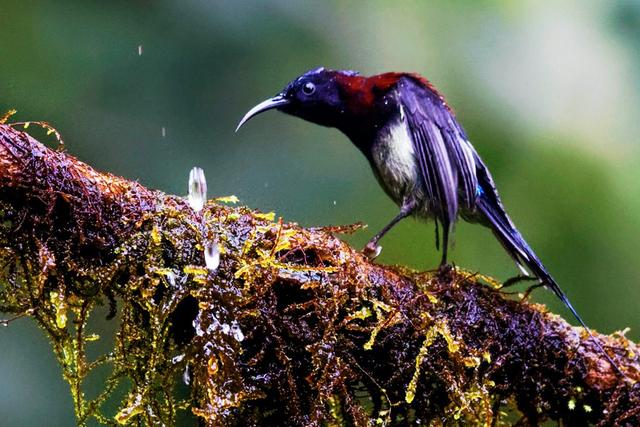
Black-throated Sunbird (scientific name: Aethopyga saturata): A small bird, body length 9-15cm. The beak is thin and downward curved. Male birds have long central tail feathers, the tail is wedge-shaped, the top of the head to the back of the neck has purple-blue with metallic luster; the back is reddish-brown, the shoulder has a yellow band, the tail coverts and the base of the central tail feathers are purple-blue, the tail is wedge-shaped, the pair of central tail feathers are particularly elongated, the extended part and the outer tail feathers are close to black. Two wings are black-brown, small coverts and middle coverts are black. The chin, throat, chest are black, some lower chest is sulfur yellow with fine red streaks, the rest of the lower body is olive-green or greenish-gray, the axillary feathers and wing undersides are yellow or white.
Female birds have olive-green upper body, yellow waist, two wings and tail are brown, feather edges are olive-green, outer tail feathers are inner-sheen white at the tip. The chin, throat and chest are gray with olive-green, the rest of the lower body is gray-green, the chest and abdomen are yellow in the middle, the two flanks are close to white, the tail underside is pale yellow, the axillary feathers and wing undersides are yellow-white.
Iris brown or dark brown, beak black, foot black-brown.
Click to add image description (no more than 60 characters)
Morphological characteristics
The male Black-throated Sunbird has purple-blue or dark blue luster on the forehead, top of the head, nape and extending to the back of the neck. The eyes, eye circles, ear feathers and head sides are black. The back, shoulder and dark red or reddish-brown, the lower back and wing coverts are dark black, the waist is yellow or has a narrow yellow band, sometimes not very obvious. The tail coverts and the base of the central pair of tail feathers are purple-blue, the tail is wedge-shaped, the pair of central tail feathers are particularly elongated, the extended part and the outer tail feathers are close to black. Two wings are black-brown, small coverts and middle coverts are black. The chin, throat, chest are black, some lower chest is sulfur yellow with fine red streaks, the rest of the lower body is olive-green or greenish-gray, the axillary feathers and wing undersides are yellow or white.
Female birds have olive-green upper body, yellow waist, two wings and tail are brown, feather edges are olive-green, outer tail feathers are inner-sheen white at the tip. The chin, throat and chest are gray with olive-green, the rest of the lower body is gray-green, the chest and abdomen are yellow in the middle, the two flanks are close to white, the tail underside is pale yellow, the axillary feathers and wing undersides are yellow-white.
Breeding method
Breeding season 5-7 months. Nests in the forest on trees, shrubs and bamboo thickets. The nest is pear-shaped, mainly made of plant fiber, root hairs, sometimes mixed with moss, grass stems and bamboo leaves, the inside is padded with fine grass stems and cotton wool, the entrance is on the middle side. There are 2-3 eggs in each clutch, the eggs are pale pink and pure white, with dark brown spots, the egg size is 14.2-15.3mm × 10.5-12.1mm.
Click to add image description (no more than 60 characters)
Breeding habits
Migration: Resident.
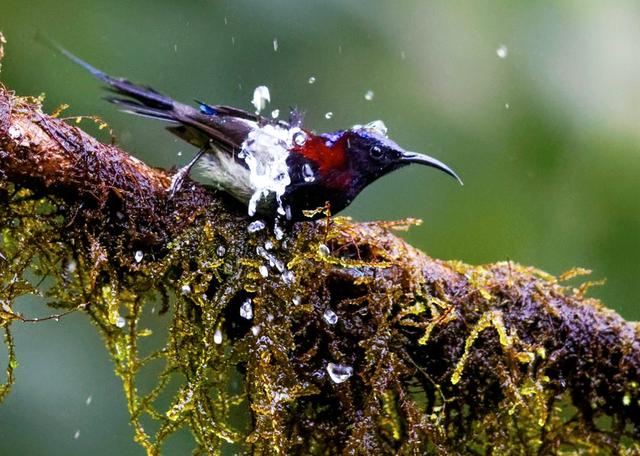
Habits: Often solitary or paired, sometimes seen in groups of 3-5 or mixed with Willow Warbler. They like to move in open areas such as forest edge sparse forests, shrubs, forest clearings and stream banks. They are lively and constantly flitting and foraging in the trees, they peck at nectar, they constantly fan their two wings, hovering in the air to peck at flowers, sometimes hanging down from branches and flowers with their heads down.
Call: Fast ti-ti-ti-ti-ti-ti-ti… call.
Diet: Mainly eats spiders, insects, ants, flower buds, flower petals, seeds and tender leaves.
Click to add image description (no more than 60 characters)
Reproductive method
Breeding season 5-7 months. Nests in the forest on trees, shrubs and bamboo thickets. The nest is pear-shaped, mainly made of plant fiber, root hairs, sometimes mixed with moss, grass stems and bamboo leaves, the inside is padded with fine grass stems and cotton wool, the entrance is on the middle side. There are 2-3 eggs in each clutch, the eggs are pale pink and pure white, with dark brown spots, the egg size is 14.2-15.3mm × 10.5-12.1mm.
Click to add image description (no more than 60 characters)
Distribution range
China: distributed in the northwest of the Kunshan Mountains, west of the western part of Tengchong, Yingjiang, Luoxi, Ganma, Zhenkang, Yongde, Xibin, Xinping, southwestern Lan Cang, Cangyuan, Menlian, southern West Kowloon, Jiangcheng, Yuan Yang, Green Spring, Guizhou south Xingyi, Chengyu, Wangmo, Luodian, Guangxi and southeast of Zangye, also occasionally seen in Hong Kong.
Worldwide: distributed in Nepal, Sikkim, Bhutan, Bangladesh, India, Myanmar, Laos, Vietnam, Cambodia, Thailand and Malaysia.
Click to add image description (no more than 60 characters)
Population status
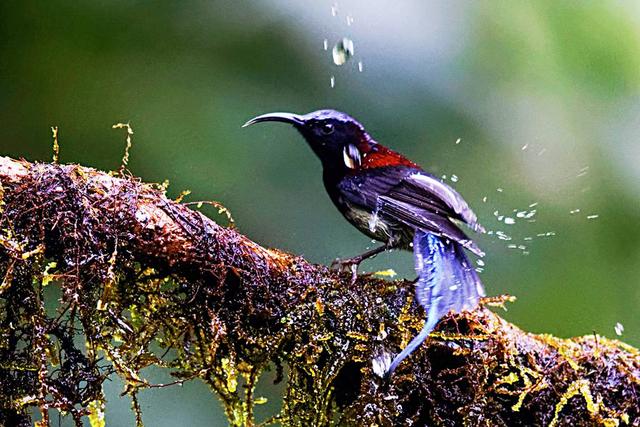
The Black-throated Sunbird's population is relatively abundant in some areas in China, especially in the western Kunshan Mountains and southwestern Guizhou.
The distribution range of this species is wide, not approaching the vulnerable critical value standard of species survival (distribution area or fluctuation range less than 20000 square kilometers, habitat quality, population size, distribution area fragmentation), population trend is stable, so it is evaluated as a species with no endangered status.
Protection level
Listed in the 2013 IUCN Red List of Endangered Species Version 3.1 – Low Risk (LC).
The text images are taken by Mr. Fu Zibao for sharing and learning purposes, the copyright belongs to the original author.
IUCN 2013ver 3.1——LC