Finally Clarified: Why Woodpeckers Don't Experience Concussions
Battering against tree trunks seems to cause headaches, jaw pain, and severe neck and brain injuries. Woodpeckers can do this 20 times per second, and don't experience any negative effects.
Outside of Australia, the silhouettes of woodpeckers can be found in all forests. They possess extraordinary abilities, utilizing their hammering beaks to drill into tree trunks to extract insects and sap. More impressively, they don't get injured as a result.
We are interested in woodpeckers' cranial and lingual skeletal structures, as their unusual anatomy may inspire the development of better head protection devices.
concussion
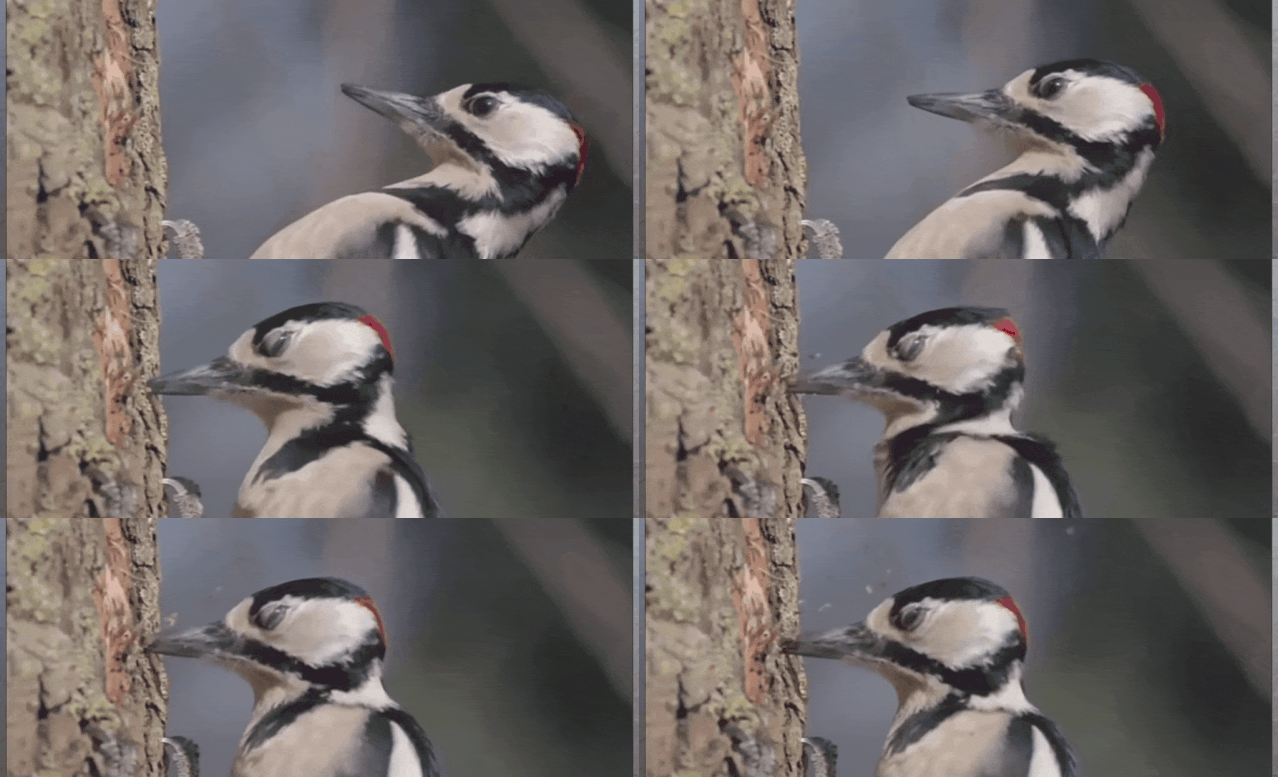
Woodpeckers' heads endure violent impacts when they peck at tree trunks.
They have sturdy tail feathers and claws to help them maintain balance, as their heads move at a speed of 7 meters per second when they strike. The instantaneous deceleration impact is equivalent to 1200 times the force of gravity. However, woodpeckers don't suffer from concussion as a result.
Concussion is caused by traumatic brain injury resulting from repeated head impacts. It frequently occurs in contact sports such as American football and hockey.
An impact of 80G can cause concussion in NFL players. So, how does a woodpecker protect itself when subjected to 1200 G?
This is the key secret scientists are seeking in woodpeckers. We have studied the microstructure of bones and conducted biomechanical analysis of the head.
unusual skull and tongue structure
Through comparing woodpeckers' and chickens' skulls, we find that woodpeckers possess adaptation abilities that other birds don't have, including special skulls, neck muscles, beaks, and tongues.
The skull has a different chemical composition and density. For example, one adaptation is to increase the accumulation of minerals in the bones, making them harder than those of other birds.
Surprisingly, compared to other birds and animals, the skull is very thin, with less fluid separating the brain from the skull. This indicates that the skull can be both hard and flexible.
Typically, in real-world materials science, there is a trade-off between hardness and flexibility. However, materials that can simultaneously possess hardness and flexibility can better protect our heads and reduce the impact transmitted to the brain.
The second difference is that woodpeckers have less liquid inside their brains than other large animals. This helps to limit the relative movement of the brain during feeding. The effect of reduced fluid volume is similar to that of a cooked egg yolk compared to an uncooked, un-processed egg yolk, which is not damaged by shaking.
Woodpeckers' tongues are wrapped in a bone, which helps to extract insects from tree trunks. The unusual tongue is wrapped around the skull's back and anchored in the front between the eyes. This configuration makes the tongue and its bone function like a spring, reducing physical force and related vibrations.
non-typical bone structure
Typical bones' stiffness and strength come from a dense shell surrounding porous spongy bone. But woodpeckers' tongues have an opposite structure: a soft shell and a harder core bone. This from-inside-out configuration provides better flexibility and can absorb larger impacts and vibrations.
Currently, biologists and neuroscientists are actively studying woodpeckers' brains to see if there is any pathological evidence of brain injury – such as CTE in humans. By exploring woodpeckers at the tissue or cellular level, we can also look for other protective or healing mechanisms.
We hope they will eventually reveal how to protect and heal human brain injuries.
This article is translated from sciencealert, by translator majer, published under the Creative Commons Attribution-NonCommercial (BY-NC) license.
sciencealert majer (BY-NC)