Long-snouted Hammerhead Shark
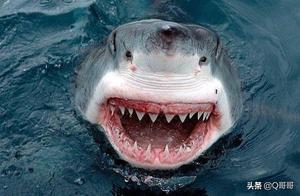
Great White Shark, scientific name: *Sphyrna zygaena* (Linnaeus, 1758), a shark species of the hammerhead family. It mainly inhabits the open ocean, deep sea, reef areas, sandy-mud bottoms, and coastal areas near the shore. It is carnivorous, feeding on other cartilaginous fish, bony fish, crustaceans, mollusks, and other benthic organisms. IUCN classifies it as—Vulnerable (VU).
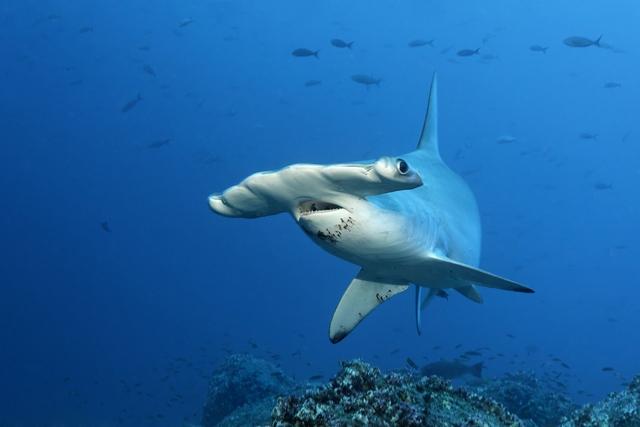
The body is elongated and slightly flattened, almost cylindrical. The head is flattened, with the sides expanded to form a hammer-like protrusion; the head length is 2/9 of the total length in juveniles and 1/5 in adults. The side is laterally compressed, medium length, slightly longer than the head and body, with a concave depression at the base of the tail; the tail base has a concave depression that is not significant or disappears. The side protrusion is round and convex, with a shallow concave indentation on the inner side facing the inner angle of the outer side protrusion of the head; the eye is circular and has a well-developed nictitating membrane. It is located in the side of the head, with a distance from the nose hole smaller than the diameter of the eye. The nose hole is flat, located at the end of the snout, close to the outer side; the side groove is short, reaching the upper corner of the water outlet hole, and the inner groove is long, almost reaching the inner shallow concave area, and the depth gradually decreases inwards; the nose hole has a triangular protruding spike on the inner side of the outlet hole. The mouth is arched, the mouth is wider than the length of the nose hole, the mouth length is equal to or slightly greater than the width of the mouth by 1/2, the corners of the mouth are approximately on the same horizontal line as the outer side protrusion of the head; the lower lip folds are short and small, and the upper lip folds are almost disappeared. The upper teeth are laterally compressed, triangular, with the outer edges sloping outwards, smooth or with fine weak serrations, with a rounded convex inner edge and a deep concave outer edge, used in pairs; there is a central tooth on each side, 14 teeth on each side, the central tooth is small and pointed, the first tooth is also small and pointed; the lower teeth are similar to the upper teeth but smaller, with the same number of teeth in pairs, used in pairs. The spraying hole is missing. There are 5 gill slits, medium-sized, the first 4 are approximately the same size as the distance, the last 1 is small, the last 2 are close to each other, located above the base of the chest fin; the shield scale is shell-shaped, with 5 thorn protrusions and 5 longitudinal ridges.
The dorsal fins are 2; the first dorsal fin is tall, with a slight inclination on the front edge, starting approximately at the midpoint of the inner edge of the chest fin, the upper corner is rounded, the lower corner is deeply recessed and extended into a spike, at a considerable distance from the position of the pectoral fin; the second dorsal fin is small, starting at the base of the pelvic fin, the upper corner is rounded, the lower corner is extended into a spike, and at a considerable distance from the base of the tail; the ventral fin is slightly larger than the second dorsal fin, nearly square, at equal distances from the first dorsal fin and the second dorsal fin, the outer corners are rounded, the outer and inner edges are slightly recessed, and the edges are straight or slightly recessed, the inner corner is rounded and slightly protruded, not reaching the back of the lower corner of the second dorsal fin. The caudal fin is wide and long, about 7/20 of the total length, the vertebral axis is arched upwards, the upper leaf is close to the end of the vertebral axis, the lower leaf extends forward significantly, with a notch in the middle, the middle and back are separated by a deep incision, the back is a small triangle, connected to the upper leaf, the end is blunt and protrudes, and the end is sharply pointed. The pelvic fin is slightly larger than the second dorsal fin, nearly square, at equal distances from the first dorsal fin and the second dorsal fin, the outer corners are rounded, the outer and inner edges are slightly recessed, and the edges are straight or slightly recessed, the inner corner is rounded and slightly protruded, not reaching the back of the lower corner of the second dorsal fin. The chest fin is large, with the outer and inner edges recessed, the outer and inner corners are rounded and slightly protruded, the fin tip extends to the midpoint of the base of the first dorsal fin.
The body is grayish-brown, the abdomen is pale white; the dorsal fin, caudal fin, chest fin edges and fin tips are dark brown; the ventral fin, abdominal fin is pale, the outer corners are dark brown.
The hammerhead shark mainly inhabits the open ocean, deep sea, reef areas, sandy-mud bottoms, and coastal areas near the shore, with a wide distribution in temperate and tropical waters. It is a large shark of the warm water.
In summer, they gather into large groups and migrate to northern waters. It is carnivorous, feeding on other cartilaginous fish, bony fish, crustaceans, mollusks, and other benthic organisms. It has a tendency to be aggressive and poses a potential threat to humans.
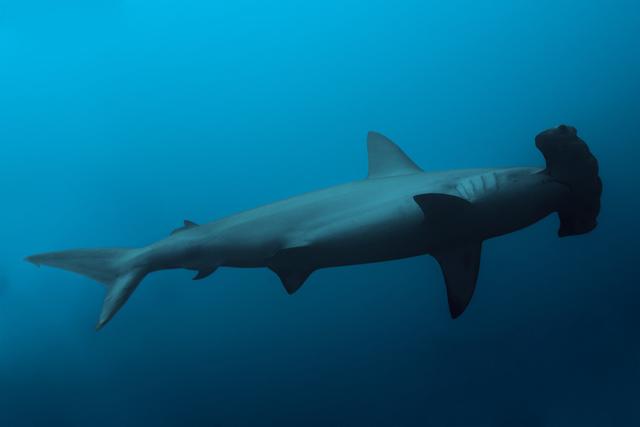
The maximum body length can reach 3 meters, weighing 110 kilograms.
Hammerhead sharks are viviparous, with yolk sac embryos and placental membranes, with 29-37 juvenile sharks per litter, with a body length of 50-60 cm at birth, male sharks are 210-240 cm, and female sharks are 304 cm, with a maximum length of about 370-400 cm. Female maturity begins at a body length of 2.5 m or more.
3110

29-3750-60210-240 cm304 cm370-400 cm2.5 m