Stunning! 34 Spoon-billed Sandpipers Gather for Return
Source: Zhanjiang Daily-Zhanjiang News
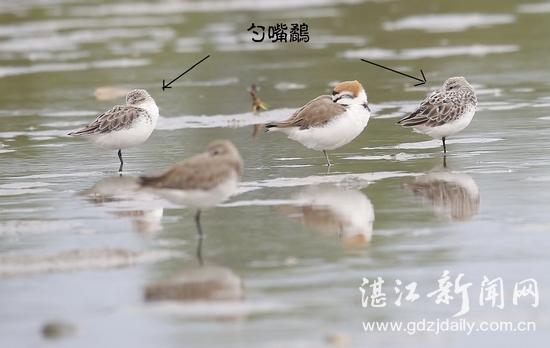
In March, when the weather warms up, it's the season when a large number of migratory birds return north. The Zhanjiang Mangrove National Nature Reserve continues to do epidemic prevention work while still vigorously carrying out the 'Love Birds and Protect Birds' action, strengthening wild field patrols and monitoring, and giving all-out support to the spoon-billed sandpiper, which travels over 7,000 kilometers from the frozen lands of Siberia to China's southern coast for wintering or transiting, and is now fully prepared for its return to breeding grounds.
On March 17th, with a light mist and drizzle, 34 spoon-billed sandpipers gathered on the beach of the Zhanjiang Mangrove National Nature Reserve to forage. They gathered and dispersed, frequently diving into the shallow water with their spoon-like beaks, or quickly running across the mudflats, almost frantically feeding themselves in preparation for their return migration. Monitoring personnel said: ‘For the extremely endangered spoon-billed sandpiper, such a large number, accounting for nearly 10% of the global population, is extremely rare, truly a feast for the eyes.’
Editor: Su Bi Yin, Review: Luo Lei

Spoon-billed sandpiper flying.
In the coming days, the protection area intensified its wild monitoring and patrol, and as much as possible, recorded spoon-billed sandpiper’s feather changes and behavioral characteristics before migration. Monitoring personnel found that spoon-billed sandpipers before migration became very sensitive, so monitoring personnel maintained a certain distance to observe and record them. At this time, most of the spoon-billed sandpipers showed obvious signs of breeding plumage on their chests and necks and wings, their calls became more frequent and dense, and they would spend a long time preening their feathers or resting on the mudflats. ‘Seeing such interesting migratory behaviors is a matter of luck, and it’s not easy to encounter. According to the weather forecast in recent days, the wind direction is also suitable for the migration of spoon-billed sandpipers.’ Dr. Cai Zhiyang, a bird ecological expert at South China University of Technology, after receiving feedback from the protection area personnel, said so.
Editor: Su Bi Yin, Review: Luo Lei

Spoon-billed sandpiper preening.
Among the flock of spoon-billed sandpipers, 10 with coded rings had spent a whole winter season here. In particular, the 87 light green spoon-billed sandpipers, which were first discovered in the autumn of last year and have been staying in the area for 179 days since then. There was also the M4 light green spoon-billed sandpiper, which has been traveling thousands of miles every winter since 2016, always arriving on time, and never missing a beat. It is clear that the Zhanjiang Mangrove Nature Reserve plays an undeniable role and status as a wintering ground or transit station for spoon-billed sandpipers, which also reflects the good results of the protection area’s scientific research monitoring and management work over the years.
This group of spoon-billed sandpipers has completed their wintering and has begun their northward journey home. But the protection area’s mission is always ongoing, ‘Spring grass will be green next year, and the master will surely return, we will meet in the autumn.’ said the protection area staff.
Editor: Su Bi Yin, Review: Luo Lei