Cute Seahorses
Hippocampus, also known as seahorses, is a collective term for several small fish species belonging to the genus Hippocampus within the family Syngnathidae. It is a small marine animal with a length of 5-30 centimeters. Named for its curved head and near-right angle body, the head resembles a horse's head and forms a corner with the body, with a long snout, a small mouth, and a single dorsal fin composed of spines. The eyes can independently move and function.
Seahorses move slowly but efficiently capture fast-moving, camouflaged stalker crustaceans. They are found in the Atlantic Ocean, Europe, the Pacific Ocean, and Australia.
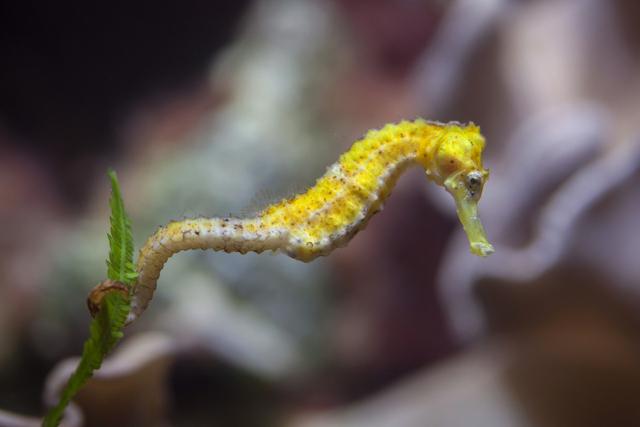
Seahorses have a laterally flattened head, with two nostrils on each side of the head. The head's curvature and near-right angle body create a bulky, laterally compressed body that is completely encased in a bony armor. The mouth is pointed and tube-shaped, and cannot close, so it can only suck small aquatic animals for food. The eyes can move independently in all directions. The chest and abdomen are protruding, and the body is composed of 10-12 bony plates. The tail is long and four-sided, with a tapered end that can be curled, often in a curled state. The head is curved and forms a large blunt angle or right angle with the body, with a protruding crest on top, with small spines at the crest end. The snout is tube-shaped. The mouth is small and terminal. The gill slits are small. The entire body is covered in membrane bones. There is an unarmed dorsal fin, no abdominal fin and no tail fin. The dorsal fin is located between the trunk and the tail. The pectoral fins are short; the pelvic fins are developed. There is no tail fin. Its fins are not easily noticeable with the naked eye, but can be seen with high-speed photography, focusing on observing the movement of individual spines. These spines can move back and forth seventy times in one second. Based on the waves transmitted from the end of the dorsal fin to the other end, the seahorse uses this to move forward or backward. Males have a brood pouch (also known as an egg pouch) on their abdomen, in front of or on the side, in which the eggs are incubated. During mating, the female releases eggs into the brood pouch, and the male incubates the eggs until they develop into young seahorses, which are then released into the sea.
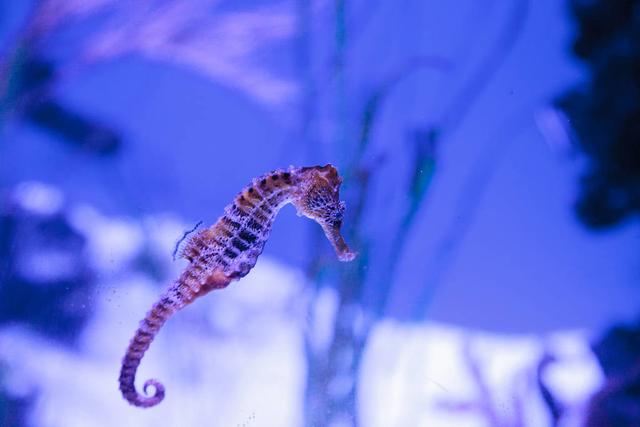
In the middle of all fish species, the seahorse is unique in that it has a curved neck and a long, tubular snout. The seahorse's overall appearance, combined with the absence of a tail fin, makes it one of the slowest swimmers on earth. They swim slowly, usually like seaweed, by attaching their tail to the seabed.
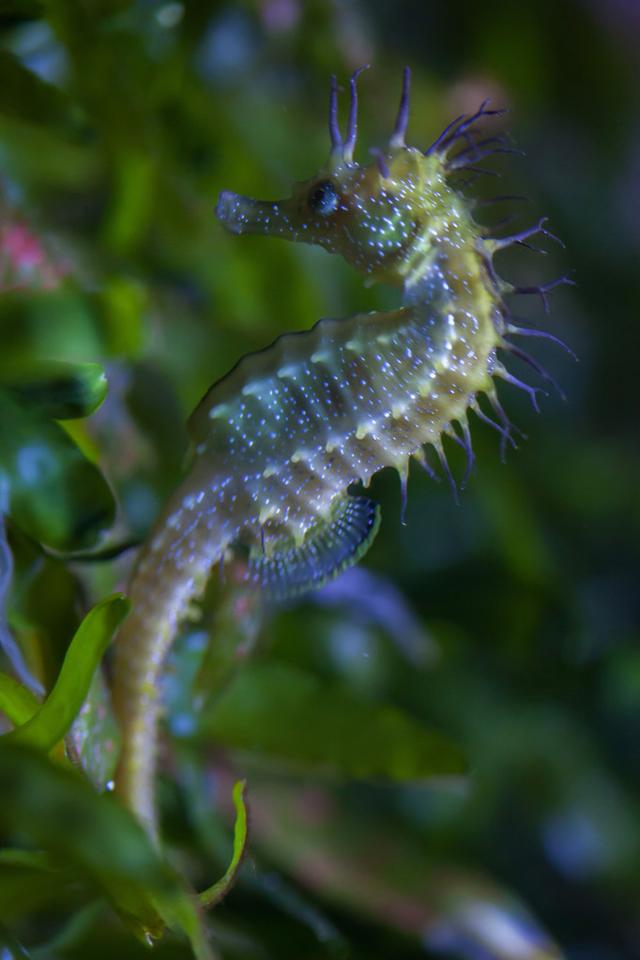
Because all marine animals eat stalker crustaceans, they are extremely sensitive to the water movements caused by approaching predators. When stalker crustaceans sense an approaching enemy, their swimming distance can exceed their length by 500 times in one second. In comparison, the cheetah, which is renowned for its rapid speed, can only move at 30 times its body length in one second. However, the seahorse. Seahorses must use their arched necks as springs to capture prey by twisting their heads forward, which limits their effective capture range to about 0.1 cm, which is the length of their snout. However, seahorses can use the special shape of their heads to quietly approach prey and capture it successfully with a success rate of more than 90%. The seahorse's mouth is at the end of its long snout, and when it moves towards prey, the water near the snout barely moves, so it can quietly approach the opponent and successfully capture it. Seahorses are very efficient at capturing prey. Seahorses can consume a large amount of food at once and have a strong resistance to hunger, from newborn to adult, resistant to hunger for 4-132 days.
The movement of the seahorse's tail and other fish species are quite different. When the seahorse is resting, the seahorse uses its tail, which can be curled, to attach its tail to the stem of the seaweed. So, seahorses often live in deep-sea seaweed. The seahorse's swimming posture is also special, with the head facing upwards, the body slightly inclined to the water, and the seahorse relies on its dorsal fin and pectoral fin to move, the fan-shaped dorsal fin plays a role in wave propulsion. Seahorses and seahorses are distinguished by their female and male, the male has a brood pouch (also known as egg pouch), while the female does not have a brood pouch.
Male seahorses do not play with their children, but they excel in one aspect compared to human fathers—after giving birth. Seahorses are the only animals in which males incubate their young. Seahorses have a brood pouch on their abdomen, in front of or on the side, in which the eggs are incubated. During mating, the female releases eggs into the brood pouch, and the male incubates the eggs until they develop into young seahorses, which are then released into the sea.
Male seahorse have a brood pouch on their abdomen, in front of or on the side, in which the eggs are incubated. During mating, the female releases eggs into the brood pouch, and the male incubates the eggs until they develop into young seahorses, which are then released into the sea. The male seahorse incubates the eggs in the brood pouch until the young seahorses are ready to emerge. The male seahorse incubates the eggs in the brood pouch until the young seahorses are ready to emerge. The male seahorse incubates the eggs in the brood pouch until the young seahorses are ready to emerge.
50030
0.190%
1
10%4132
———
5-850-608-9