Ocellaris Clownfish
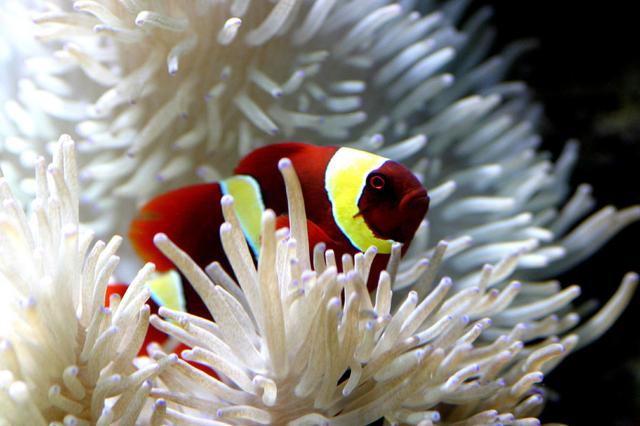
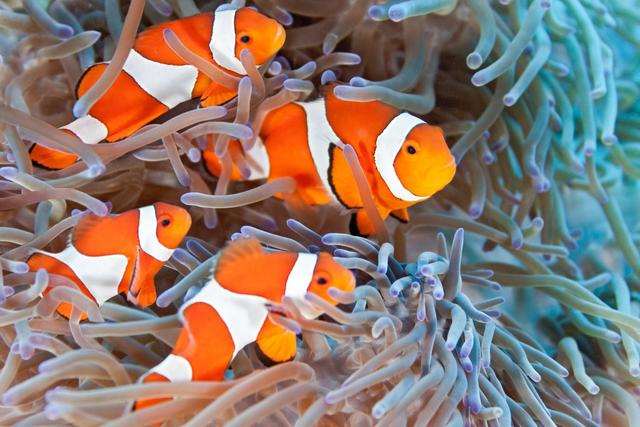
Clownfish is a common name for marine species of the subfamily Pomacentridae, sea bass, due to the one or two white stripes on their faces, named after the clown character in Chinese opera. It is a tropical saltwater fish. There are 28 species, one of which comes from the genus Premnas, the rest come from the genus Amphiprion. Clownfish and anemones have a close symbiotic relationship, so they are also called anemonefish.
Environment: Reef fish; non-migratory; non-migratory; marine; depth limits 155m
Climate: Tropical; between north latitude 25 degrees and south latitude 35 degrees
Importance: Fisheries, low economy; aquariums, commercial
Responsiveness: High, the breeding time of the group doubling less than 15 months
Biological characteristics: Live in coral reefs and rocky reefs, the fry often coexist with large anemones, sea urchins or small coral tops. Form small groups to large fish schools, the contents in the stomach include algae, animals and other planktonic crustaceans
Reproduction method: oviparity
Diet: omnivorous
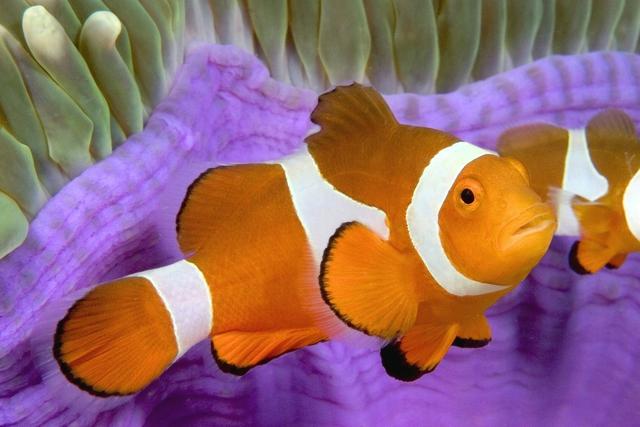
Clownfish is not the only hermaphrodite animal, but it is one of the few species in which the male can become female, and the female cannot become male. Each clownfish population has a dominant female and several adult males, which are sexually dimorphic in their youth. If the dominant female dies, one of the adult males will undergo hormonal changes and transform into a new female in the population. During the breeding period, the males and females have a nesting and guarding behavior. The one end of its eggs is fixed with fine hairs on the stone, and it takes about one week to hatch, and the fry floats in the water layer for a period of time before choosing suitable groups for growth, and after adaptation, they can live together. It is worth noting that clownfish cannot live in every anemone, only in specific objects can live; and clownfish can still survive in the absence of anemones, just lack protection
Clownfish has a special mucus on its body surface, which can protect it from the influence of anemones and safely live among them. Because of the protection of anemones, clownfish are safe from attacks by other large fish, and the remaining food provided by anemones can also supply clownfish, and clownfish can use the tentacles of anemones to build nests and lay eggs. For anemones, they can attract other fish to approach by means of the free movement of clownfish, increasing the opportunity for predation; clownfish can also remove dead tissues and parasites from anemones, and because of the movement of clownfish, debris will not settle in anemone clusters. Clownfish can also use the friction between its body and the tentacles of anemones to remove parasites or fungi from its body.
Clownfish lay eggs in anemone tentacles, after hatching, the fry lives in the water layer for a period of time before choosing suitable groups for growth, and after adaptation, they can live together. It is worth noting that clownfish cannot live in every anemone, only in specific objects can live; and clownfish can still survive in the absence of anemones, just lack protection
Clownfish is a very territorial species, a pair of male and female fish will occupy one anemone, preventing other members of the same species from entering. If it is a large anemone, they will allow some young fish to join in. In such a big family, the strongest physique is the female, and she and her male partner are dominant, and other members are male and juvenile fish that have not yet appeared. The female will chase and oppress other members, letting them only activity in the surrounding corners of the anemone. If the home female is gone, the original couple of males will turn into females within a few weeks, completely having female physiological function, and then it will take more time to change external features, such as shape and color, and finally completely turn into females, and there will be a strongest tail among the other males become her partner.