The Fantastic Drift of the Chameleon
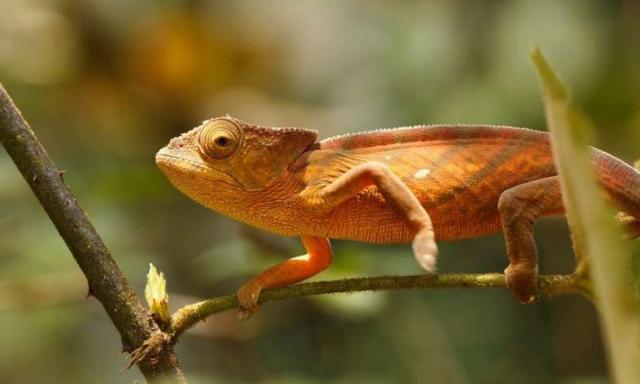
Chameleon
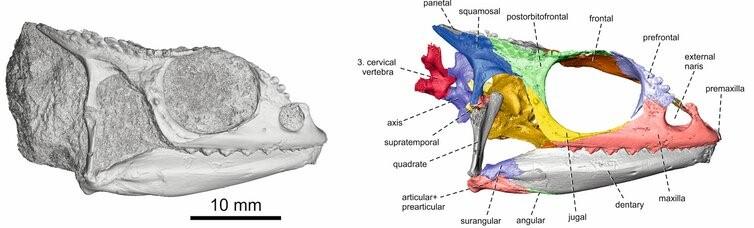
Calumma benovskyi skull CT scan image
Chameleons are a group of unique lizards, they have some unusual features: the tongue can quickly pop out, the toes have two pointing forward and two pointing backward, the tail can wrap around, and each eye can independently rotate. Most species can change their skin color.
There are about 213 species of chameleons worldwide, distributed in Africa, the Middle East, southern India, Sri Lanka and the Mediterranean region of Europe. About half of the species live on the island of Madagascar, so the island is considered a biodiversity center for chameleons. People have always believed that chameleons originated in Madagascar, they rafted on trees and spread to the African continent by ocean currents.
However, how these lizards spread worldwide and how they evolved is little known. Fossil records are the only direct evidence of their early evolutionary history, but they are very scarce. In 2013, a study found that chameleons did not originate in Madagascar, but in Africa. However, the study lacked a key piece of information—fossil records, which matched the location and date.
Researchers discovered a chameleon skull fossil from Kenya in 1992. After study, they found a surprising result: this chameleon belongs to a genus that currently only exists in Madagascar. Chameleons may actually have originated in Africa. Evidence shows that at the time, ocean currents flowed towards Madagascar, and animals could raft to the island by wood.
This fossil comes from Kenya's famous fossil site of Rusenga Island, which is one of the oldest chameleon fossils and the only well-preserved mid-late Middle Ages specimen (about 18 million years ago). Researchers used CT scanning to carefully examine the skull, including the bone, surface and bone sutures, to determine which species it was closest to. Finally, it was found to be a new species within the genus Calumma. All existing species of the genus Calumma are endemic to Madagascar, this fossil proves that the genus once lived on the African continent.
When this chameleon fossil was alive, Madagascar was in a position similar to Africa today, it separated from Africa about 150 million years ago in the dinosaur age. The endemic species on Madagascar lived in Africa during the mid-late Middle Ages, which may be surprising, but other endemic species on the island (such as lemurs) also had similar situations, fossil records show that lemurs also originated from the African continent. It is believed that animals rafted to Madagascar from the mainland by wood. However, why not drift to the African continent?
From the late Middle Pleistocene to the late Middle Ages (about 50 million to 150 million years ago), ocean currents tended to flow from the African continent to Madagascar, so chameleons may only spread to the island from Africa. Studies have shown that shortly after the end of the Middle Ages, the ocean currents between the African continent and Madagascar turned. Therefore, starting from the Middle Ages, it was impossible for swimming animals to reach Madagascar by ocean currents. Madagascar's isolation from the mainland led to the further evolution of its terrestrial animals and the development of unique biodiversity. These chameleons continued to spread and evolve on the island, resulting in many different endemic species.
The research results challenge the long-held view that chameleons originated in Madagascar, spread to the African continent, it provides strong evidence for the African origin of some Madagascar branches.
Compilation: Light wire Review: A Miao Editor: Tang Lingfang
Original link: https://phys.org/news/2020-02-kenyan-fossil-reveals-chameleons-rafted.html
Copyright statement: This article is compiled by the Science World platform, Chinese content is only for reference, all content is subject to the English original version. Please indicate the source when reprinting Science Worker's Home - Sci-Fi App.