Following the Midline in Tai Chi
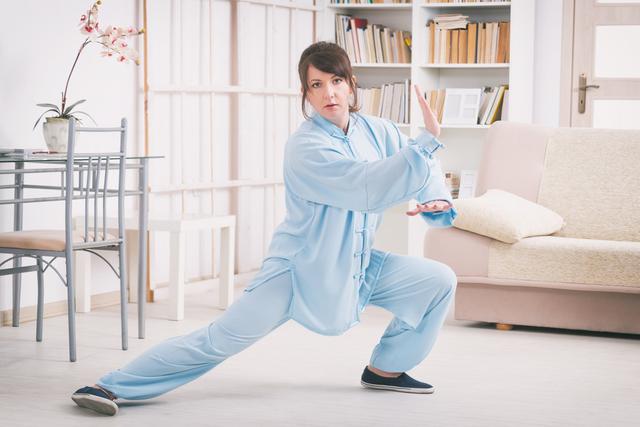
The teacher often mentioned the Baihui point, the Shenmen point, and the Haishi point when practicing Tai Chi. When practicing, these three points should be on the same line. This line is the midline of the body. When practicing Tai Chi, the hands should follow the midline:
1. This can also serve to protect yourself, and at the same time, you can immediately attack the opponent because the original purpose of Tai Chi was to use skill.
2. The hand follows the midline, the power is complete, not scattered.
The overall midline movement of the body, center to achieve.
The midline is the Baihui, Shenmen and Haishi, this is the center line of the human body. The principle of the midline has two concepts. First, the midline between the two sides of the enemy and the self. The defensive range does not deviate from this midline too much. If the opponent loses control of the midline, you can immediately attack. In the relative opposition, it should maintain a sideways stance, that is, not give one front and not give one side.
So even if you don't make a movement, the straight attack of the opponent will hit on a slant. Secondly, assuming that two people's height and arm length are exactly the same. The speed is the same. If you attack with the same move, the two people will certainly hit each other. There is also a center line between the two people. Martial arts are simple, very simple. It is how to quickly occupy the midline, hit the opponent, and not be hit by the opponent. The following requirements need to be stated:
1. Overall midline displacement
The midline is the natural gravitational line of the human body, which is the gravitational line that concentrates on the human body's point of mass (center of gravity) due to the Earth's gravity. Since the human body has symmetry, this line passes through the human body and is located in the central position. The purpose of centering is to maintain balance and stability at the same time, and to control the opponent's center of gravity so that it is unstable (pull the root), so when exerting force, you can do whatever you want.
Push hands when practicing, the overall midline displacement with the midline axis rotation, can maintain the state of overall unity, and can very skillfully resolve the opponent's incoming force and momentum. This is consistent with the requirements of centering, because centering is not the intention of the body to be fixed and cannot move, but rather, the intention is to keep the earth undisturbed – the movement of the center of gravity should be as small as possible, and when centering, the overall unity of centering is the state of overall unity, and with the help of terrain inward force to defeat the opponent. However, the overall midline movement (forward, backward, left shift, right flash) can be extremely flexible in the real practice.
2. Midline axis rotation
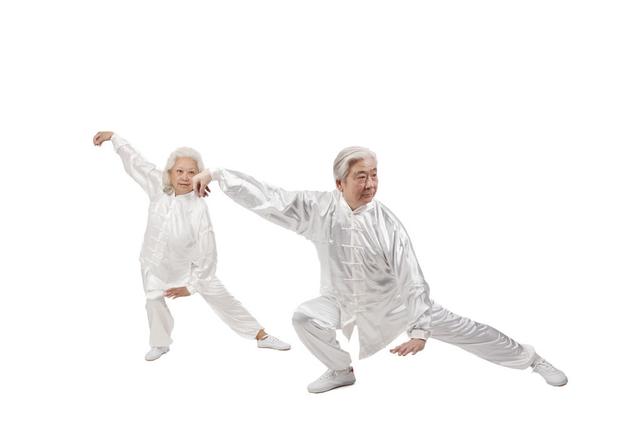
The rotation here should not be limited to 'one up and one down, relying on the left and right turns'. The correct posture of Tai Chi is: Baihui leads the way, elevates the neck, holds the throat, the vital point is slightly bulging, the waist spine is straight, the chest is relaxed, the hips are circular, the knees are rounded, the ankles are bent, the tailbone inserts downwards; here, it is not 'Baihui - Haishi' a vertical line of absolute 180 degrees on the ground, but to emphasize 'tailbone - the inner side of the two feet' a vertical line, one foot is completely false (such as kicking the foot), the tailbone points to the other foot's heel, at this time, the tailbone plays the role of a, slightly adjusts the direction of movement. Note, when rotating, do not shift the midline, otherwise the shape will be scattered.
3. The principle of circular cutting and force transmission
In Tai Chi practice, circular cutting and force transmission is the most ingenious way to transmit force, far more ingenious than using a lever to hit a bad concert player. When practicing push hands, fuse with the opponent, no matter whether you succeed in hitting or not, focus on the Dao, and the two people are enclosed in an invisible circle, and you are also a hollow circle. Wherever you hit the opponent, the point of incoming force and momentum should be at the circular cutting line, whether it is a local arc or a whole circle, the principle is the same. The circular cutting line force transmission can rotate and transmit force, determined by the deviation of the opponent's incoming force and momentum.
Whenever rotating, you must follow the principle of the midline (tailbone) axis rotation. The circular cutting line force transmission is like letting a bad concert player hit not the center of the white concert player's ball, but the cutting line of the ball. On the Dao, you cannot deviate to the left or right, and the consciousness must be evenly distributed around the surface of the skin, absorbing and transmitting the opponent's force. When you hit, you can know the opponent's subtle changes, and the intention will be broken.
The human body can be divided into several Tai Chi balls, and the local transmission of force must obey the overall transmission of force, and can only play a limited role in the local force transmission. Therefore, it must rely on timely and effective counter-transmission of the opponent's force path. Only the overall circular cutting line force transmission can be empty, and can transmit force quickly, or to the opponent's (such as using index fingers to press the back of the spine) two pounds of force can be used to defeat it.