Biodiversity Encyclopedia: Large Green Stink Frog – Don't Provoke Me, Beware of My Foul Attack
Today, we're going to introduce you toSpine animals · Large Green Stink Frog.
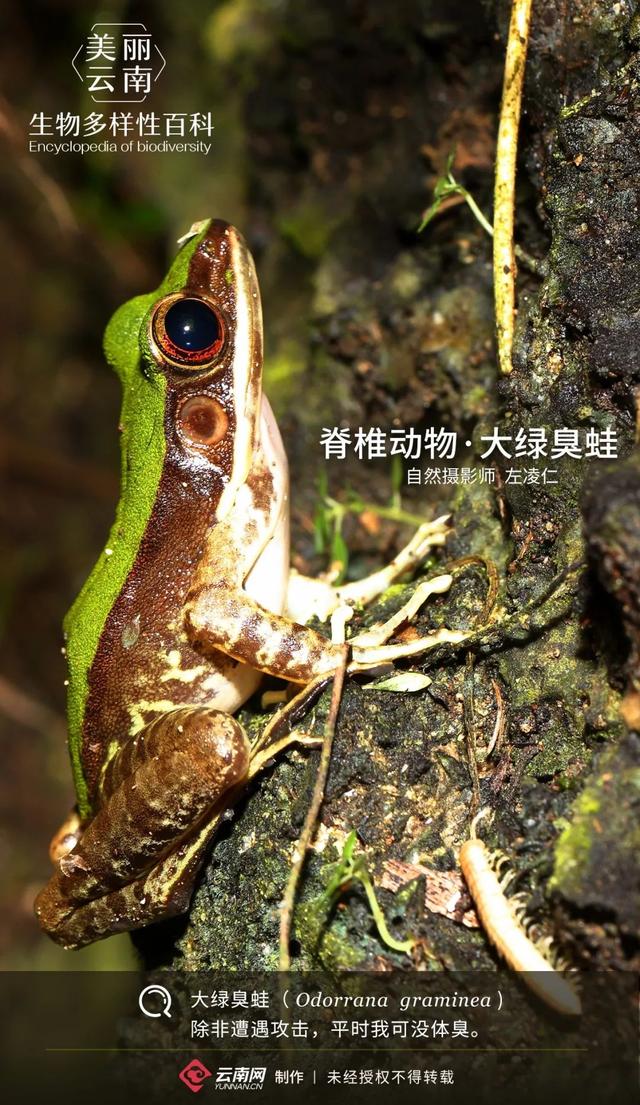
Large Green Stink Frog
Odorrana graminea
Vertebrates, Amphibians, Caudata, Anura, Stink Frog Tribe. Commonly known as frogs, field frogs. Inhabits forests with dense vegetation in mountainous streams and nearby areas at an altitude of 450-1200m, with a wide distribution in China. Photo taken at Hong River Mouth South Stream River.
Like all frogs, the Large Green Stink Frog undergoes complete metamorphosis in its life cycle, experiencing three forms: egg, tadpole, and adult frog. During the tadpole stage, the total length averages 34mm, the head is a slender oval, and when viewed from the side, it is flat, with small dark spots on the tail.
When the frog grows into an adult, the Large Green Stink Frog shows its beauty. The skin is smooth, the back is pure green or emerald green, the abdomen is white, the sides are light brown, and the limbs have brown-brown transverse stripes. Some individuals have irregular brown-brown spots. The overall color combination is very beautiful and pleasing to the eye, quite attractive.
The Large Green Stink Frog is a nocturnal animal. During the day, it hides under rocks by streams or in the leaves of nearby dense forests. At night, it often squats on rocks exposed above the water or on rocks by the stream. Its diet is diverse, and it can capture smaller arthropods or other frogs. Female frogs are significantly larger than male frogs. Male frogs have a gray-white nuptial pad on their first finger and a tympanic membrane on their side of the throat. The breeding season is from late May to June, with female frogs laying 2240-3724 eggs, forming egg masses that attach to rocks by the stream.
Stink frogs in the Odorrana genus do not usually emit a bad odor, but when captured, their skin secretes a smelly, irritating mucus. If you have cuts on your hands, you will feel a stinging sensation after contacting this mucus.
Little Science: Where are the frogs' ears?
I believe many of you have heard the croaking of frogs, but when asked if frogs have ears, you may hesitate. In fact, frogs have ears, but their ears only consist of a tympanic membrane and inner ear, without an outer ear. Please carefully look at today's science photos, the small circular gleam behind the frog's eyes is the tympanic membrane, just like our human ear membrane, it can receive external sounds. According to academia, the frog's tympanic membrane is connected to the lungs, so the pressure inside and outside the tympanic membrane can be balanced, so the frog will not be disturbed by its own croaking.

Left Lingren, nature photographer, special editor of National Geographic China, long-term shooting of domestic wildlife and plants, dedicated to expressing the beauty of biodiversity.

Click the picture to enter the topic