Ten Thousand Waters and Thousands of Mountains Only Wait Patiently? How Did Swarms of Desert Locusts Easily Cross the Sea and Ocean to Rampage in South Asia?
Perhaps the 30-mile strait would deter bridge builders or submarine tunnel constructors, even deter the ambitions of the Nazi Empire, but it would not prevent the terrible footsteps of the desert locusts.
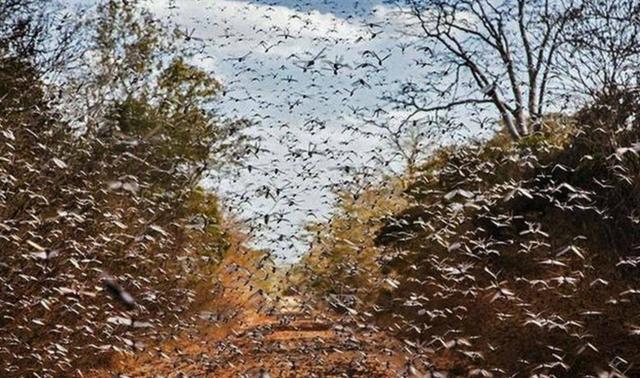
Although these timid and sluggish little creatures are usually inconspicuous and their adults are no more than a few centimeters long, their weight is only two grams, but once they gather together, they will become a veritable disaster, especially this time's invasion of the Indian subcontinent and East Africa.
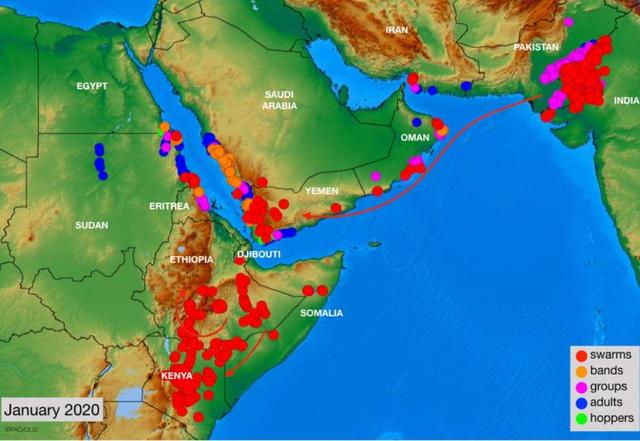
From the map, the locusts traveled thousands of miles from East Africa to the Indian subcontinent, crossing the Arabian Peninsula, Iran Plateau and other complex land terrains, and also crossing the Red Sea, the Arabian Sea and the Persian Gulf series of sea areas.
So the question is, although the land terrain is complex and diverse, it can at least land and rest, and the ground vegetation can provide a lot of food for the locusts. But how can the ocean be crossed? It seems to be an insurmountable barrier.
However, as seen by Quiet Night Show, the shallow sea is not enough to obstruct the locusts, because the factors that help them drift across the ocean to eat food in India are too many, such as:
1Desert locusts are suitable for long-distance migration
As one of the most dangerous types of locusts, desert locusts threaten more than 1/10 of the world's population, their disasters have affected Africa, the Middle East and Asia for hundreds of years, and are a headache for mankind.
And desert locusts are not scary because they look unsightly and their beauty is not high, but because they live in arid climates such as deserts, their tolerance to extreme climates is far greater than that of other locust species.
More importantly, they can eat a lot, even for the purpose of sucking moisture from vegetation, they eat whatever they can, which means that when desert locusts pass by, the vegetation is basically not left,
And besides being able to eat, because they grow in the tropics, they can reproduce extremely well, with an average of at least 2-5 generations per year, which makes their disaster scale not only large but also long-lasting.
Desert locusts are widespread because they can eat and reproduce, and also because they are very suitable for long-distance migration, after all, since they live in deserts, their endurance is correspondingly stronger.
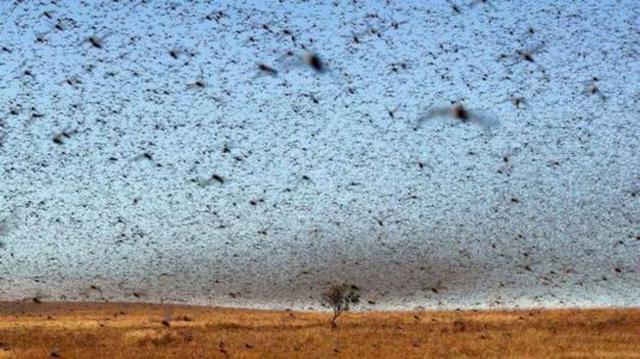
With suitable migration characteristics, desert locusts can fly across the Red Sea without difficulty. When they migrate in groups, their average daily activity time is about 8 hours, and their migration distance averages 150 kilometers, which means they can eat a meal and fly from Africa to Asia.
Desert locusts have the most glorious achievement in history in 1987-1989, 'ten-day locust plague', these locusts crossed the Atlantic Ocean to the Caribbean region of America, which shocked the world.
2The locust plague is not only in East Africa
Although this 25-year locust plague has been named 'African locust plague', the highlights of the locust plague are not only in Africa.
In general, due to the overall altitude is higher and the climate is drier in Africa, so it also corresponds to the most frequent areas of locust outbreaks, especially the Sahel region between the Sahara Desert and the Sudanese Grassland.

But the initial source of this locust plague came from the Rub' al Khali Desert in southern Arabia in 2018. In May 2018, Hurricane Mekunu, originating from the Indian Ocean, unexpectedly landed in the Arabian Peninsula, which brought rare rainfall to the desert. In October, Hurricane Luban also landed, and the southern coasts of the Red Sea and the Persian Gulf appeared again, bringing rainfall.
Desert locusts, as one of the locust families, their survival environment has a ground vegetation coverage rate less than 50%, the soil moisture humidity is 10% ~ 20%. When there are a lot of rainfall in the desert, the vegetation has grown wildly, which provides a lot of food for locusts, and the number of locusts has increased a lot. When the rainfall ends and the climate returns to dryness, the locusts gradually gather with the recession of vegetation, and when the posterior leg's sensitive nerves are stimulated, these desert locusts will quickly transform, and then through mutual dissemination of pheromones, the scale of the locust swarm becomes larger and larger.
After the Rub' al Khali locust plague broke out, it quickly spread to eastern Iran and western East Africa.
And although they are not from the same place, they also have accents, but they have the same desire for food and the attraction of pheromones. So the locust swarm spreading is like a signal, igniting the locust plague, especially in East Africa.
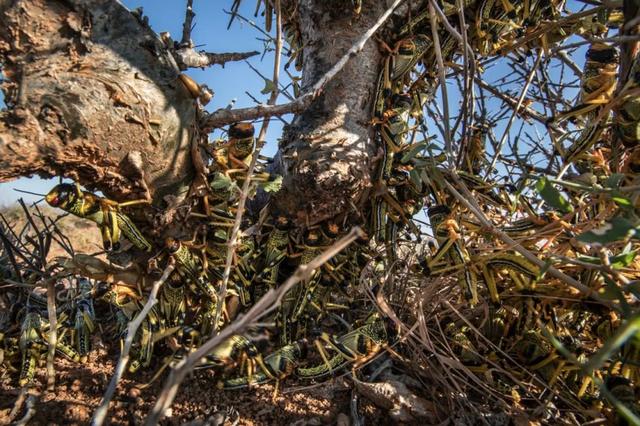
So the locusts that appeared in India are not only from Africa, but also from almost all locust plague areas along the way, perhaps many locusts died in flying across the Red Sea, but the number will not decrease.
3Climate factors amplify the situation
As a small insect weighing only two grams, it can fly across the Red Sea and cross the Atlantic Ocean, theoretically, without other support, it cannot complete such a feat solely relying on strength.
So desert locusts basically fly by wind.
But the problem is that it's currently the winter in the Northern Hemisphere, whether in South Asia or West Asia is affected by the northeast monsoon, in this case, the locusts can only fly to West Africa to eat cacti, and cannot reach South Asia.
Although the northeast monsoon or northeast wind is weaker or disappeared, the vertical air circulation will be particularly strong. And because the locusts' activity time is basically during the day, this means that the locusts can use air currents to reach a so-called gliding height.
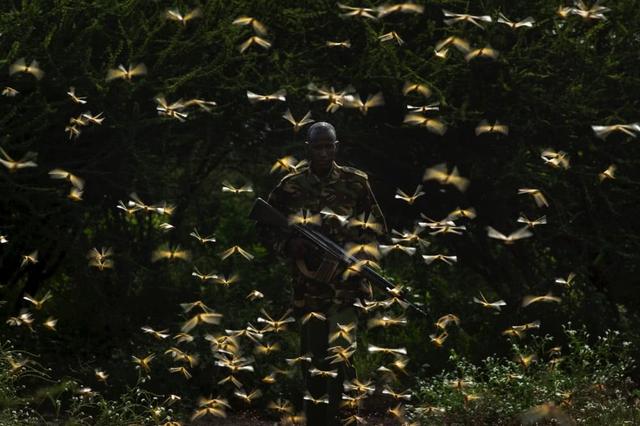
Generally, the maximum flight height of desert locusts is 2000 meters, at this height, air resistance is obviously smaller than on the ground, and it can cross the Red Sea without difficulty.
And because the locusts are not from East Africa, even when flying across the Red Sea, they can cover the sky.
There are many omissions, please correct the mistakes.
I am Quiet Night Show, looking forward to your attention.