Nature Sometimes Shows a Little Hand
I used to think that an Antarctic adventure was pretentious.
According to our usual perception, there is strong wind and big wave, and it's freezing, but it's just a misfortune. Most of the time, there is no danger. After all, the most common creatures there are penguins, seals, sea dogs, albatrosses and whales, and they are mostly docile. Especially the first three, they are very flexible in the water and lazy on the shore, as long as they don't get angry, they can stay at a distance to take pictures and make shadow. Of course, don't use flash.
However, nature always likes to show a little hand at an unexpected moment, to teach such rational people like me who boast of being rational and arrogant and ignorant.
Being rammed by a little penguin was unbelievable
Penguins are always so cute and adorable, especially on land. They take two steps and stumble, then bounce, adjust their chubby bodies, shake their feathers, and continue walking. Even when they are angry, they will stretch their short legs, open their small wings, and put all their effort into it, it seems that they can't run as fast as a chicken. Moreover, they often fall head over heels and need to struggle for a while before they can crawl up. So, based on my limited experience of observing penguin fights, penguin fights are not about winning or losing, they usually end with one side falling down.
However, penguins are not without anger.
There is a research station called 'Werder' at the north end of Paradise Bay. Due to the relatively warm climate, the island has become a home for chinstrap penguins.
According to the standard Antarctic exploration procedure, we need to avoid penguins throughout the entire Ross Sea. However, due to the penguin density on the island, 5 meters is impossible, and 2 meters is already the limit. So we can only execute the second plan, when there are penguins approaching, we stop in place and slowly squat down. After all, the size of chinstrap penguins is very small, they can only exceed people's knees, for them, humans, who are 'big masses', their visual impact is still quite strong. So, from the beginning of the landing, we all knelt down…
I thought kneeling was a solution, but it wasn't. Just me, I took a photo, turned around, and at a distance of about one meter, a little penguin was trying to look up at me. No need to say anything, just squat down.
Well, I know the little penguin probably doesn't want me to block its way, but heaven helps those who help others, I'm wearing such thick clothes, carrying such a heavy and cumbersome equipment, and I've been squatting for half a minute, my legs are already numb, it's difficult for me to let it pass, so I can only kneel.
Finally, the little penguin lost patience, it flapped its wings and opened its mouth, then turned an S-shaped, wobbled, and walked away.
After standing up, I rubbed my sore legs and asked my teammate, 'Hey, did that little guy just scold me?'
Friend confidently replied: 'It probably told you to scram!'
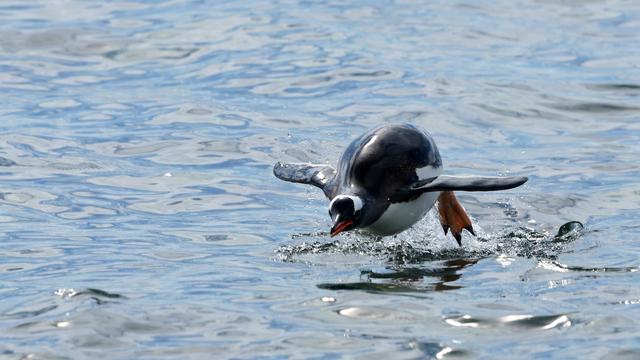
Being rammed by a little penguin. Photo by Han Xu.
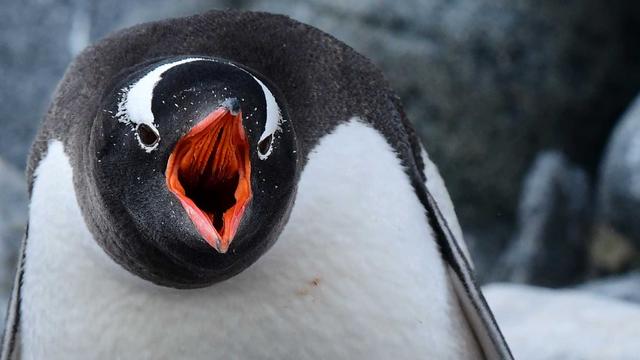
'Getting angry' chinstrap penguin. Photo by Han Xu.
Being scared by a whale calf
If you come to Antarctica and haven't seen whales, you must be regretting it; but if you see whales up close, the scene, gentlemen, please imagine it yourself.
That day, we were cruising in a speedboat in the Lemaire Strait. So-called cruising means sitting in a speedboat and drifting on the sea, encountering icebergs, turning around at a distance of 100 meters, encountering seals or whales, stopping quietly and waiting.
I don't know who was more and more fascinated, when we saw three whales playing in the distance, it was already a rare sight. More importantly, they were playing in the water, spraying water and waving their tails, and a lively whale calf jumped up in the air and flipped over, causing everyone on the boat to exclaim.
I don't know who it was that attracted the little whale, it stopped playing and slowly swam towards us, and its face, which was no less than the size of our speedboat, appeared suddenly. Well, it's okay, I admit that at that moment, I was only one step away from being terrified.
Still, I had to admit that the whale calf was just trying to scare me.
Still, according to the standard Antarctic exploration procedure, when we get close to wild animals, we should turn off the engine, maintain absolute silence. But this time, it was our expedition captain who broke the rules. The girl decisively opened low-speed engine, the speedboat slowly and steadily retreated, we watched as the whale calf slowly swam past us.
Fortunately, the whale calf didn't make another prank, it just let us be silent and left.
Later, I asked the girl, 'Why did you turn on the engine and didn't run away?' She said, 'Because the whale calf is a bowhead whale, it's curious, but it's very gentle, it won't attack us intentionally, it just wants to play with us.' However, considering the current situation, if we didn't turn on the engine, the whale calf might accidentally hit our speedboat; if we ran away too quickly, the loud noise of the engine might scare it, and it might turn and run.
So, turning on the low-speed engine has only one purpose, which is to tell the whale calf our exact location, so that it doesn't accidentally hit us.
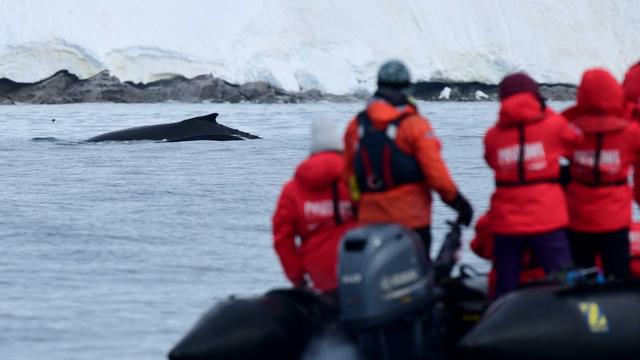
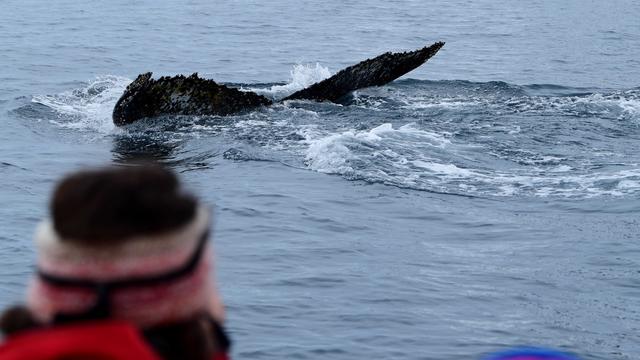
In the speedboat, observe whales up close. Photo by Han Xu.
Being rammed by a little penguin. Photo by Han Xu.
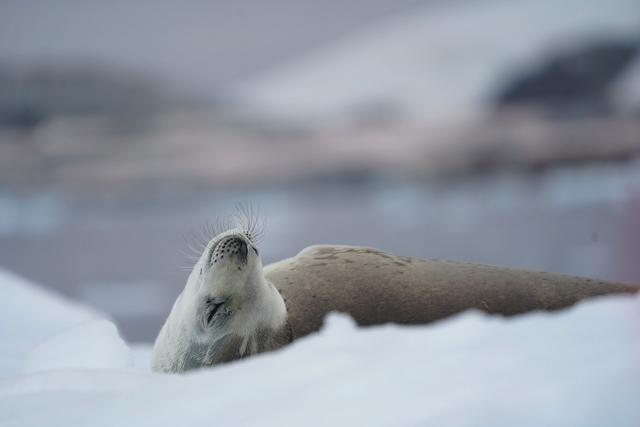
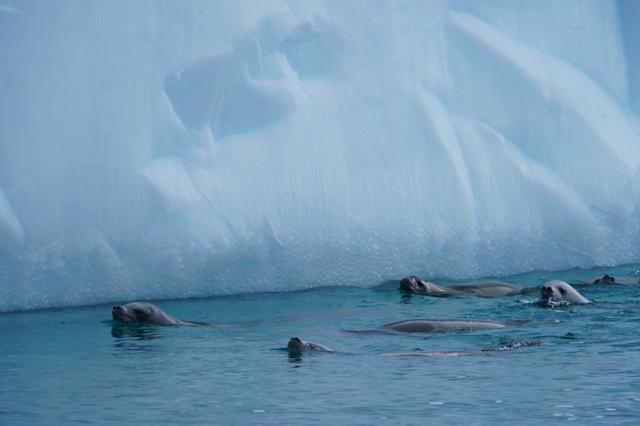
Seeing a large group of them is not difficult. We encountered a group of Weddell seals in the Lemaire Strait.
As one of the four most popular seals in Antarctica, seeing it is not difficult, but seeing a large group is not easy. We were lucky.
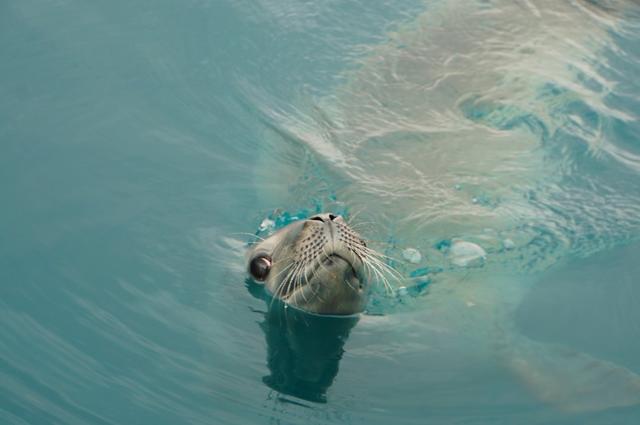
Weddell seals are cute. Of the four seal species in Antarctica, Weddell seals are undoubtedly the cutest. They are relatively docile, mainly eat fish, shrimp and squid, so they are relatively friendly to us, as mammals. Moreover, their calves are especially chubby and adorable, and you can often see them on the Internet, such as fluffy white calves are their babies.
We encountered a group like that.
I don't know why, about fifteen or sixteen Weddell seals were particularly interested in our speedboat. A group of little guys first circled around us, then stopped and surrounded us, our speedboat was full of smooth little heads. In the distance, a clearly younger calf was just learning to swim, so it was unsteady on the surface, only able to jump up and down like an uneasy little puppy.
Unfortunately, before our teammates could be fascinated, the seals suddenly ran away, leaving us with a trail of waves running against the waves and us still taking pictures.
Our expedition captain was very experienced. When the seals hadn't run away, our speedboat had already begun to roar.
The girl's teammates said, 'Grab on!' We immediately ran away. Until we returned to the cruise ship, the captain told us that the seals ran away so suddenly, it was probably because a predator had appeared.
In the speedboat, observe whales up close. Photo by Han Xu.