Common Tropical Fish – Neon Tetra
Neon Tetra (Paracheirodon innesi), also known as glowlight tetra or emperor tetra, is a freshwater ornamental fish belonging to the family Perchidae and the genus Paracheirodon. It is native to the upper Amazon River in South America. The body length is 3-4 cm, with a slender body shape and beautiful colors. The green line on the upper body may appear blue depending on the angle of light, and is coordinated with the red line below the body (from the ventral fin to the base of the tail fin). There are also neon red and green tetra (Paracheirodon simulans) with obvious differences. It is timid in nature, often quietly swimming in a quiet environment on the water surface. It feeds on live brine shrimp and is very easy to raise.
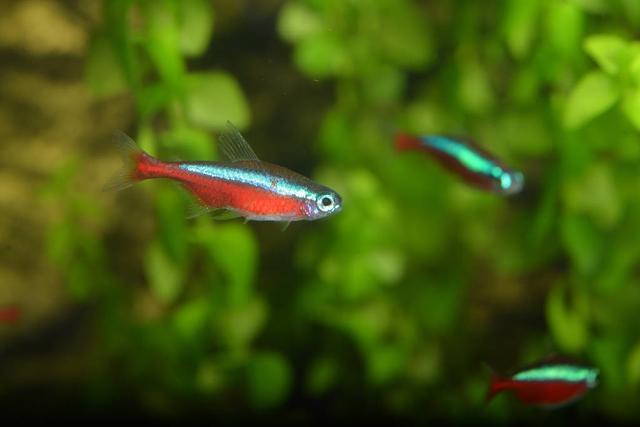
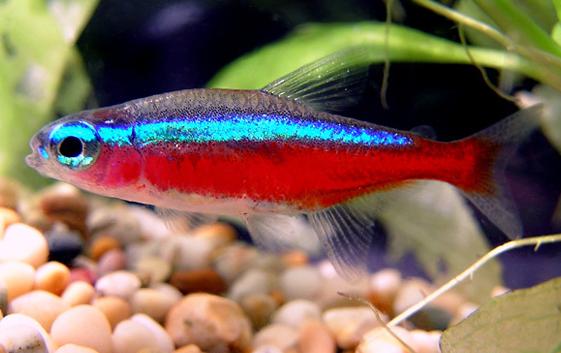
Neon Tetra's original habitat is the upper reaches of the Peruvian, South American Amazon River. The body length is 3~4cm. The body sides have a bright red stripe and a bright green stripe. The red stripe extends from the ventral fin center to the tail fin. The green stripe extends from the eyes to the back fin tip. The red and green stripes pass through the body, dazzling and brilliant. They swim in green and blue waters and grassy areas, like a few fireflies, beautiful beyond words. The neon tetra is one of the more famous varieties among tropical freshwater fish.
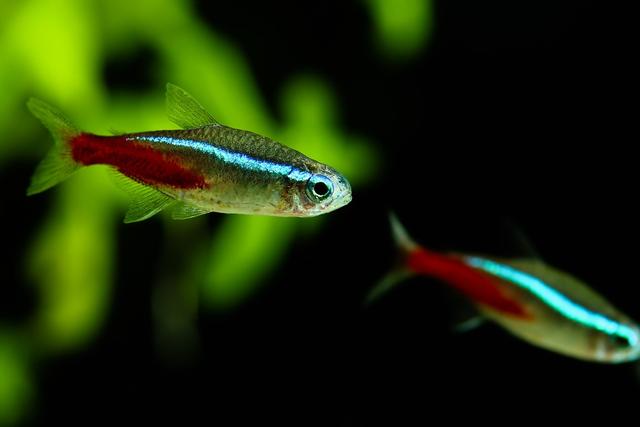
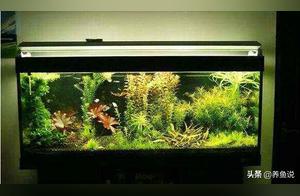
Neon Tetra's body color is vivid and luxurious, with an olive green back. The eyes are black, with silver blue eye rims with black edges, emitting green light. On the upper side of the side line, extending from the eyes to the tail fin, there is a pale blue neon color longitudinal belt, which is dazzling and brilliant. Above the longitudinal belt, up to the back, turns to black, and the longitudinal belt below the dorsal fin is silver white. There is a red stripe in the center of the back extending to the tail fin. The bright color belt varies with the angle of light, sometimes shows green, sometimes shows blue, coordinated with the red stripe up and down, and the silver dorsal fin, the color matching is just right, especially in the lighted nighttime aquarium with aquatic plants, dozens of neon tetras swimming together, forming a group, which greatly enhances the beauty of the aquarium with aquatic plants, like fireworks, with infinite charm and fascination, very lovable.
Neon Tetra's sex differentiation is mainly: male fish are thinner and longer than female fish, the caudal fin is sharp at the end, and the color is deeper; female fish are fuller in the reproductive period, the caudal fin is fan-shaped, and the color is lighter.
Neon Tetra reproduction is difficult, mainly due to the high requirements for breeding water quality and the special requirements for fry care, which is not suitable for beginners to try. Neon Tetras enter sexual maturity at 6 years old, and the best breeding period is 8-10 months. Female fish should be fed well for several days before pairing with male fish, and then paired into the box.
The breeding water quality requires pH5.6~6.8, GH1°~3.5°(tap water must be distilled or treated with ion exchange resin before use as breeding water), water temperature 25℃, and put in artificial fish nests (such as silk and gold silk grass). The breeding tank requires shading and maintaining quietness. One pair of female fish can spawn about 150 eggs. After spawning, the parent fish should be removed to avoid eating eggs. After 24 hours, the fry will hatch.
Fry feeding
Due to the small size and small swimming volume of the fry, the bait must be fed at the edge of the mouth. Using a 200-mesh net to filter the egg yolk water, and then feeding drop by drop with a tube, waiting for the fry to swim normally, and then change to 150-mesh net filtered egg yolk water. Because the fry grows slowly, the time for feeding egg yolk water is longer than other small varieties. In addition, the fry's hatching water is extremely soft and the water temperature is different from the daily breeding water. When the fry grows to 5mm, it should be moved to a large tank to allow the fry to adapt to the water quality.
6810
pH5.66.8GH1°~3.5°25℃15024
2001505