The World's Largest Deer – Moose
Moose: The largest deer species, belonging to the Cervidae family, the Moose genus contains two species and eight subspecies. The name 'moose' derives from the moose's elevated shoulders, similar to those of a camel. It is also known as Kandahar and Khadar in Mongolian, and 'moose' in North America, while 'elk' is used to refer to Canadian elk in Europe. Characterized by its distinctive male antlers. Moose is a typical subarctic boreal forest herbivore, living alone or in small groups, primarily active in the early morning and evening. Distributed across Eurasia and North America. Moose exhibit varying coat colors depending on their subspecies.
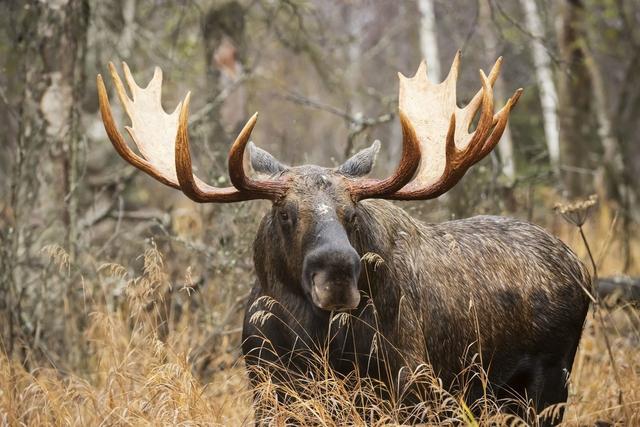
Moose is the largest and tallest land animal in the world (note: giraffe does not belong to the deer family), generally measuring 200-260 cm in length and 160-240 cm at the shoulder, taller than most rhinos; Chinese moose typically weigh 400-600 kg, but those from North America can reach 300 cm in length and weigh up to 700 kg, with a record of 1000 kg, a veritable giant among deer.
Its tall body resembles that of a camel, and its four long legs are similar to those of a camel, with its prominent shoulders resembling a camel's hump, hence the name. The moose's coat is uniformly brown-tan, darker in summer than in winter. The head is large, the eyes small, the face long, while the neck is short. The nose is large and drooping, with an elongated upper lip, 5-6 cm longer than the lower lip. It does not have upper incisors, unlike other deer species. Male and female moose have a fleshy pillar below their throat, covered with drooping hair called the 'gular pad', which is more developed in males. The body is short and bulky, appearing disproportionate to its four slender legs. The tail is short, only 7-10 cm long.
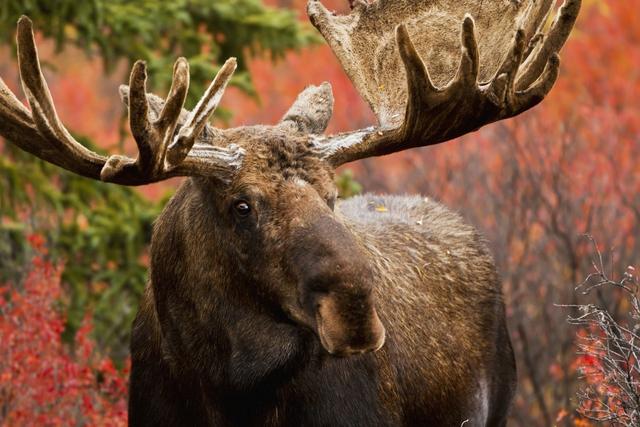
Male moose have antlers, which are the largest in the deer family, and have a unique shape that differs from other deer species, not branching like a fork, but a flattened shovel-shaped, the antler surface is rough, extending from the base of the antler to the sides in short segments, then branches out into brows and main branches, extending horizontally, wide in the middle, resembling a cactus, with many spikes appearing at the front one-third, up to 30-40 in number. Each antler exceeds 100 cm in length, with a maximum length of 180 cm and a width of about 40 cm, with a horizontal spread of 230-160 cm and a weight of 30-40 kg.
The number of tines on a moose antler is related to age; at 6-8 months old, they grow a new antler as a single branch, called a cone antler; the third year branches into two forks, and appears at the base a horn plate. In the fourth year branches into three forks, in the fifth year branches into four-five forks, and the sixth year or later does not show a regular pattern. The length and weight of the antlers increase with the number of tines, with a significant increase in the palm-shaped area. The antlers shed annually, dropping old antlers from mid-February to late March, approximately one month later, new antlers begin to grow. The antlers are bone-filled from the base during July-August, and fully bone-filled by September, and the velvet is shed in about a month.
Moose also change their fur annually, typically shedding winter fur from ears and nose in early April to mid-May, then the back and legs, gradually replacing them sequentially, the timing of this change differs depending on sex and age, usually the mature, heavy male moose is the first to shed fur, followed by calves and pregnant females, old and weak individuals may delay until mid-July.
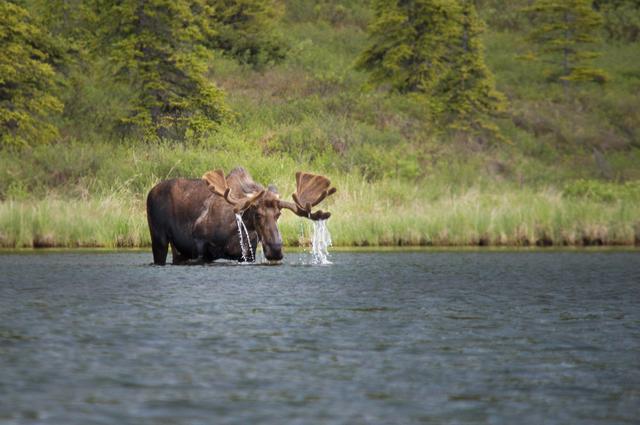
Moose is a typical subarctic boreal forest animal, inhabiting primarily in original coniferous and mixed coniferous-broadleaf forests. They often live in flat, low-lying areas of the forest, in forested swamps, and are never far from the forest, but they change with the seasons.
In spring, they are active in mixed coniferous-broadleaf forests, birch forests, mountain ash forests, and along rivers and lakes, in dense willow thickets.
In summer, they spend most of their time in river forests, burned areas, areas with dense thickets of shrubs and grasses, river bays, river valleys, marshy areas, and high grassy meadows, and old riverbeds, especially enjoying mountain streams, and areas with abundant succulent plants and marshes.
In autumn, they often roam in herds in forest clearings, forest edges, or forest swamps, or on the upper reaches of mountain streams.
In winter, they primarily inhabit north-facing slopes of willow-birch forests, willow thickets in marshes and thickets, and frequently gather in small groups in places with underground water openings.
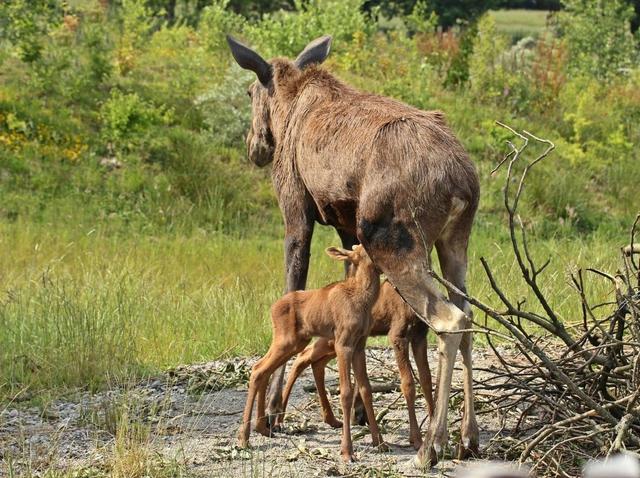
In harsh winters, moose often gather in small groups in places with underground water openings.
6055“”205-6
891010
“”“”
1-2242-250571270-8210-12“”“”610-141313-4