Zoological Encyclopedia: Bee-eater (Corythornidas): Don't Look! I'm Just a Bee-eater (Cyanocitta)
Today, we're going to introduce you toSpinal animals • Corythornidas.
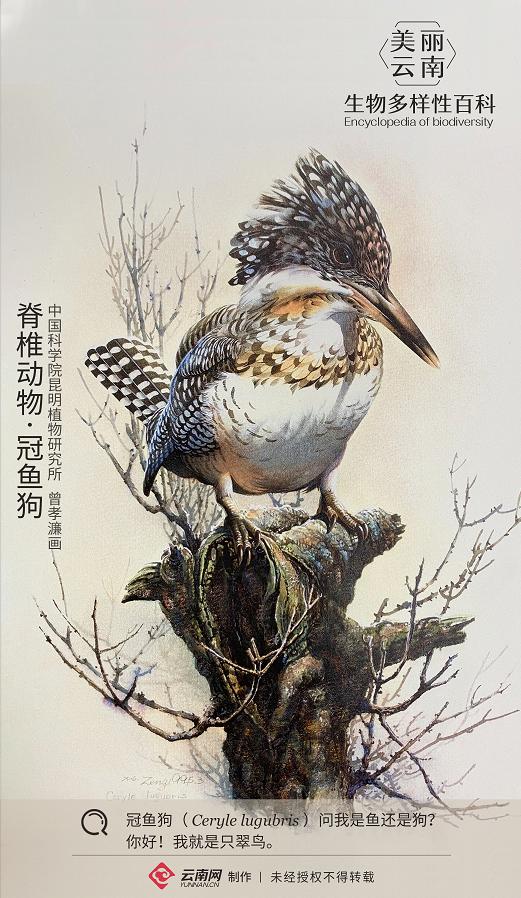
Corythornidas
Ceryle lugubris
Vertebrates, Aves, Passeriformes, Merops, Corythinae. Distribution in Hebei, Shanxi, Shaanxi, Gansu, Sichuan, Yunnan, Hainan, etc.
The first time many people hear the name Corythornidas, they won't associate it with the bee-eater. Corythornidas is actually a name recognized by academia, and its name has a long history. Li Shizheng's 'Compendium of Materia Medica' (Birds One • Corythornidas) already contains a record: 'Dogs, tigers, and teachers are those that prey on animals. This bird harms fish, so it gets such a name.' He further explained: 'The big ones are called bee-eaters, and the small ones are called Corythornidas. Corythornidas is found everywhere by the water's edge. Like a swallow, it has a long, sharp beak and short feet.'
Therefore, at that time, this fish-catching bee-eater was named Corythornidas.
The most distinctive feature of the Corythornidas is its well-developed crest feathers, and its name comes from this. The body is mainly black and white with alternating and conspicuous patterns. As a Corythornidas, the Corythornidas mainly feeds on fish and shrimp. They like to stand on rocks or stumps, staring intently at the water, and when they spot prey, they will immediately dive in to hunt, with a very high success rate.
The Corythornidas has a special fondness: it likes to play with its prey before catching it, just like a cat playing with a mouse. It will place the fish on a branch, then fiddle with it, sometimes raising the fish high in the air and then catching it with its mouth to swallow.
Breeding season for Corythornidas is from May to June. Steep banks and cliffs in mountain streams and lakes are their main nesting locations. Unlike other birds where only the female bird is responsible, the Corythornidas couple is a model couple. As soon as they establish a relationship, whether they are building a nest or hunting, 'the two' are always inseparable and very loving. When raising their offspring, the male bird will never miss it, not only rotating with the female to incubate eggs, but also taking on the responsibilities of guarding and hunting.

Zheng Xiaolian, born in 1939. Originally from Wenshan, Yunnan, China Academy of Sciences, Kunming Institute of Botany, Research Level Senior Engineer, Member of the China Artists Association.
Participated in the completion of multiple national and provincial-level scientific research projects, and drew illustrations for more than 50 scientific books, held a solo exhibition at the China Art Museum, and published several personal albums domestically and internationally.
Designed nine sets of postage stamps for the National Postal Service, of which 'Azalea', 'Pine Tree', and 'Lotus' were named as 'Stamps of the Year' and 'Expert Award' respectively. 'Lily' was named 'Excellent Stamps of the Year', and 'China Bird' was named 'Best Consecutive Tickets' by the International Intergovernmental Postal Union Printing Societies Conference.
Overall planning: Lian Hui Ling
Text Compilation: Tian Yuan
Poster Design: Zheng Bin Yin