Entomology Encyclopedia: Giant-Eyed Fireflies – Before and After ‘Makeup’ Reveals Two Distinct Insects
Today, we're going to introduce you toJointed animals • Giant-eyed fireflies.
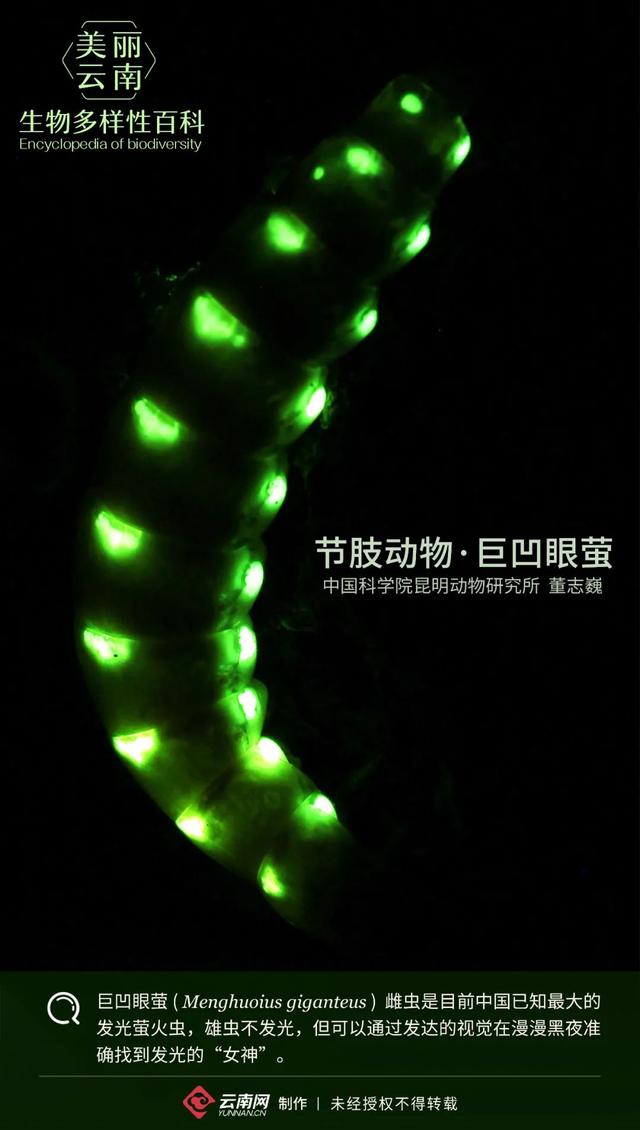
Giant-eyed firefliesMenghuoius giganteus
Jointed animals, Class Insecta, Order Coleoptera, Family Photoridae. Giant-eyed fireflies are very rare fireflies, distributed in Yunnan, Guangxi, and Sichuan. The photo was taken in Red River Pingbian Great Surround Mountain.
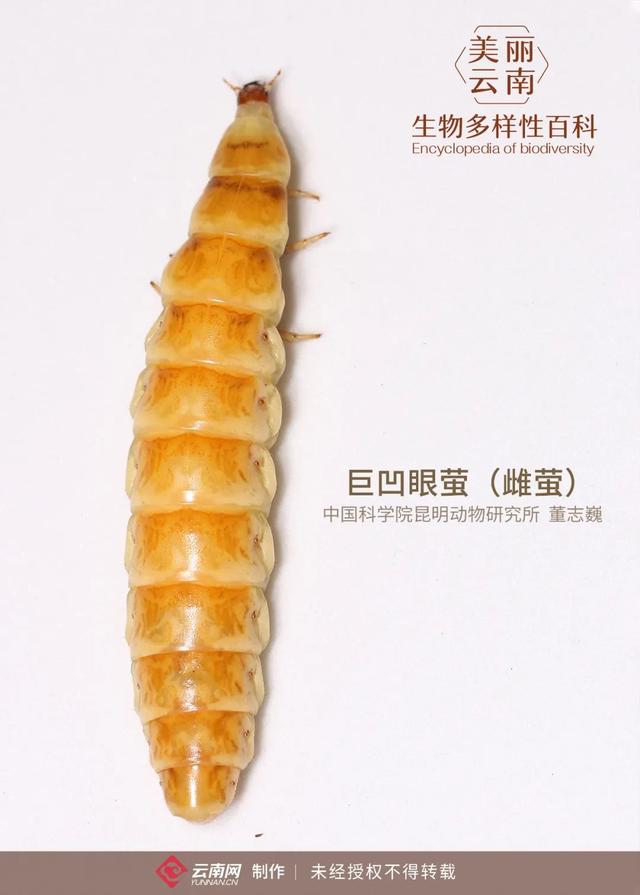
If the Yunnan window fireflies last time were too weak in their glow, then the giant-eyed firefly female is a 'bright body'. It is currently the largest firefly known in China. The female body length is about 50-60mm, and it turns into a 'walking light bulb' one to night, with multiple light organs in each segment emitting green light, very conspicuous. However, after 'turning off the lights' during the day, the female looks like a goddess before makeup, looking particularly ordinary. Unlike male insects undergoing complete metamorphosis (with significant differences in morphology and life habits between larvae and adults), giant-eyed firefly females remain consistent with the larval stage in terms of morphology and habits, with extremely thin brown-shaped antennae and a dark brown head, and the body segments are pale yellow in color, with a 'caterpillar bread'-like overall appearance.
Compared to the female, the male looks very 'miniature', with a body length of about 10mm, and does not glow, but its well-developed eyes allow it to accurately find the 'goddess' emitting light in the darkness.
Furthermore, researchers have found that fireflies that do not rely on glowing to attract mates, such as the Yunnan window fireflies last time, generally have more developed antennae in male insects because they rely on antennae to sense and find female insects emitting chemical signals. Fireflies that rely on glowing to attract mates often have well-developed vision in their males, such as the giant-eyed firefly, allowing them to find glowing females more quickly in the darkness.
People regard fireflies' glow as a rare romantic thing, but researchers have found that fireflies' glow consumes a lot of energy, and some adults need to glow to attract mates to complete the mission of creating new life, such as giant-eyed fireflies. Currently, there are 2000 species of fireflies known in the world, belonging to 8 subfamilies and more than 100 genera, and the complete life cycle of fireflies includes four periods: egg, larva, pupa and adult.

Dong Zhiwei, who founded the Yunnan Firefly Protection Association and now works at the Kunming Animal Institute of the Chinese Academy of Sciences, conducting research on the classification and systematics of Photuris insects, insect feeding and research. He often conducts field investigations in Yunnan, Tibet and Southeast Asia, dedicated to the protection and conservation of fireflies and their survival.