Encyclopedia of Biodiversity: Roseback Orbweaver - I Just Love Dressing Myself Up ‘Flowerly and Fancy’
Today, I'm going to introduce you toSpiders·Roseback Orbweaver.
Roseback Orbweaver
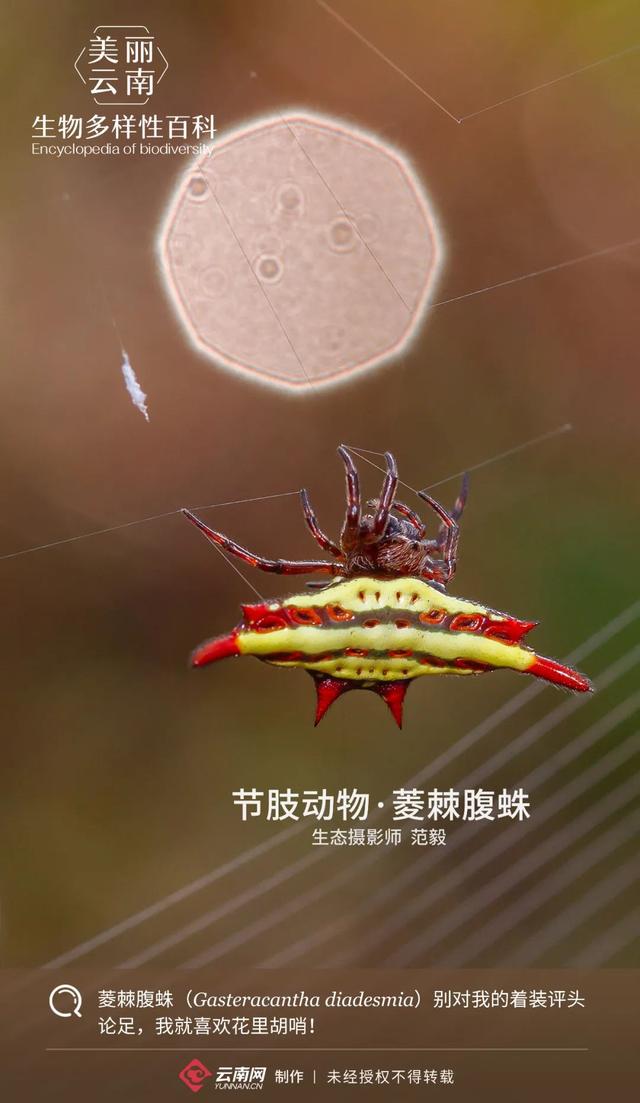
Gasteracantha diadesmia
Arthropods, Arachnid class, Order Spiders, Family Orb-Weavers, Genus Roseback Spiders. They often weave webs between tree branches and under eaves, feeding on small insects such as mosquitoes and flies. It is mainly distributed in Guangdong, Guangxi and Yunnan in China. The photo was taken in Pumei Ximei, China.
Roseback Orbweaver is a relatively small spider, with the female body length about 7mm, and the male is much smaller than the female, almost invisible to the naked eye. The common female roseback orbweaver has a stretched, quadrilateral abdomen, with 3 pairs of 'spines' on the back of the abdomen and on the sides, which are the parts with sharp spikes as seen in the photo. At a glance, they look like two overlapping 'maples'. There are more than a dozen asymmetrical reddish-brown muscle marks distributed on the abdomen, which are the irregular 'small squares' in the picture, of which 6 are larger on the edges.
Besides its peculiar appearance, the roseback orbweaver's color is also very brilliant, with the abdomen being a vibrant yellow stripe, interspersed with reddish-brown and black.
Actually, these colorful colors are the 'camouflage' worn by the roseback orbweaver. In nature, many animals are 'dichromatic', they cannot distinguish colors, and some even see objects as mosaic-like. 'Flower and leaf' colors can perfectly 'deceive' those less evolved creatures with low vision. As for those animals that can clearly see the colors of objects, vibrant and colorful colors can also play a warning role, as if saying: 'Hey, stay away from me, I'm venomous.'
Special thanks: Dr. Huang Guiqiang of Guiyang Normal University, Guizhou Province, for providing professional materials and text support.

Fan Yi, ecological photographer. He has won the International Garden Photographer Award for 4 consecutive years, and won the first prize of the 2018 China Ecological Photography Competition for Wild Plants and Animals. He is committed to photographing the human landscape, especially in the western region of China, as well as the beauty of biodiversity.
Overall planning: Lian Hui Ling
Text collation: Tian Yuan
Poster design: Zheng Bin Yin