Macaroni Penguin
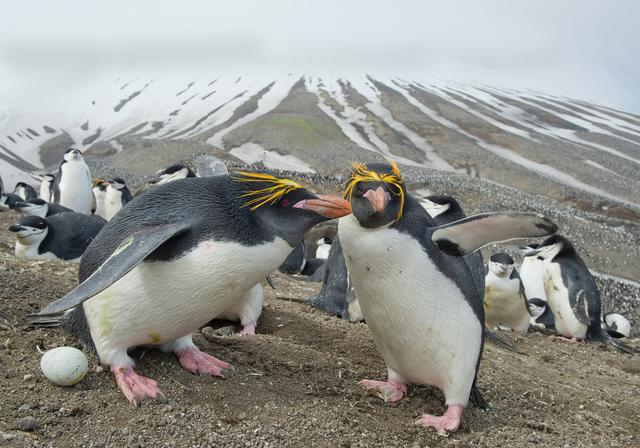
Macaroni Penguin (scientific name: Eudyptes chrysolophus): body length about 70cm, weight about 5.5kg. There is a side-by-side orange decorative feather between the eyes, due to the 'fusilli' penguin name, the English meaning of 'Macaroni' can also be explained as 'trickster'.
Like all penguins, the Macaroni Penguin has strong diving ability, but does not fly. Its appearance is easily confused with the Rockhopper Penguin. Every summer, thousands of Macaroni Penguins swim to the Southern Ocean, to breed on small islands with rocky terrain. They mainly feed on krill and also hunt squid and small fish. They are distributed along the coasts of South Africa to western South America and the Antarctic.
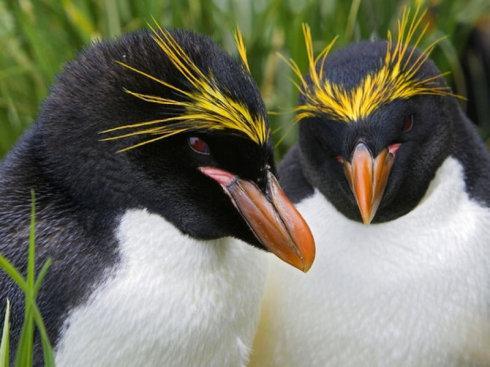
The Macaroni Penguin weighs 3.2-6.1 kilograms and stands 51-77 centimeters tall. Males are significantly larger than females, but males have smaller wings and longer yellow feathers on the top of their heads. They have red eyes, and their bellies, chests, and tails are white. Their heads and faces are black or dark gray, and their backs are blue-black. Young chicks lack the elegant crown, their eyes are brown, and their feathers and beaks are black. The forelimbs have developed into fin-like feet suitable for swimming. The feathers have a scaly texture, with short, stout axes and narrow, dense feathers, evenly distributed across the body. The skeleton is heavy but not inflated, with a prominent bony ridge in the sternum containing fatty bone marrow. The tail is short, and the foot is short and shifted to the rear of the body. The foot has webbed feet. The horn of the upper beak consists of 3-5 horn-like plates. The surface of the tongue is covered with thorn-like papillae suitable for feeding on krill and fish.
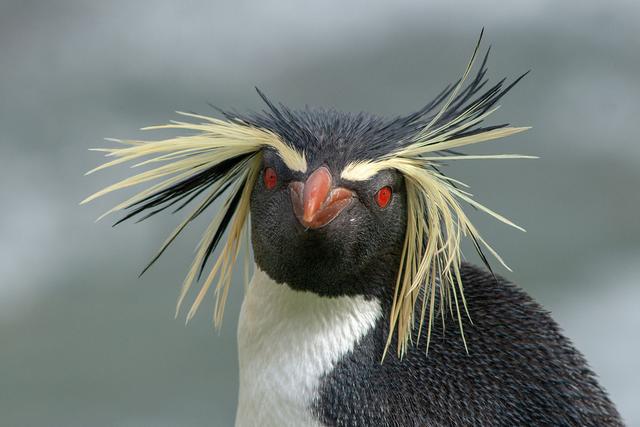
The Macaroni Penguin spends months adrift at sea before returning to land to form groups and breed. They return to the same breeding area every year, and often return to the same nest, and usually seek out their partner from the previous year. They have strong and powerful legs, named for their ability to jump in and out, and if other animals try to approach, they will aggressively open their hard, sharp beaks.
Penguin groups dive and come ashore together. Macaroni Penguins generally nest on steep, mountainous ground, often traveling hundreds of meters from the sea to reach their nests. The nests are typically free of birds or have very few birds. They have the same liking for jumping as the Rockhopper Penguins, jumping over steep rocks instead of clumsily swaying over obstacles like other penguin species.
Throughout the winter, Macaroni Penguins swim in the narrow seas of the Antarctic Ocean's polar zone, where the cold Antarctic waters mix with warm waters from the north, creating a feast of crustaceans. Macaroni Penguins mainly feed on krill and also hunt squid and small fish. Like all penguins, the Macaroni Penguin has strong diving ability, but does not fly.
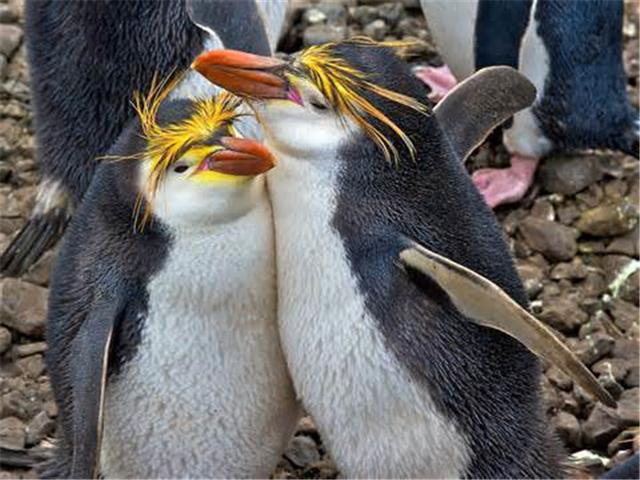
They usually build nests in crevices or caves on steep cliffs. The breeding ground is noisy. Like all Adélie Penguins, they lay two eggs, the smaller of the two eggs has a slim chance of survival. The eggs are incubated and fed by parents in turns, but as the chicks grow to about two months old, the parents must go out to sea to satisfy the young 'gluttons' appetite.
Adult female Macaroni Penguins reach sexual maturity at 5 years old and breed once a year, with irregular breeding seasons, but the entire species breeds at the same time. The incubation period is about 5 weeks, with three shifts in charge of incubation, each shift approximately equal in length. After the eggs are laid, the male incubates first for the first shift, the female incubates for the second shift, and when the male returns for the third shift, the female goes out to sea and does not return until the chicks hatch. During incubation, Macaroni Penguins are always on land during the day. Sometimes the chicks do not eat until a week after hatching. The chicks' average meal at this stage is about 200 grams. As the chicks grow, they need more food to maintain their growth. The penguin parents travel 40 kilometers or more from the feeding grounds to reach the nest. Then the penguin chicks form a unique nursery. The male and female penguins continue to care for the chicks for 60-70 days until the chicks can survive independently.
When the first feeding is completed, the Macaroni Penguin's feathers are grayish-black, and the underside and belly are milky-white. This type of feather can maintain the body temperature of the young chicks when both parents are away hunting, which is important because the chicks' appetite is about 1000 grams at this time, and the parents must go far out to sea to provide them with enough food. At the breeding ground, the chicks gather together, which is beneficial for resisting the enemy and the cold weather.
Young Macaroni Penguins' feathers become waterproof and long feathers about 11 weeks after hatching. There is no crown in adult penguins, just a few scattered small feathers, which are not yellow. They have a different black-brown beak and brown eyes than adult penguins. Adult penguins spend about three weeks hunting at sea. The chicks change their feathers for about 25 days, and then leave the breeding grounds with adult penguins to spend the winter at sea.