40 Million Years Ago, Fish Brains Were Prepared for Land
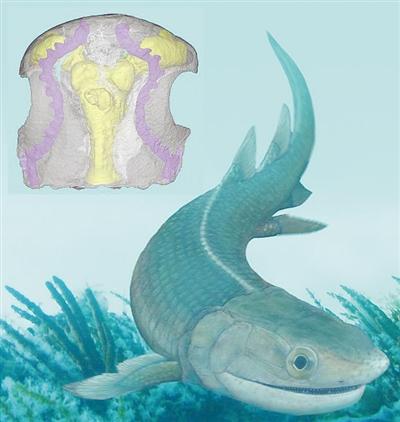
Reconstruction images of the *Dongshangyu* fish art and its brain cavity reconstruction model, provided by the interviewee
related links
Ms. Lu Jing previously specialized in *Dongshangyu* fish, which is currently the earliest and most primitive four-footed fish-like pectoral fish. If you could see it completely, alive, you wouldn't doubt it was a fish, but its jaw structure had 'advanced' to show early characteristics of four-footed animals. More surprisingly, when paleontologists reconstructed the *Dongshangyu* fish's skull cavity, along with related neural, vascular, and other structures using high-precision X-ray computed tomography and three-dimensional virtual reconstruction technology, they found that a region within the skull cavity was likely to be a chamber that could accommodate the glandular node of the brain of four-footed animals. This suggests that the glandular node of four-footed animals may have evolved as early as 40 million years ago.
The glandular node may sound strange, but it plays an important role in regulating the day-night rhythms of terrestrial animals.
The appearance of *Dongshangyu* fish has solved many mysteries for paleontologists. It turns out that as early as 40 million years ago, our ancestors were still living in the water, and their brains had already evolved structures to adapt to terrestrial day-night rhythms, laying the groundwork for adapting to terrestrial day-night rhythms.
Source: China Daily