Dunhuang West Lake National Nature Reserve 'Discovers' Another Freshwater Lake
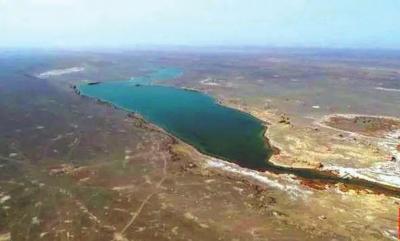
Aerial view of Eishan Lake
On March 31st, reporters learned from the Gansu Dunhuang West Lake National Nature Reserve Administration that during the spring investigation, research staff discovered a freshwater lake about 3 square kilometers in area in the Eishan Wellzhan area within the protection zone. This is the latest large-area freshwater lake to appear in the Dunhuang West Lake Protection Zone’s core area. According to its location, the West Lake Protection Bureau has named the lake Eishan Lake.
The reporter saw the scene from the aerial footage. Eishan Lake appeared in a low-lying area on the northwest segment of the Silkie River Protection Zone. The lake’s east segment is connected to the river and wetlands, and its central and western segments extend into the Shulu Desert and Badain Wulagai Desert. The lake is about 3 square kilometers long from east to west and about 800 meters wide from north to south. At the lake’s edge, Eishan Lake’s water is clear and rippling, with dense growth of willow and reeds around the lake shore, especially in the east segment. Fish swim in the lake, and cormorants, white egrets, wild ducks, and seagulls reside or fly over the water. The scene shows that this ‘paradise on earth’ has become a ‘new home’ for wild plants and animals.
Gansu Dunhuang West Lake National Nature Reserve Administration Chief Engineer Sun ZhiCheng told reporters that Eishan Lake is a freshwater lake formed by the convergence of the Silkie River. It formed later than the Silkie River convergence lake Haranor that appeared in 2016, earlier than the Silkie River terminal lake Harazi that appeared in 2017, but Eishan Lake is a low-lying area of Badain Wulagai Desert, which has not had a lake footprint in the past. Now, like Haranor and Harazi, Eishan Lake, which is a large area of freshwater lake, plays a key role in protecting the Dunhuang West Lake wetlands and restoring biodiversity.
Gansu Dunhuang West Lake National Nature Reserve Administration Chief Engineer Sun ZhiCheng said: ‘Now we can see that the vegetation around the formerly desertified lake has recovered, and wild animals are increasing. When this place was not water, there were no water birds at all, now we can see cormorants, great white egrets and other water birds frequently migrate and reproduce here. On February 24, 2018, we recorded 31 peaks of wild camels in this area, which is the first time we have discovered such a large population of wild camels along the Silkie River, indicating that the ecological environment in this area is gradually improving, and attracting wild animals such as wild camels.
At the same time, this year we used infrared cameras to shoot rare animals such as desert cats in this area. This shows that through the Silkie River water conveyance, the ecological environment of this area has been further improved. We also hope that the Silkie River will continuously supply water to Dunhuang West Lake, so that it can play a greater role in protecting the Dunhuang Oasis, protecting the western ecological environment of Dunhuang and protecting the ecological security of Gansu Province.’