In Datong, Shanxi, this ancient town thrived due to its military origins, boosted by trade, and once known as the ‘Tea-Horse Road’.
The ancient town of Xinpingbao in Shanxi is particularly numerous, and many famous ones across the country. Considering the reasons, it mainly benefits from the historical connection of Shanxi as the 'Old Hearth of Jin Merchants'. It can be argued without exaggeration that Xinpingbao was fostered by the Jin merchants, and the prosperity of the town was built by the thriving Jin merchants. However, there are some exceptions, namely, that some towns developed due to other reasons besides the influence of the Jin merchants.
This ancient town is located at the northernmost end of Shanxi, bordering Xinhe County of Inner Mongolia and Huai'an County of Hebei. It is known as ‘Hearing Three Provinces with One Drumbeat.’ Xinpingbao Ancient Town, belonging to the administration of Tianshen County, Datong City, was historically an important strategic location bordering the Northern Plains nomadic peoples. Throughout history, it has served as a military outpost, and its prosperity was driven by trade. The town is often referred to as ‘Tea-Horse Road’ due to its location facilitating trade between the Han Chinese and northern minority groups like the Xiongnu and Qiangnu.

Initially, the ‘Camp of Soldiers’ was established at Xinpingbao, marking the beginning of its development. Xinpingbao has a long history as a military outpost, and has been a coveted location for centuries. Ancient Xinpingbao was primarily used as a garrison, but due to the relatively peaceful times and its strategic location on the border, it became a melting pot of Han and northern minority cultures, leading to the inevitable growth of trade. Historical records indicate that in 1769, Xinpingbao was designated as a national-level Mongolian-Han horse trading market, which continued until 1773.
‘First the Camp of Soldiers, then the City of Tianshen’ became a source of pride for the people of Xinpingbao.
Xinpingbao thrived due to trade. Historically, it had a developed merchant industry.
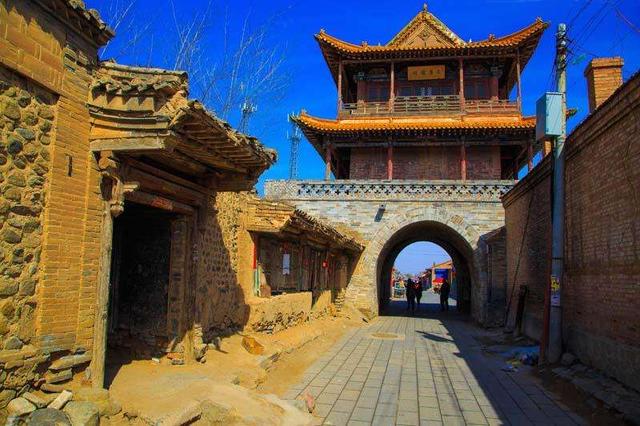
Although Xinpingbao was primarily a military outpost, its relatively peaceful times and its strategic location on the border led to the integration of Han and northern minority cultures, which in turn boosted trade. Historical records indicate that in 1769, Xinpingbao was designated as a national-level Mongolian-Han horse trading market, which continued until 1773.
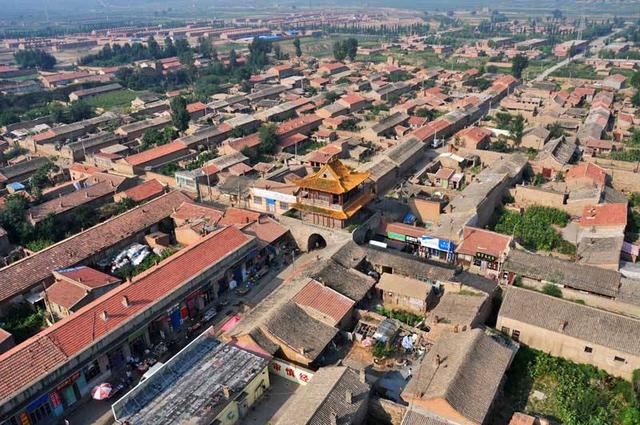
The layout of Xinpingbao Town is characterized by a main street crossed by sixteen small streets. This ‘four-way eight-street’ layout is typical of fortified castle layouts, facilitating travel while considering military needs. The north and east streets were primarily occupied by merchant shops, while the west street housed the magistrate’s office.
Currently, if you pass by the Jade Emperor Palace, the intersecting roads extend in four directions, and on either side are a mix of old and new buildings. Walking through this area, you can feel the distinctive Ming and Qing architectural style and appreciate the well-preserved wood carvings and brick carvings.
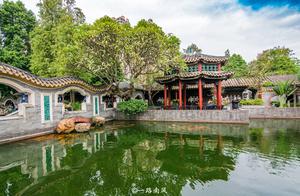
In the south-east alley of the town, there is a well-preserved courtyard with a rich history, believed to be the residence of the Commander of Horse Cavalry. The courtyard was built during the late Ming Jiajing period. The main gate is a pyramidal roofed structure with beautiful brick carvings on either side. Inside the gate is a small courtyard with a brick carving reflecting pool, which is very exquisite and beautiful.
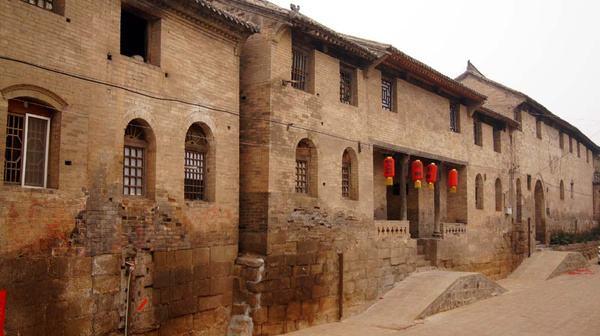
Due to the history of Xinpingbao as a military outpost, in addition to the Commander’s residence, there is another well-preserved courtyard on the north side of the west street, built during the Jiajing period of the Ming Dynasty, which belonged to the ‘Guard of the Northern Tribes.’ The gate also has beautiful brick carvings and a reflecting pool.
In summary, Xinpingbao is both a military outpost and a major trading center.
This ancient town in Shanxi, and even in China, is a rare and legendary place, which has already attracted widespread attention from society. In 2010, Xinpingbao Town was awarded the title of ‘China’s Historical and Cultural Heritage Town’ by the Ministry of Housing and Urban-Rural Development and the State Cultural Heritage Administration. In 2011, it was named a National Featured Tourism Town by the Ministry of Housing and Urban-Rural Development and the National Tourism Administration. In 2012, it was named one of China’s Traditional Villages (First Batch) by the Ministry of Housing and Urban-Rural Development, the Ministry of Culture, and the Ministry of Finance. In 2015, it was named China’s Beautiful Leisure Countryside by the Ministry of Agriculture.
2010"”201120122015