Efficient people win, it's not about time.

In mid-February, I left my previous company and entered a startup in the United States, which has a characteristic that is very popular in the current office mode—working from home (Remote Work).
In the future, I will not be like everyone else for these few months working from home, but I will no longer take the bus or subway, but directly squat at home to go up and down.
No one will constantly stare at you when you come to work or leave, nor will anyone wander around beside your desk, let alone suddenly arrange a meeting to interrupt your work.
However, there are also some new things to adapt to:
No one will supervise you when you come to work or leave,
It's necessary to hold team meetings remotely, and communication is obviously worse than face-to-face conversations.
Before collaborating with others, you need to make full preparation, grasp the key points, clarify your thinking, and express clearly, in order to avoid wasting communication time;
…
These difficulties are not too big for me, what's really made me reflect is that my working hours at home are three to two hours longer than before.
Perhaps due to the initial onboarding, I wasn't very familiar with everything, so I wanted to spend more time to understand the new products and new teams, but this reflected a cognition in my heart:
The more you work, the more output you have.
As for the relationship between input and output, it's not as simple as it seems.
Each book that increases output and efficiency tells you the same thing: make every minute count, seize every opportunity, just like the 996 culture in the internet industry, use time as the competition's leverage.
I believe everyone's productivity and efficiency are different because we have different brains, ideas, preferences, and habits. So, we should focus not on new tools to increase productivity and efficiency, but on our mental state.
For example, procrastination is closely related to anxiety, so it's important to explore and understand your inner fears; Action requires motivation, so developing habits to make it easy for you to snowball is more important than drinking coffee and shouting slogans.
Today, I want to share with you about the relationship between input and output.
| Linear work
Most of us treat work as a linear function throughout our lives.
Here, 'linear' means that the number of outputs you get is proportional to the amount of time you spend.
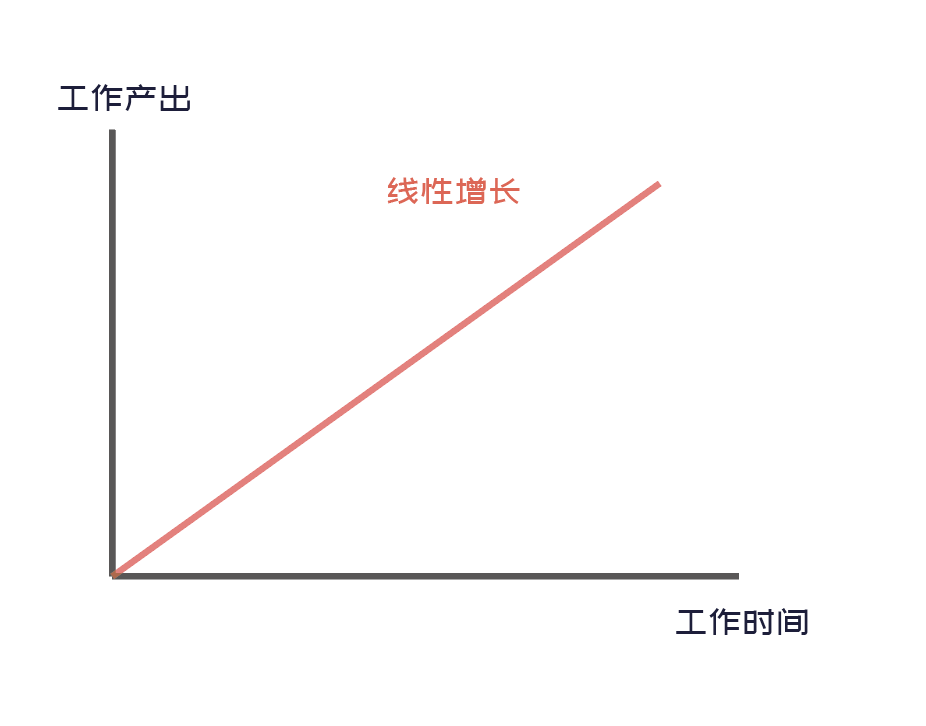
So, two hours of work will produce twice as much as one hour; eight hours of work will be four times as much as two hours.
When we were young, we had similar experiences in school. The more things we had to memorize, the more times two hours would be twice as much as one hour. When we grew up, we thought that everything would operate in this way.
But this is not the case.
The most demanding types of work – those involving mental labor – will not operate like linear work; they will yield diminishing returns.
Yielding diminishing returns
Imagine you run 10 minutes outside for a jog, which is obviously a very healthy thing.
Now imagine you run for 20 minutes, it's still healthy, but the fitness benefits may not be twice as much as 10 minutes.
If you run for an hour, you may still be tired and unable to achieve much. As muscle fatigue sets in, the ability of your muscles to grow is gradually weakened until it disappears.Spending two hours in the gym will not yield much additional benefit compared to spending one hour; spending one hour will only give you a slight advantage over 45 minutes.
| Most types of mental work operate according to a diminishing returns pattern.
Why?
Because your brain is like a muscle, it gets tired and fatigued.
If you spend a lot of time and energy on thinking and making decisions, you may not actually get much done that day; my friend works in the advertising industry, he's very busy, especially when he needs to make important presentations or bid plans, he often works late until 10 pm, he realized that in these extra hours, the output is very low, from 6 pm to 10 pm, those four hours produce only half of the work done in the whole day.
What's worse,
People become less productive and make mistakes when they are tired. When you accumulate enough bad work output and wrong decisions, you will unknowingly create more work for yourself, because you constantly need to correct what you didn't do well.
Just like recently working from home, I can endlessly extend my working hours to solve a problem, but this didn't let me solve the problem in the best way, and I was also exhausted the next day. A good idea suddenly popped into my head and perfectly solved the problem in a short time.
Previously, working late would only make me feel worse, the problem wasn't solved, and I was also exhausted.
Sometimes,
More time invested yields even negative returns.
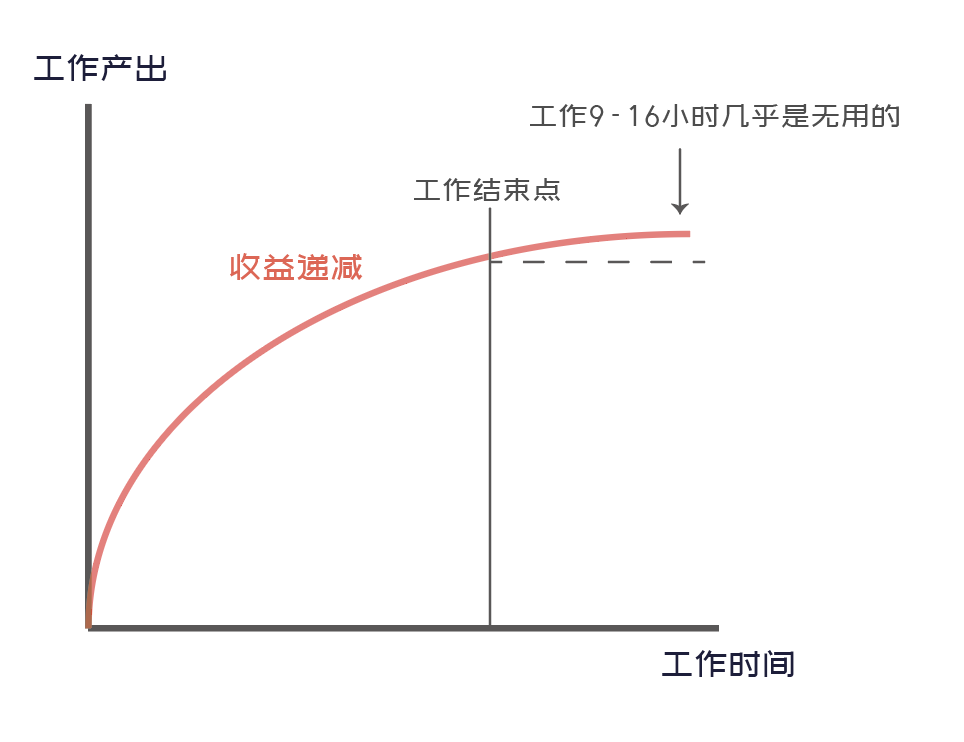
In the worst case, you may even have negative returns.
For example, when I first started writing, I would specifically arrange a Sunday to do it, without going out, without gatherings, to spend the whole day writing more than a few thousand words.After a week, I realized that the words I could actually use were less than 1000 words. I then had to overturn my original writing ideas, collect and sort the materials again, and then rebuild the entire article, which actually increased my work more.
Spending the whole day writing on a Sunday produces little positive output, and even creates negative output because it takes more time to achieve the same results.
Finally
When I held a meeting with the new team in Ukraine, I found that the Ukrainian website designer would always appear in different coffee shops.Asked him about it, I learned that because he was working from home, he often lived in different countries for a period of time, so this week he held a meeting in London's coffee shop, and next month he might appear in a quiet square in Paris.This discovery gave me an inspiration, I could go to a small town, choose a guesthouse, and stay for a period of time.
This plan is most important: I can increase my productivity by reducing my working hours, so that I not only have high output at work, but also have time to enjoy different life experiences.
People who are efficient at work don't focus on time.
They know how to find the leverage points in their work, use strategic procrastination to improve their input-output ratio, so that fish and bears can both have honey.
In the Paris Review's 'Writer Interviews I', someone asked (Murakami Haruki): What's a typical workday like for you?
(Murakami Haruki) answered—
When I enter a book's writing stage, I'll get up at 4 am and work for five to six hours; in the afternoon, I'll run 10 kilometers or swim for 1.5 kilometers (or both), and then read a book and listen to music, and finally I'll go to bed at 9 pm.
I repeat this schedule every day, never changing it.
(Murakami Haruki) clearly understands that a person's deep work time is only four to five hours; beyond that, it won't produce much more output, so he doesn't rush to finish a book in one go, but chooses strategic procrastination to give his work sustainable positive returns through this leverage point.
Finally
In the Paris Review's 'Writer Interviews I', someone asked (Murakami Haruki): What's a typical workday like for you?
(Murakami Haruki) answered—
When I enter a book's writing stage, I'll get up at 4 am and work for five to six hours; in the afternoon, I'll run 10 kilometers or swim for 1.5 kilometers (or both), and then read a book and listen to music, and finally I'll go to bed at 9 pm.
I repeat this schedule every day, never changing it.
(Murakami Haruki) clearly understands that a person's deep work time is only four to five hours; beyond that, it won't produce much more output, so he doesn't rush to finish a book in one go, but chooses strategic procrastination to give his work sustainable positive returns through this leverage point.
| Finally
In the Paris Review's 'Writer Interviews I', someone asked (Murakami Haruki): What's a typical workday like for you?
(Murakami Haruki) answered—
When I enter a book's writing stage, I'll get up at 4 am and work for five to six hours; in the afternoon, I'll run 10 kilometers or swim for 1.5 kilometers (or both), and then read a book and listen to music, and finally I'll go to bed at 9 pm.
I repeat this schedule every day, never changing it.
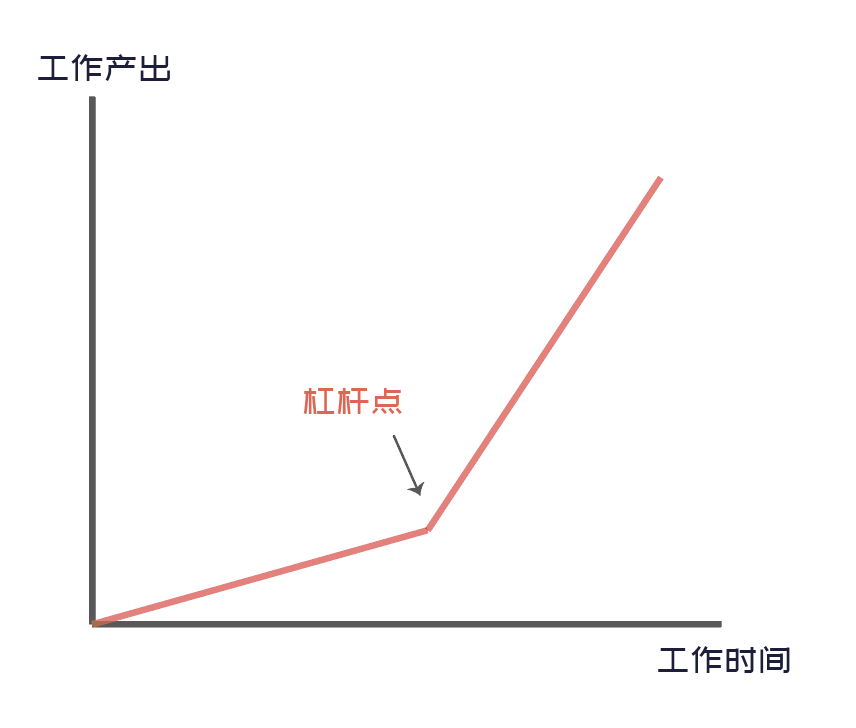
(Murakami Haruki) clearly understands that a person's deep work time is only four to five hours; beyond that, it won't produce much more output, so he doesn't rush to finish a book in one go, but chooses strategic procrastination to give his work sustainable positive returns through this leverage point.
Finally
In the Paris Review's 'Writer Interviews I', someone asked (Murakami Haruki): What's a typical workday like for you?
(Murakami Haruki) answered—When I enter a book's writing stage, I'll get up at 4 am and work for five to six hours; in the afternoon, I'll run 10 kilometers or swim for 1.5 kilometers (or both), and then read a book and listen to music, and finally I'll go to bed at 9 pm.
I repeat this schedule every day, never changing it.
| (Murakami Haruki) clearly understands that a person's deep work time is only four to five hours; beyond that, it won't produce much more output, so he doesn't rush to finish a book in one go, but chooses strategic procrastination to give his work sustainable positive returns through this leverage point.
Finally
In the Paris Review's 'Writer Interviews I', someone asked (Murakami Haruki): What's a typical workday like for you?
(Murakami Haruki) answered—
When I enter a book's writing stage, I'll get up at 4 am and work for five to six hours; in the afternoon, I'll run 10 kilometers or swim for 1.5 kilometers (or both), and then read a book and listen to music, and finally I'll go to bed at 9 pm.
I repeat this schedule every day, never changing it.
(Murakami Haruki) clearly understands that a person's deep work time is only four to five hours; beyond that, it won't produce much more output, so he doesn't rush to finish a book in one go, but chooses strategic procrastination to give his work sustainable positive returns through this leverage point.
FinallyIn the Paris Review's 'Writer Interviews I', someone asked (Murakami Haruki): What's a typical workday like for you?
(Murakami Haruki) answered—
When I enter a book's writing stage, I'll get up at 4 am and work for five to six hours; in the afternoon, I'll run 10 kilometers or swim for 1.5 kilometers (or both), and then read a book and listen to music, and finally I'll go to bed at 9 pm.
I repeat this schedule every day, never changing it.
(Murakami Haruki) clearly understands that a person's deep work time is only four to five hours; beyond that, it won't produce much more output, so he doesn't rush to finish a book in one go, but chooses strategic procrastination to give his work sustainable positive returns through this leverage point.
Finally
In the Paris Review's 'Writer Interviews I', someone asked (Murakami Haruki): What's a typical workday like for you?
(Murakami Haruki) answered—
| When I enter a book's writing stage, I'll get up at 4 am and work for five to six hours; in the afternoon, I'll run 10 kilometers or swim for 1.5 kilometers (or both), and then read a book and listen to music, and finally I'll go to bed at 9 pm.
I repeat this schedule every day, never changing it.
(Murakami Haruki) clearly understands that a person's deep work time is only four to five hours; beyond that, it won't produce much more output, so he doesn't rush to finish a book in one go, but chooses strategic procrastination to give his work sustainable positive returns through this leverage point.
5