Standing Rotation and Twist Action: Analyzing Human Joint Stability and Flexibility
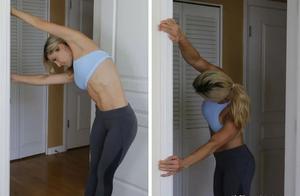
Many people feel stiff in their bodies after sitting for a long time, driving for a long time, or maintaining a posture for a long time, and they often do several twisting movements to move their waist, feeling refreshed. However, twisting movements are not just about twisting the waist. Here, let's analyze the standing twisting action, which can give you many insights because this action is not only a training action in the rehabilitation field but also a testing and evaluation action. It is used to assess the rotation degree and flexibility of many joints.

The standing twisting action is a multi-joint action, mainly involving the lower limb's hip joint, the trunk's lumbar vertebrae and thoracic vertebrae. In this action, the waist contributes the smallest angle, because it is relatively stable. According to the adjacent joint theory, the hip joint is flexible, the vertebral column and lumbar vertebrae are stable, and the thoracic vertebrae are flexible. Therefore, the hip joint and thoracic vertebrae contribute the largest angle during rotation, not the lumbar vertebrae.
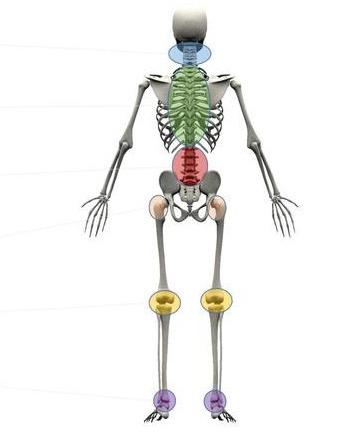
The adjacent joint theory means that when two adjacent joints are one is relatively flexible and the other is relatively stable, if both are flexible, a person may be like a soft animal. If both are stable, a person will be like a robot. To ensure the stability and flexibility of the human body, the combination of adjacent joints is the best, so the flexible joints are ankle joint, hip joint, thoracic vertebrae, upper neck segment, shoulder joint, and wrist joint, while the stable joints are knee joint, vertebral column, lower neck segment, and elbow joint. Stability is relative, and it needs to be understood.
Then the question arises: what happens if the flexible joint is not flexible? The human body must achieve the required range of motion, which will inevitably lead to compensation, using the stability of the stable joint to make up for it. If the stable joint becomes unstable, the adjacent joints will sacrifice their flexibility to stabilize it.
Let's return to the standing twisting action. When assessing it, the requirement is that the feet are together, the body rotates backward, how much can you turn? If the feet are not moving, and you press your feet firmly on the ground, how much can you turn backward? At most, you can turn 110 degrees.
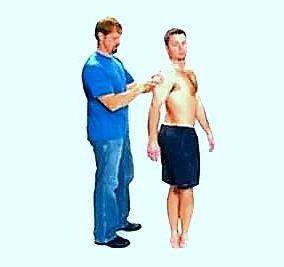
What does this mean? It means that with your feet firmly planted on the ground, you can turn back as far as 110 degrees. If your right shoulder turns to the left shoulder in front of you, a person standing behind you should be able to see the front of your left shoulder. This is easy to understand. If you can’t see the back of your left shoulder, it means you’ve turned less than 90 degrees. If you can see the front of your left shoulder, it means you’ve exceeded 90 degrees.
Action analysis: As mentioned earlier, the adjacent joint theory, you should know that the 110 degrees of twisting, the lumbar vertebrae contribute a small angle because it is relatively stable, and its rotation angle is much smaller than you imagine, only 10 degrees.

The remaining 100 degrees should come from the hip joint and thoracic vertebrae, and they will share the work equally, with 50 degrees each.
Many people’s hunching over their desks for a long time or poor posture causes their thoracic flexibility to be poor. When the thoracic flexibility decreases, the adjacent joints of the lower neck segment and lumbar vertebrae will compensate. Over time, it can lead to problems in the cervical and lumbar spine. It's originally poor thoracic flexibility that causes related problems, and if it doesn't improve over time, it will also burden the upper and lower parts. Similarly, if the hip joint is not flexible, it will affect the lumbar vertebrae and the sacroiliac joint and the knee joint. Imagine that if it continued for a longer time, would the knee joint's adjacent ankle joint be affected as well?
Therefore, before performing functional training, we need to conduct detailed assessments, analyze the root cause of the problem. If the problem is early, it's better to solve it. When there is widespread bone and joint pain, it's difficult to distinguish between chicken and egg.
The purpose of this article is to let the friends who see it clearly understand that the rotation flexibility of the lumbar vertebrae in the human body is not large, the rotation angle mainly comes from the thoracic vertebrae and hip joints. When training, strengthen the flexibility of the thoracic vertebrae and hip joints, reduce the rotation compensation of the lumbar vertebrae, strengthen the stability training of the lumbar vertebrae, which can reduce or prevent the occurrence of waist-related diseases.
Please like and follow me, and I will regularly update you with little knowledge of functional rehabilitation, to help you with your health. You are also welcome to leave a message.