Anatomy of Exercise - Gluteus Maximus (13)
Position and Structure: Gluteus MaximusBelongs to the group of hip external rotators, the hip external rotator muscle group is primarily located in the buttocks, also known as the gluteal muscles. According to its depth, it is divided into three layers: superficial, intermediate, and deep. The superficial layer currently includes the fascia lata and gluteus maximus, the intermediate layer includes the piriformis, geminius, and obturator internus, and the deep layer includes the minimus and geminus externus.
Located subcutaneously in the buttocks, it is large and thick, forming a characteristic buttock prominence as an irregular quadrilateral muscle, covering the posterior surface of the piriformis and the entire gluteal muscles (except the fascia lata).
Muscle Connections:AboveTo the posterior iliac crest, posterior sacrum, and tailbone behind, extending from the posterior superior iliac spine to the apex of the tailbone, originating from a wide area of short tendons between the iliac crest, the underside of the sacrum, and the posterior of the tailbone, as well as the iliolumbar ligament and sacrotuberous ligament. The muscle fibers are parallel, obliquely downward and outward to the upper portion of the femur.
BelowMost of the upper portion transitions toThe deep surface of the Iliotibial BandA small part terminates at the lateral side of the femur'sGluteal muscle ridge.
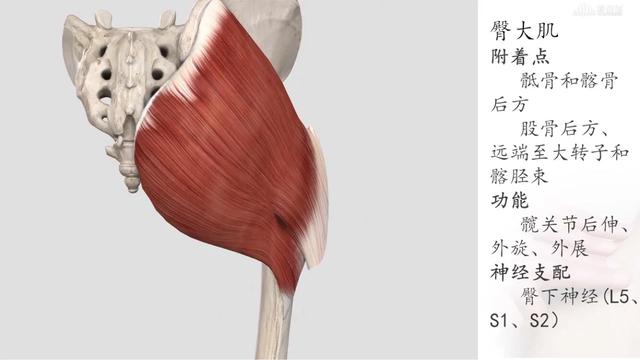
Function:: Hip extension, external rotation, abduction. The gluteus maximus is a powerful climbing muscle, stretching the legs, especially when bending from a flexed position when climbing stairs or rising from a seated position.
Nerve Supply: L3-S1 nerve supply.
Manifestations:From the buttock valley to the back of the thigh, a feeling of discomfort at the base of the tailbone.'
Two. When the gluteus maximus is weak, the body tends to lean backwards, often using one hand to support the buttocks when walking.
Three. Uncomfortable on uphill slopes, the gluteal muscles and thighs are restricted and the step is tilted.Four.
Muscle cramps in cold weather.An abnormal sitting posture, its manifestation is the knees are separated and cannot be brought together.
Six. Gluteus maximus strain generally does not cause pain in the buttocks, the manifestation is discomfort in the lower lumbar region, the outer side of the buttocks, the tailbone, and the buttock valley.
Seven. If you bend down and cannot touch your toes, one of the reasons is due to strain-induced shortening of the gluteus maximus.
Eight. The discomfort caused by the strain of the gluteus maximus is often misdiagnosed as pain from the buttock bursa, intervertebral disc herniation, joint pain, sciatic nerve, or relaxed sacroiliac joint in the tailbone, often misdiagnosed as damage to the tailbone, which is actually related to discomfort from nearby strain.Nine. The gluteus maximus is the antagonist muscle of the lumbar muscles. When there is discomfort in the lower back, it is often related to it.
yzyst