Jump Rope Benefits for Runners: Three Training Methods Explained by Experts

Jump rope is not just a children's game, jump rope is an effective and portable tool, you should add a jump rope to your equipment, because it can provide a warm-up and a serious workout. Jump rope has many benefits: it is an instant effective aerobic exercise, which can improve your coordination, promote your metabolism, and make you sweat profusely.
James Bagley, an exercise kinematics assistant professor at the University of California, San Francisco, says: 'Jump rope is a great warm-up and an effective cross-training for runners. Research shows that according to your rhythm, it can increase your metabolic rate by 10 to 12 times, similar to running at a speed of 6 to 7 miles per hour.' When your time is short, in winter, when the weather is cold, or if it's raining or dark outside, jump rope is an ideal alternative aerobic exercise, Bagley says: 'You can jump rope in a small space with the least equipment, which is helpful when the weather is bad.'
Just like running, the intensity of jump rope training is your ability. Arnold Gonzalez, a professional boxer and coach at EverybodyFights in New York City, says: 'Jump rope is as challenging as a fast run, but you can also slow down and use it as a warm-up.' In fact, Gonzalez and many other boxers often use jump rope training as a light warm-up and a vigorous aerobic exercise.
Just like running, your physical condition is also important, so pay attention to the following points before you start running, Gonzalez says: 'Don't jump up directly, but keep your feet relaxed, to maintain your rhythm.' Of course, due to the high impact of jump rope, if you have any joint-related problems, you can find a floor like grass in the gym to ensure the safety of the jump rope.
Jump rope training is not just a choice on rainy days, it is also challenging and fun. Try the three jump rope training methods provided by Gonzalez to do a quick aerobic exercise, which is no less than a short run training.
Exercise 1: Jump rope exercise for beginners
Gonzalez says: 'This is a full-body jump rope training suitable for beginners. The footwork is the most basic, but your cardiopulmonary, leg, arm and core muscles are all being exercised.'

Jump rope: 3 minutes
Push-ups: 30 seconds
Jump rope: 3 minutes
High kicks: 30 seconds
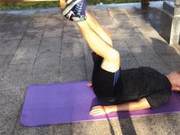
Sit-ups: 30 seconds
Repeat 1 to 3 times
Exercise 2: Single-leg jump rope exercise
This exercise challenges your balance and single-leg interval ability, and improves your heart rate and leg lifting ability. Do a 5 to 10 minute quick warm-up before starting.
Jump rope: 3 minutes

10 squats, 10 push-ups, 10 sit-ups
High knee jump rope: 30 seconds
10 squats
High knee jump rope: 30 seconds
10 push-ups
High knee jump rope: 30 seconds
10 plyometric jump
Jump rope (left foot only): 30 seconds
Jump rope (right foot): 30 seconds
Jump rope (both feet): 1 minute
Repeat 3 times
Exercise 3: Advanced jump rope exercise
The design is simple, but the action is difficult. Gonzalez says: 'Intense jump rope training will accelerate your heart rate, you need to warm up with the jump rope for 3 minutes before starting.'
Double swing (twice in each jump): 30 seconds

Plyometric: 30 seconds
Rest: 30 seconds
Repeat 10 times
Plyometric (Burpees) consists of 5 actions: Squatting Down (squat) ➤Leg Thrust (back kick) ➤Push-Up (push-up) ➤Forward Jump (forward jump) ➤Vertical Jump (vertical jump). It seems particularly simple, but it is not, when squatting, don't let your knees exceed your toes, the hips naturally squat down, the feet jump back, and the hands support the body (you can abandon this step when the training is just beginning), the feet return, prepare to restore the initial squatting action, then upward jump, restore the initial preparation stage.
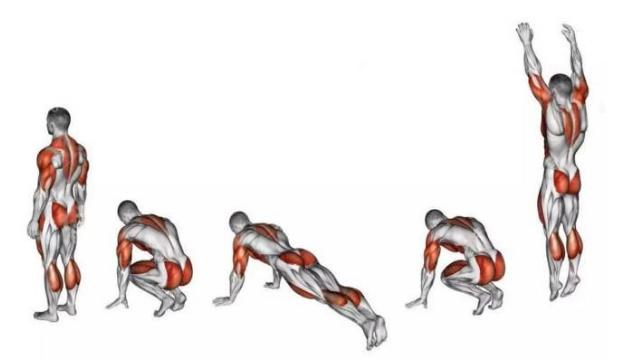
Burpees5Squatting Down() ➤Leg Thrust() ➤Push-Up() ➤Forward Jump() ➤Vertical Jump()