Yang Style Small Frame Taijiquan Internal Silk Thread Technique – Fixed Step Rotating Taijiquan Ball (Down)
Fifth Style Round Ball Rotation Technique
Round Ball Rotation Technique is our body's rotation driven by the turning of the hip, knee, and ankle joints, while simultaneously drawing a ‘∞’ shaped spiral circle horizontally, and with the body’s assistance, our hands hold the ball and draw a vertical circle in front of the body.
Action One: Stand with legs slightly wider than shoulder-width apart, with a slight bend in the legs, resembling a high-step stance. Other requirements are the same as the first style.
Right hand up, left hand down, holding the ball in front of the body. As shown in (Figure 1).
Action Two: Primarily driven by the rotation of the right knee and hip, with the left knee and step assisting, our body’s spine acts as a pen, rotating counterclockwise horizontally to the left, while the center of gravity shifts to the left. Simultaneously, our hands holding the ball draw a vertical circle upwards and to the left in front of the body. This double-hand holding of the ball (Figure 1) moves from the middle position to the left upwards to (Figure 2). At this time, the body rotates approximately 45 degrees to the left, with the left leg bearing 60% of the weight, and the right leg bearing 40% of the weight.
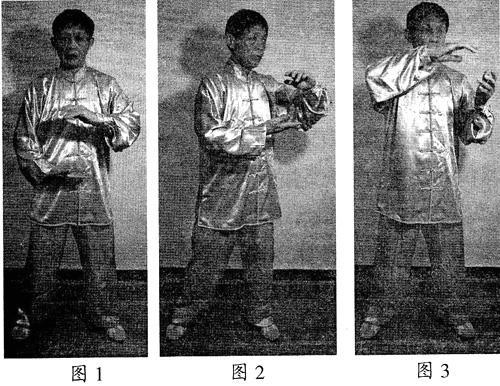
Action Three: Driven by the rotation of the left knee and hip counterclockwise, the body rotates counterclockwise to the right, drawing a vertical circle. The center of gravity shifts to the right. Simultaneously, our hands holding the ball, from (Figure 2) move upwards to the right, while also flipping the ball being held. The right hand is now up, and the left hand is down (Figure 3).
Action Four: The body continues to rotate to the right, and the hands holding the ball continue to move upwards and to the right, the body faces forward. Hands holding the ball are placed in front of the chest, the right hand is up, with the palm facing down, the left hand palm faces up, the right leg bears 60% of the weight, and the left leg bears 40% of the weight (Figure 4).
The body has drawn a horizontal ‘∞’ shaped circle counterclockwise, and the double-ball has drawn a vertical circle in front of the body.
Action Five: Starting from (Figure 4), driven by the rotation of the left hip and knee, the body rotates counterclockwise to the left, the center of gravity shifts to the left. The hands holding the ball move from (Figure 4) downwards to the right (Figure 11).
Action Six: The body continues to rotate counterclockwise to the left, drawing a vertical circle, and the hands holding the ball move backwards to the left. While moving, the ball is flipped, from the right hand up, left hand down (Figure 12).
Action Seven: Driven by the body’s rotation, the hands holding the ball continue to move backwards to the left, returning to (Figure 1). At this time, the body rotates with the turning of the left and right knees and hips, completing a flat ‘∞’ shaped circle. The double-ball draws a high-low diagonal vertical circle in front of the body. Then repeat the above actions.
Key Points:
1. Round Ball Rotation Technique is when both hands holding the ball and the circular motion are drawn in a horizontal circle, while Round Ball Rotation Technique is when both the knees and hips turn along the horizontal plane, drawing a ‘∞’ shaped spiral circle.
2. The spiral circle is not just a rotation driven by the waist, the most important thing is the circular drawing of the body driven by the turning of the ankles, knees, and hips, which draws a (hollow) spiral circle. The rotation driven by the waist is a self-rotation and cannot draw a spiral circle, only the public rotation driven by the turning of the ankles, knees, and hips can draw a spiral circle.
Above is the method of drawing the diagonal round ball moving forward in a clockwise direction. Practice for 3-5 minutes. The method of drawing the diagonal round ball moving backwards is the opposite action, starting with the left hand down, right hand up, also practice for 3-5 minutes. Sixth Style
Slanted Round Ball Rotation Technique
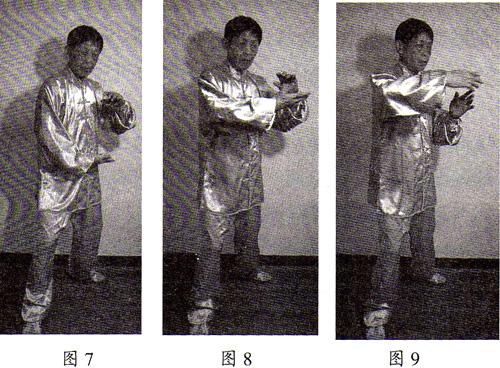
Slanted Round Ball Rotation Technique is our body's rotation driven by the turning of the hip, knee, and ankle joints, while simultaneously drawing a ‘∞’ shaped spiral circle horizontally, and with the body’s assistance, our hands hold the ball and draw a diagonal circle upwards from the back lower position to the upper front (Figure 7).
Action Two: Standing with the right leg forward and the left leg backward, resembling a three-point stance (not a three-point or eight-point stance), facing left and forward, with the legs evenly bearing weight. The hands hold the ball in front of the body, with the right hand up and the left hand down, the right hand palm faces up, and the left hand palm faces down. The right hand is at the same height as the navel, 10 cm away from the navel, and the two palms are 20 cm apart. Relax the waist and hips, opening the (Figure 7).
Action Three: Primarily driven by the rotation of the right knee and hip, with the left knee and step assisting, our body’s spine acts as a pen, rotating clockwise forward to the right, while the center of gravity shifts to the right. Simultaneously, our hands holding the ball, from (Figure 7) move to (Figure 8) position.
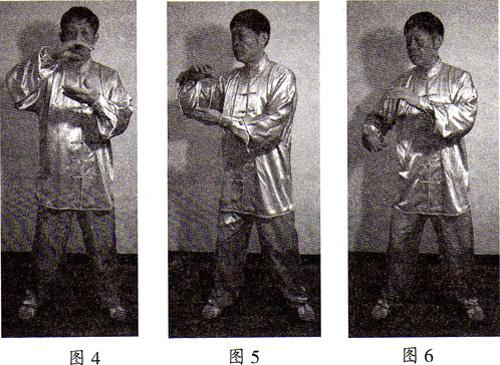
Action Four: The body continues to rotate to the right, and the hands holding the ball continue to move upwards and to the right, the body faces forward. Hands holding the ball are placed in front of the chest, the right hand is up, with the palm facing down, the left hand palm faces up, the right leg bears 60% of the weight, and the left leg bears 40% of the weight (Figure 10).
Action Five: The body continues to rotate to the right, and the hands holding the ball continue to move upwards and to the right, the body faces forward. Hands holding the ball are placed in front of the chest, the right hand is up, with the palm facing down, the left hand palm faces up, the right leg bears 60% of the weight, and the left leg bears 40% of the weight (Figure 10).
Action Six: The body, driven by the rotation of the left hip and knee, rotates counterclockwise to the left, the center of gravity shifts to the left. The hands holding the ball move from (Figure 10) downwards to the right (Figure 11).
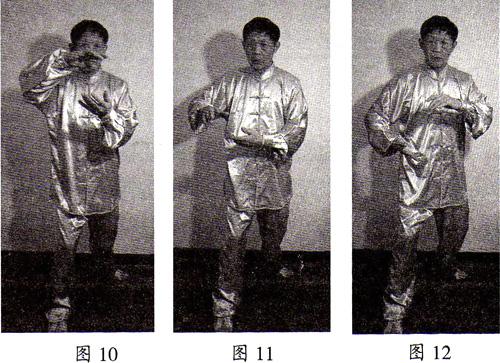
Action Seven: The body continues to rotate counterclockwise to the left, drawing a diagonal vertical circle, and the hands holding the ball move backwards to the left. While moving, the ball is flipped, from the right hand up, left hand down (Figure 12).
Action Eight: Driven by the body’s rotation, the hands holding the ball continue to move backwards to the left, returning to (Figure 7). The left leg bears 60% of the weight, and the right leg bears 40% of the weight. The entire process draws a flat ‘∞’ shaped circle, and the double-ball draws a high-low diagonal vertical circle in front of the body. Then repeat the above actions.
Key Points:
1. Slanted Round Ball Rotation Technique is when both hands holding the ball and the circular motion are drawn in a horizontal circle, while Slanted Round Ball Rotation Technique is when both the knees and hips turn along the horizontal plane, drawing a ‘∞’ shaped spiral circle.
2. The front leg is arched, the knees should not exceed the toes, the weight borne by the front leg should not exceed 60%, and the weight borne by the back leg should also not exceed 60%. Pay attention to opening the.
Above is the method of drawing the diagonal round ball moving forward in a counterclockwise direction. Practice for 3-5 minutes. The method of drawing the diagonal round ball moving backwards is the opposite action, starting with the left hand down, right hand up, also practice for 3-5 minutes.