‘Most Mysterious Bird’ Appears in Poyang Lake Protection Zone; Only Approximately 500 Pairs Remain Globally
Welcome everyone to read 'Jingdezhen Nanhe Public Security' Toutiao channel. If you like the articles published by this Toutiao channel, you can also click the top left corner to follow my Toutiao channel. There are exciting articles recommended every day.
In April, the grass is growing and the swallows are flying. At 8:00 AM on April 7th, patrolling officers of the Wu City Station of the Poyang Lake National Nature Reserve discovered a 'Black Bird' while patrolling the Poyang Lake Protection Zone. After observation through binoculars, the 'Black Bird' was identified as a national level protected animal, the Black Stork.
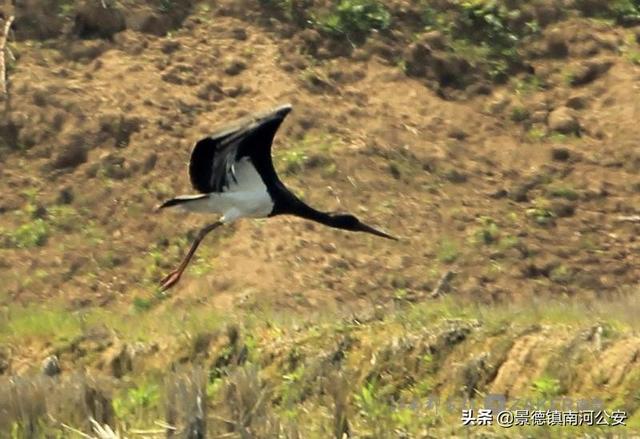
(Photo taken on April 7th of the Black Stork. Due to limited conditions, only one Black Stork photo was captured.)
On the same day at noon, famous photographer Wang Xiaohua, Xu Yong, and Li Zhemin entered the Poyang Lake Protection Zone to look for the migratory bird Oriental White Stork. When the team reached the rice field area bordering Poyang Lake and Yongan, they suddenly discovered two Black Storks drinking water on the meadow. Through a long-focus lens, they saw one Oriental White Stork chasing another Black Stork in the sky, and the two were fighting. Afterwards, they gracefully glided to a patch of bushes about 300 meters away. Thus, three Black Storks had been recorded in Poyang Lake in April.
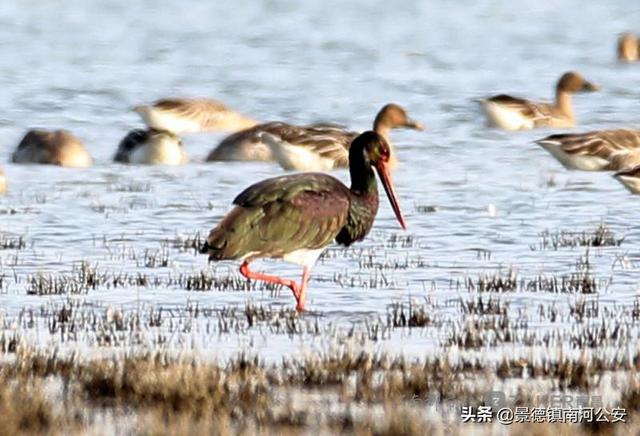
Black Storks recorded in Poyang Lake in recent years
On April 8th, the reporter forwarded the photos to the Jiangxi Poyang Lake National Nature Reserve Administration, and researcher Wen Sibiao was very surprised. He told Jiangnan Urban News all-media reporter that the migratory Black Storks basically migrated north in late March and early April, and it was the first time to find Black Storks in this protection zone in April. This indicates that Black Storks have adapted to the natural environment and climate of Poyang Lake, and their survival environment has become increasingly good. Currently, the Poyang Lake Protection Zone is closely monitoring the migration and wintering bird dynamics to ensure the safety of the Black Stork's habitat.
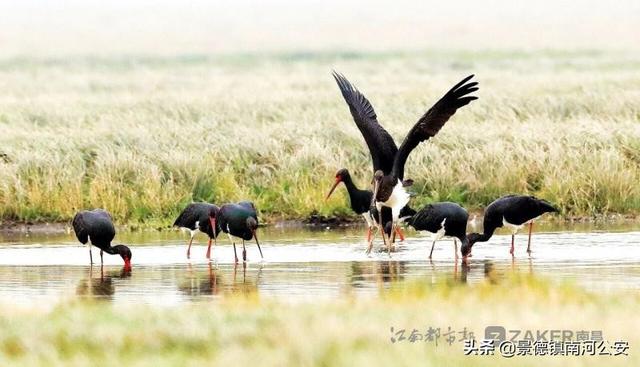
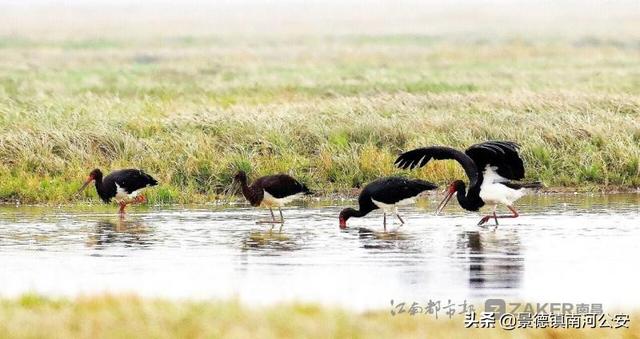
Black Storks photographed in Poyang Lake in recent years
Wen Sibiao introduced that the Black Stork is a national level key protected wild animal, with a rarity level not less than that of the Giant Panda. The current number is still decreasing. This bird has a beautiful figure, bright color, agile movement, and is alert and cautious. It belongs to a large raptor with a strong flying migratory ability. The body length of the adult is 1-1.2 meters, and the weight is 2-3 kilograms. The plumage on its body is mostly black except for the chest and abdomen, which is pure white. It often uses old nests. In recent years, the global population has decreased significantly and has been listed as an endangered species by the Convention on International Trade in Endangered Species of Wild Fauna and Flora.
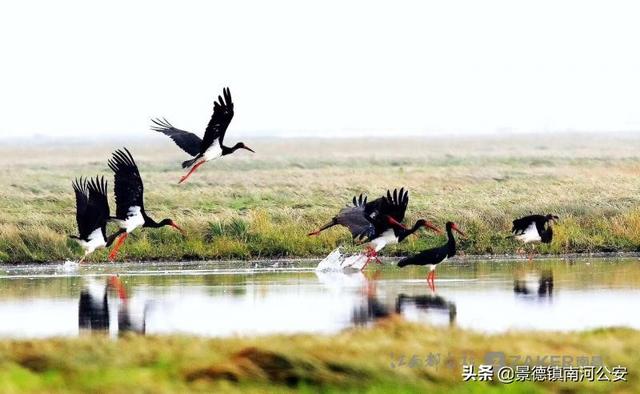
There are only about 500 Black Storks left in the world. Black Storks are solitary, alert and cautious, with well-developed hearing, vision, and is difficult to approach. Black Storks are also called 'the most mysterious bird' by bird researchers.
(Source: China Jiangxi Net, Jiangnan Urban News)