Shanghai Enacts Legislation for Chinese Sturgeon! This Species, Contemporary with Dinosaurs, Awaits to ‘Drink from the Same River’ with Humans
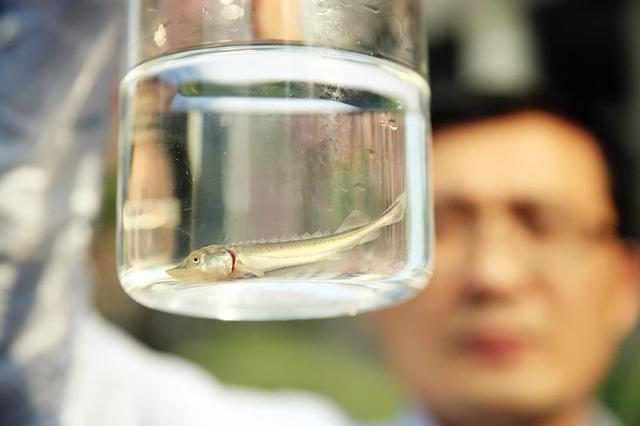
In 2015, researchers in the estuary of the Yangtze River detected wild Chinese sturgeon juveniles, and they have since been difficult to find. (Photo provided by the People's Daily.)
140 million years ago, what was the Earth like? The Chinese sturgeon knows. 140 million years ago, what happened on Earth? The Chinese sturgeon knows. As one of the oldest existing vertebrate species on Earth, the Chinese sturgeon has an extraordinary adaptability, which is facing severe environmental degradation challenges, and its population has declined sharply, currently at a critically endangered state.
Recently, the ‘Draft Regulations on the Protection of Chinese Sturgeon in the Yangtze River’ (hereinafter referred to as ‘the Regulations’) submitted to the 18th session of the Shanghai Municipal People’s Congress Standing Committee for review, this is also China’s first legislation to protect a single species.
Experts in sturgeon said that to protect a fish, it is necessary to protect the entire ecosystem, safeguard human and all aquatic life together, and implement a green development concept of ecological priority. This legislation has a distinctive value orientation – it will make more people realize that protecting Chinese sturgeon is to protect ourselves.
Assess ‘habitable’ parameters to support the restoration of the Yangtze River estuary environment
The Chinese sturgeon is one of the oldest existing vertebrate species on Earth, its scientific, ecological and social value is difficult to estimate. In 2010, the Chinese sturgeon was listed as critically endangered species by the World Conservation Union. It is estimated that the number of wild Chinese sturgeon is less than 100. The main reason for the extreme endangerment of the Chinese sturgeon is environmental change: there is no place to lay eggs, and this species, which existed with dinosaurs, has ‘no offspring’ problems.
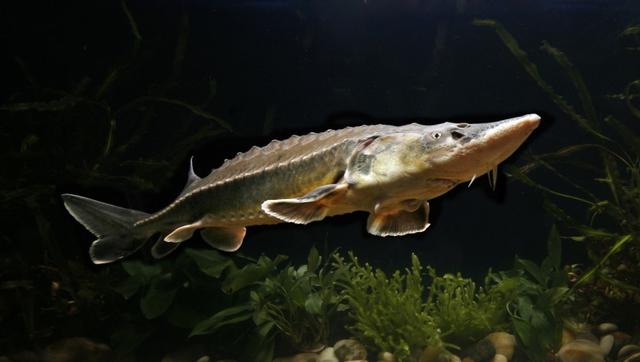
Wild Chinese sturgeon numbers are now less than 100. Photo taken by Zhuang Ping.
According to Zhuang Ping, Director of the East China Fisheries Research Institute of the Chinese Academy of Fisheries Sciences, the Yangtze River segment 2800 kilometers upstream of Shanghai, the Jinsha River segment, is the most stable ‘breeding ground’ for Chinese sturgeon, under the influence of climate and human activities, Chinese sturgeon had to search for new breeding grounds along the Yangtze River.
From the scientific monitoring of Chinese sturgeon, in 2015, in the spring and summer of Shanghai Yangtze River, a large number of Chinese sturgeon juveniles appeared, and since then they have been difficult to find. This means that the Chinese sturgeon’s process of seeking new ‘breeding grounds’ may not be smooth.
To save the endangered Chinese sturgeon, it is first necessary to understand its life history, understand what it lives on, under what hydrological conditions it lays eggs, and under what flow speed conditions it migrates. In recent years, China has increased the protection of rare aquatic organisms such as Chinese sturgeon, and scientific research has gradually kept up, led by Zhuang Ping, the Chinese sturgeon research and protection team from nothing to now, has grown to a considerable extent. They have conducted detailed research on a series of scientific issues that affect the survival of Chinese sturgeon, mastered a ‘habitable’ parameter.
Among the many parameters, one indicator is related to Shanghai – salinity. Chinese sturgeon is a fish that breeds in freshwater and migrates to seawater. During its three-month stay in the Shanghai Yangtze River estuary, it transitions from freshwater to seawater, and every day during this period, its salt demand is different.
Through research, the Zhuang Ping team has mastered the physiological changes of Chinese sturgeon from entering the sea to entering the sea, as well as the influence of different salinity on the growth and development of Chinese sturgeon, the data is precise to the day. This provides important scientific basis for the ecological restoration of the Yangtze River estuary.
Protecting a fish actually means protecting the entire ecosystem.
The ‘fish’ life trajectory of the Chinese sturgeon is closely related to the entire Yangtze River. Zhuang Ping told reporters that according to experience, Chinese sturgeon breeds in the Jinsha River segment in autumn, and the Chinese sturgeon juvenile uses about six months to migrate down the Yangtze River to Shanghai, where it stays for about three months, then migrate into the sea, where it lives for about 20 years before it matures and returns to the Yangtze River to breed.
In addition, as a large fish with a length of 2 to 3 meters, which is the apex predator in the Yangtze River aquatic ecosystem, the Chinese sturgeon relies on the replenishment and support of smaller fish. If the biodiversity of the Yangtze River is damaged, the prey they can feed on becomes less and less, and the risk of extinction is also coming.
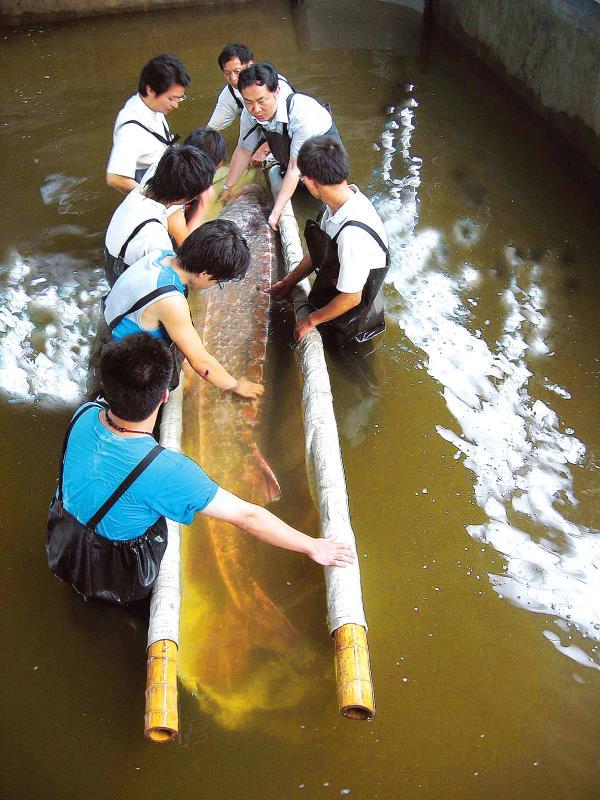
Experts are rescuing injured Chinese sturgeon, and there has been no wild juvenile Chinese sturgeon detected in the Yangtze River estuary for many years. (Photo provided by the People’s Daily.)
‘The more we study, the more we realize that protecting Chinese sturgeon is not just protecting this species, but protecting all the environmental factors that support its survival. They are not rescued just by keeping them in fish ponds or protected areas.’ Zhuang Ping said.
Precisely because of this, Zhuang Ping’s team’s scientific work has gradually shifted from studying Chinese sturgeon itself to studying its relationship with the environment, such as the environmental requirements of Chinese sturgeon at different stages, the ecological scheduling of hydraulic engineering, and the opening of new breeding grounds, etc. He told reporters that as the research scope expands, the research difficulty also increases, such as how to coordinate cross-regional protection and how to handle different regional ecological compensation.
Named after the Chinese sturgeon, let ecological restoration have a legal basis.
Zhuang Ping has been studying Chinese sturgeon for more than 30 years, and he knows the past and present of Chinese sturgeon intimately. His team has also actively participated in the drafting of ‘the Regulations.’ In his view, it is not enough to rely solely on administrative orders to prevent the extinction of rare aquatic organisms such as Chinese sturgeon, it is necessary to provide legal support for protection.
So far, the Chinese sturgeon has been listed as a national level key protected animal, both the Wildlife Protection Law and the Environmental Protection Law have declared the country’s legislative protection attitude to the world. Now, Shanghai’s local legislation needs to ‘run the last kilometer’ to protect Chinese sturgeon, providing a systematic and efficient legal supply, so that Chinese sturgeon can live on in the Yangtze River.
The establishment of ecological compensation, rewards for protectors, and cross-regional collaboration are key institutional innovations in ‘the Regulations.’ Zhuang Ping believes that rewarding protectors is of great significance. All citizens who actively participate in the rescue of Chinese sturgeon and report illegal activities, are granted legal rewards, which will make more people realize that the survival of the Chinese sturgeon is closely linked to each of us.
Zhuang Ping emphasized that protecting Chinese sturgeon is to protect the entire Yangtze River ecosystem. Only when the Yangtze River ecosystem is restored, we can still live with Chinese sturgeon ‘drinking from the same river.’