Blue-Headed Ducks Establish Themselves in Beijing's Dashahai River
Beijing Fangshan district's Dashahai River bank's Honglingjin Park, a little park that is not easily seen, has recently attracted many photography enthusiasts to admire the endangered Blue-headed Duck.
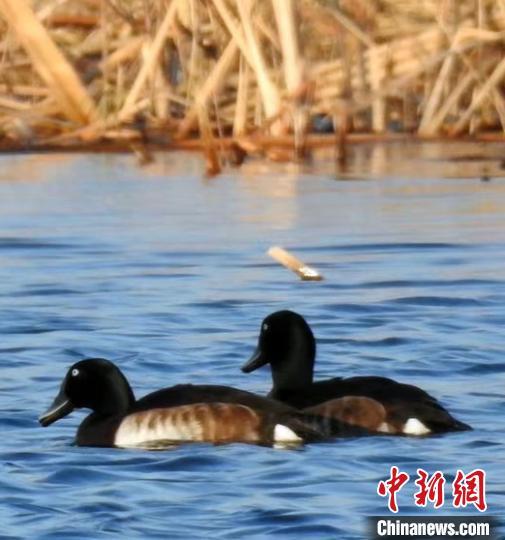
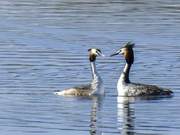
A pair of Blue-headed Ducks are swimming in the water. Photo taken by Guo Geng.
Blue-headed Ducks are migratory birds, typically migrating from southern wintering grounds to northern breeding grounds in mid-March to early April. It was once one of China's common, but due to a sharp decline in population, it has been listed as ‘Critically Endangered’ in the ‘Red List of Threatened Species’ of the World Conservation Union.
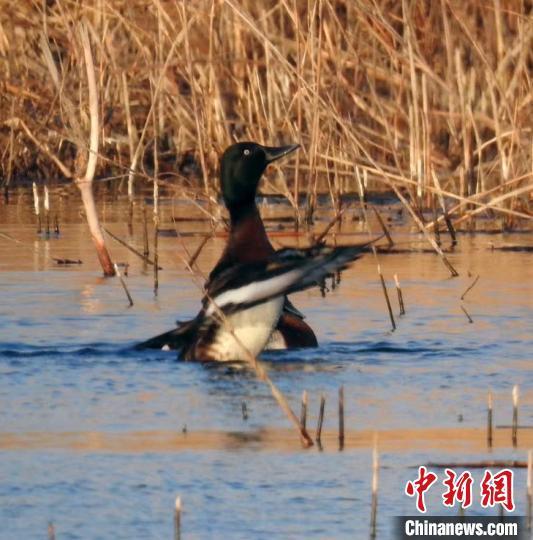
Blue-headed Ducks are migratory birds, typically migrating from southern wintering grounds to northern breeding grounds in mid-March to early April. Photo taken by Guo Geng.
Last spring, 2 Blue-headed Ducks appeared for the first time in Honglingjin Park. Li Li, director of the Black Panther Wild Animal Protection Station, analyzed that the Blue-headed Ducks have arrived at Dashahai River for two consecutive years, and the population has increased, which is not a coincidence. ‘The water quality of Dashahai River is good, which is an ideal habitat for Blue-headed Ducks, and the riverbank provides abundant food sources.’
The Blue-headed Ducks are often grooming their feathers on the water surface, and sometimes dive to the bottom of the river to catch small fish and shrimp. The Black Panther Wild Animal Protection Station has been monitoring these 6 Blue-headed Ducks for more than a month. Li Li found a interesting phenomenon — these 6 Blue-headed Ducks don’t fear people and like to move at a distance of about 100 meters from the people’s camera.
‘Early on, Dashahai River, let alone this rare bird, was rarely seen even by magpies.’ A local birdwatcher from Fangshan said with emotion.
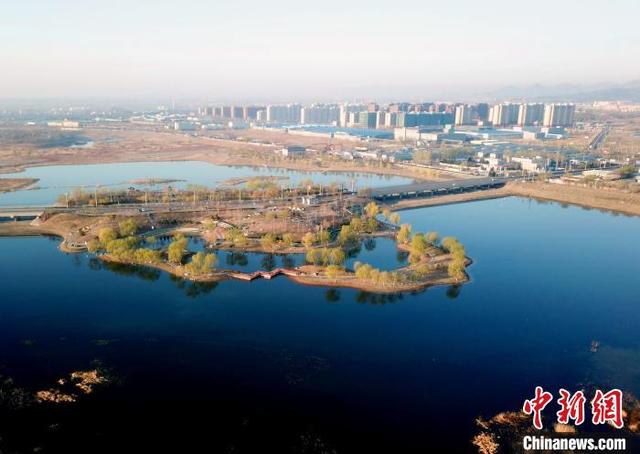
In 2017, the Fangshan Municipal Party Committee and District Government attached great importance to the ecological restoration of Dashahai River and invested a lot of manpower and materials to build sewage treatment facilities. Fangshan ecological environment bureau provided pictures.
Early on, Fangshan was known as ‘Little Cinderella’ because of its abundant high-quality coal, cement and slate. As the mother river of Fangshan, Dashahai River was dimmed because of pollution from enterprises in the basin, and its water quality was very poor, let alone attracting birds to live in it.
Li Xin, a responsible person of Fangshan ecological environment bureau, introduced that in 2017, the Fangshan Municipal Party Committee and District Government attached great importance to the ecological restoration of Dashahai River and invested a lot of manpower and materials to build sewage treatment facilities. As of now, 29 sewage treatment facilities have been built in the Dashahai River basin, with a daily processing capacity of 193,000 tons, and 4 facilities are under construction, with a daily processing capacity of 26,000 tons, which basically meets the sewage treatment needs of the Dashahai River basin. (Completed)
Source: China News Agency