Archaeological Remains Around the Great Buddhist Temple Village
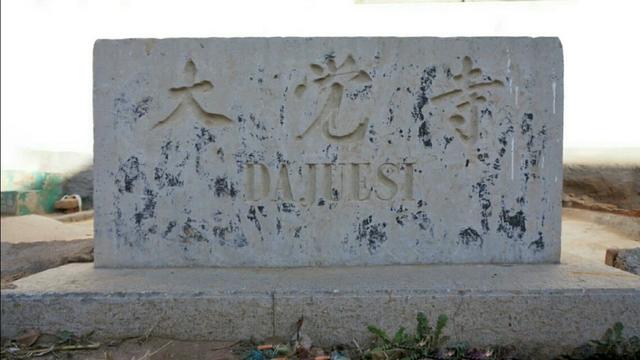
With the mighty Yellow River nurturing a splendid Chinese civilization, the frequent floods of the Yellow River have brought immense suffering to the Chinese people, and countless cultural relics have been lost forever. The Great Buddhist Temple is one such example.
From Qingjin District, Jinan City, Guiquan Township, Duiguang Village, along the ancient Bingu River west for about one kilometer, we arrived at the Great Buddhist Temple Village. There is a tomb mound west of the village's old village, and since the tomb mound's earthen structure is higher than the surrounding fields, a temple was built on the tomb mound during the Wu De years of the Tang Dynasty. The ancient people worshipped 'Awakening Buddha' as the deity enshrined in the 'Three Halls,' hence the name Great Buddhist Temple. When the Yunxiu clan established the village in the Tianyuan years of the Tang Dynasty, the villagers named the tomb mound and the temple 'Tomb Temple Village.' During the Qing Qianlong years, the tomb mound was renamed 'Great Buddhist Temple'.
It can be said that the former Great Buddhist Temple Village had a flourishing palace and temple, with numerous cultural relics. The exact number of ancient buildings surrounding the tomb mound was unknown. However, the underground tombs were numerous. But due to the Yellow River problems, the land around the village was flooded and silted up, and after repeated floods, the historical remains remaining around the village became increasingly scarce.
From the Qing Qianlong years to the 1960s, the villagers continuously dug up soil from the tomb mound to raise the foundation, in order to evade the threat of floods. The earthen tomb mound was greatly reduced in height, but the Great Buddhist Temple, Tianqi Temple, and other ancient buildings were still relatively well-preserved at this time.
In order to fundamentally avoid the Yellow River problem, starting in 1979, the entire village of the Great Buddhist Temple was relocated to the east of the old village, about one kilometer to a higher location, and a new home was built. The old village and surrounding areas were turned into fields. This relocation, in effect, brought to an end the accumulation of a brilliant culture, which suffered a devastating blow.
Coincidentally, or perhaps fortunately, a few stone cultural relics from different historical periods were still preserved in the vicinity of the Great Buddhist Temple Village, which made them even more precious.
On an afternoon in April 2020, famous photographer Cao Jiemin, along with cultural relic protection expert Han Tie, together with the author, embarked on this archaeological journey to investigate these historical remains.
The car was stopped beside a pond to the west of the village. Under the guidance of several enthusiastic villagers, we first arrived at the Han Dynasty stone, known as 'Bird and Fish Stone,' which dates back to the Eastern Han Dynasty.
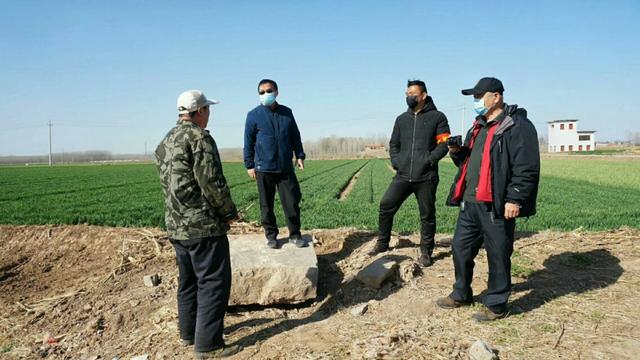
This is a rectangular stone measuring 1 meter by 1 meter, with a thickness of 35 centimeters and a weight of about one ton. On the upper right side of the front, 'Bird and Fish Offering Fish' is engraved, and 'Qiang Stone Can Seven Hundred' is engraved below. The image of a bird carrying a fish is easy to understand, while the meaning of 'Qiang Stone Can Seven Hundred' remains a mystery to everyone present. Historian Li Xianxin has interpreted this as 'Qiang, likely referring to sheep; this phrase may have been used as a marker for quantity or distance.'
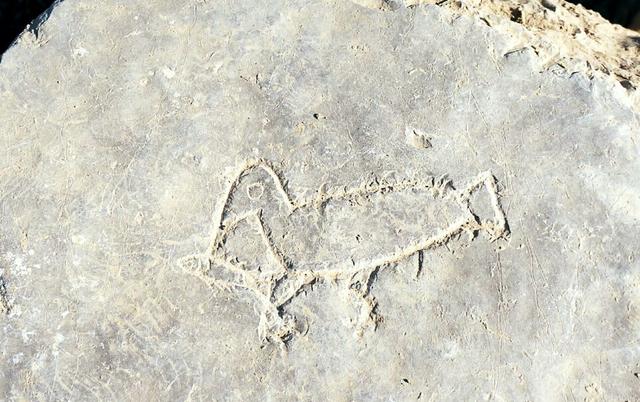
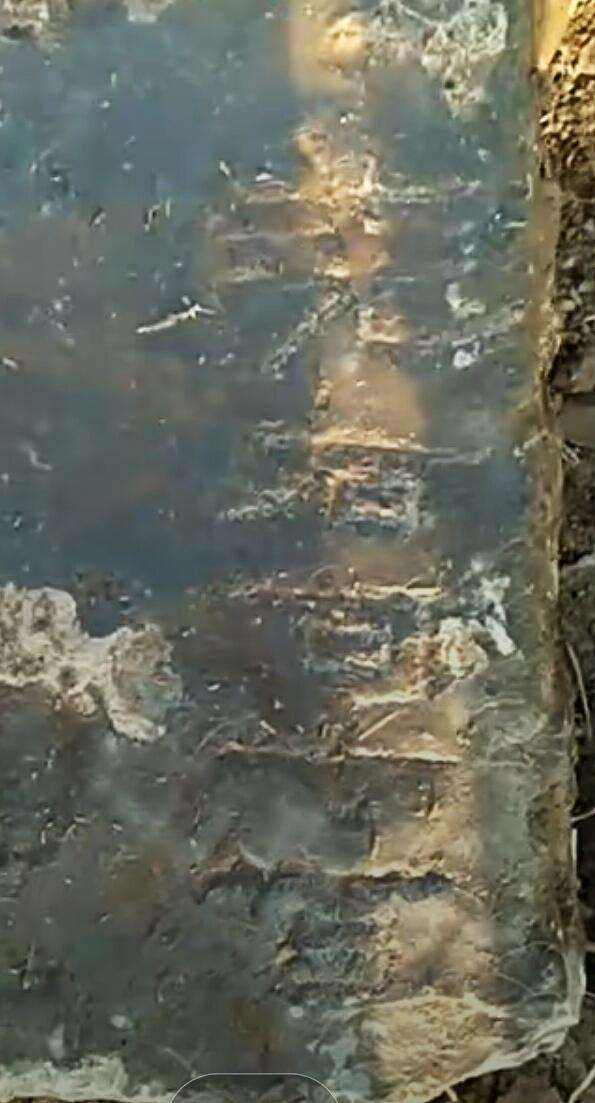
Cultural relic protection expert Han Tie introduced that this square stone with engraved fish and bird characters is a tombstone from a Han Dynasty tomb near the site, which was excavated in 2003 and yielded stone amulets and jade artifacts. He also participated in the excavation and sorting of this tomb at that time. 'Although this stone and its engraved images are crude and clumsy, they are still valuable cultural relics from 2,000 years ago, so this heavy stone is certainly of cultural value,' Han Tie said.
From this square stone, walking south for dozens of meters, and then west for a short distance to the north of the road, there is a rectangular stone tablet lying horizontally on the sloping road. The stone tablet is 180 centimeters long and 75 centimeters wide, with a thickness of 25 centimeters. The central part between the upper and lower parts of the tablet is protruding, providing a fixed cap and base for the tablet. Including the cap and base, the total height of the stone tablet is about two and a half meters.
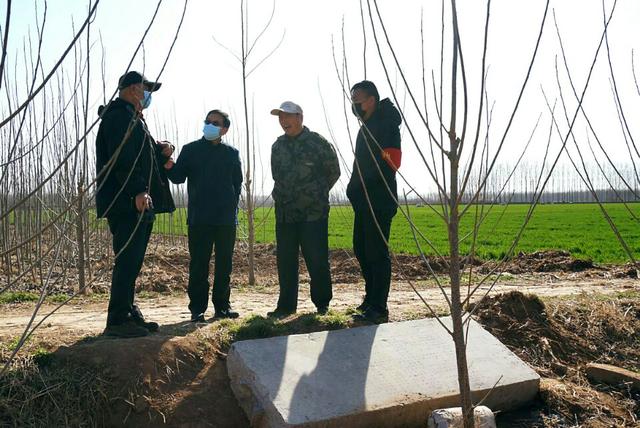
The inscription on the front of the stone tablet is 'Record of Rebuilding Tianqi Temple,' which means 'Mount Tai, the sacred mountain of China, is the god who governs life and death and oversees the underworld.' It is said that there was a temple beside the temple, but it was unknown how it came to be. This place was called Guzi Kingdom in ancient times, and the Jiang family was granted a fief by King Wu of Zhou, and it continued until the late Tang Dynasty. When the Northern Song Dynasty (Southern Song Dynasty, established by the Han people) general, Tan Daoji, attacked the Northern Wei Dynasty (established by the Xiongnu), he suffered a defeat and buried himself here, building a false grain tomb. The Northern Wei Army thought that the Southern Song Army still had a lot of grain, so they didn't pursue it, which is one of the reasons. The bottom of this false grain tomb was the tomb of General Tan Daoji of the Southern Song Dynasty.
This temple was built in the 11th year of the Chongde reign of the Ming Dynasty. A man named Jiao Bowen and his nephew, along with others, built the temple. Just as the building was completed and the statues were not yet painted, it was suddenly set on fire, and at the end of the Chongde reign of the Ming Dynasty, there were frequent wars, so everyone dispersed and returned home. This caused great trouble.
During the Qing Dynasty, with the establishment of the Qing Dynasty, the wars were quelled, and the world was peaceful. A man named Jiao Xian had a thought: 'The statue has not been painted, and the worshippers who built the temple have all perished in the wars. There is no news of them, so they are saddened and mournful, and they continue to repair and rebuild the temple.' So, he and his neighbors raised funds to repair the temple. After the temple was rebuilt, the villagers said that this was a good thing and a good deed. Therefore, the villagers of all genders donated their money and worked together to raise more than twenty taels of silver to rebuild the temple. All the craftsmen voluntarily came forward, and at this time, there was a monk in residence and young novices, and everyone worked together.
At the end of the year, the monks held a ceremony to pray for salvation and celebrate the good deed. Mr. Yuan Liang, the head monk, wrote a decree, saying that even if there were no ancient relics or ancient people, how could they be remembered? In the temple, they engraved stone tablets to commemorate the ancient people. If they were to write down the stories of famous writers and poets traveling through the mountains and rivers, with magnificent scenery, surrounded by mountains, this would not be written. Or if it was a noble official climbing the mountain to admire the beautiful scenery, I would never write such an article. Mr. Yuan Liang wrote this inscription.
The stone tablet was made in the 44th year of the Kangxi reign of the Qing Dynasty, and the author of the inscription was Yuan Liang, who was born in December 1705. Yuan Liang was a Jinshi in 1694. So why did a Jinshi from Yucheng come to write this inscription, we do not know.
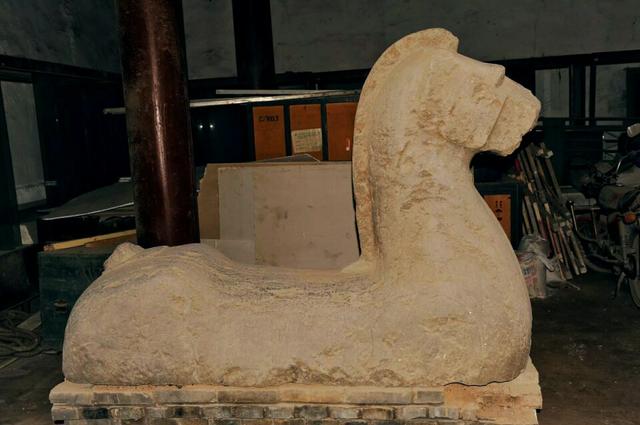
Leaving the village is a vast expanse of flat land. Finally, the group drove to the east corner of the Great Buddhist Temple Village, where they stopped at the side of a pond, and at that location, there is a very large turtle stone, which is worth seeing.
The author and Mr. Cao pulled out a ruler and measured the turtle stone. The length is 2.7 meters, the width is 1 meter, and the thickness is 0.7 meters. The head is 0.6 meters long, and the circumference is 1.65 meters. Looking at it straight, the weight is about five thousand kilograms.
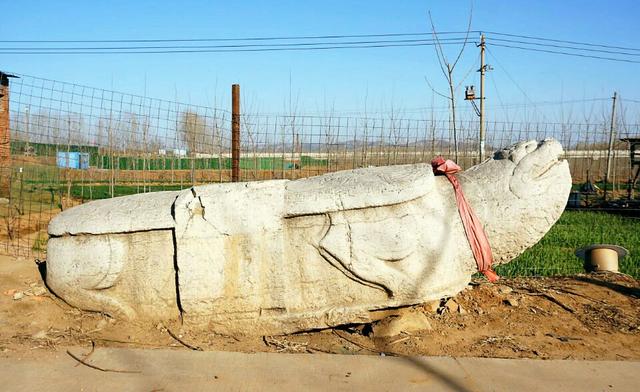
The base of the turtle stone was originally located inside the Great Buddhist Temple's southeast corner in the old village. In the 1960s, when the temple was demolished, the stone tablet was broken and destroyed, and the base of the turtle stone was reduced to rubble. In the 1980s, the villagers who had moved to the new village saw the turtle stone lying in the old village and no one was taking care of it, so they used a tractor with a powerful engine and tied it to a steel wire and dragged it to the top of the village to place it.
Due to the tremendous changes in the Great Buddhist Temple Village, after the village'﹗s old village was demolished, and due to the large-scale relocation, the brilliant culture has gradually disappeared. The stone amulet, which is now a cultural relic, was excavated from the site in 1983 and is currently on display in the old hall of the Great Hall of the People.
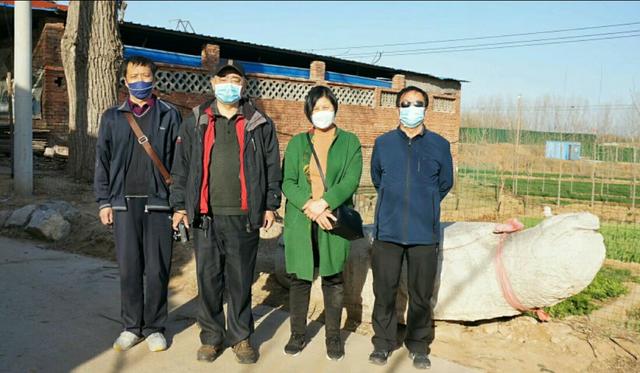
(During the writing of this article, I expressed my sincere gratitude to Mr. Zhang Houyi and Mr. Zhang Jiu for their enthusiastic support. )
“”