It's Knowledgeful! These Three Characters ‘Double Dragon Cave’ Were Written by This Person! Do You Recognize Them?
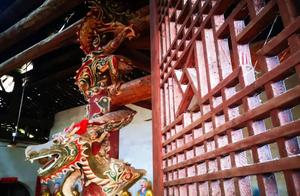
Golden Hill Mountain has a famous tourist attraction called Shuanglong Cave, connected to Ice Boat Cave, renowned for its rugged rock formations, cave wonders, clear springs and streams, and cliff carvings. Its most distinctive features are the 'Boat in Double Dragon' scene and the 'Waterfall Dropping Ice into a Boat' phenomenon, forming the core scenic area of the Golden Hill Double Dragon Scenic Area. Chinese modern educator and writer Ye Shengtao visited after touring and wrote a travel account 'Record of Two Caves in Jinhua', which was included in the elementary school textbooks published by People's Education Publishing House, making the beautiful scenery of Shuanglong known throughout the world.
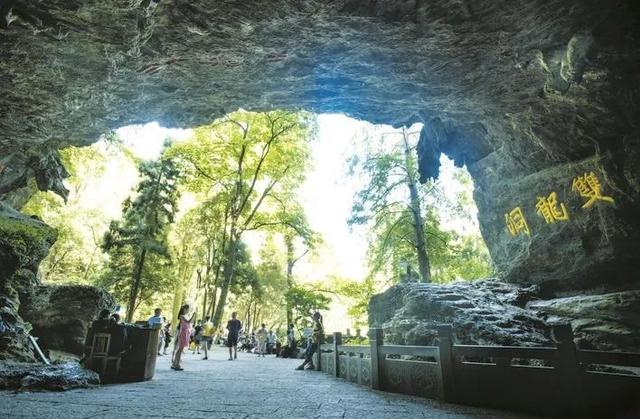
Golden Hill Double Dragon – Heng Bing / Photography
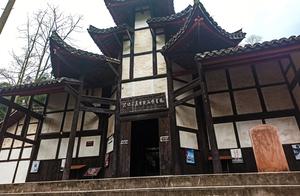
Approaching Double Dragon Cave, you can see the right side of the cave entrance with the carved 'Double Dragon Cave' (in traditional Chinese characters) from a distance. Tourists like to take photos in front of the inscription to mark their visit.So, who actually carved these three characters?
In 1988, the book 'Golden Hill and Ancient Sites' edited by Lu Biao was published, which stated: 'Three large characters 'Double Dragon Cave' are carved on the western wall of the cave entrance, which is said to be the work of a Tang Dynasty person.' In 1991, the 'Golden Hill Culture Chronicle' published by Golden Hill City also said 'the three characters 'Double Dragon Cave' were said to be the work of a Tang Dynasty person.' Even the Golden Hill City Local Chronicle compiled by the Golden Hill City Local Chronicle Compilation Committee and published by Zhejiang People's Publishing House in 1992, in the 1106-page 'Double Dragon Scenic Area' section, also recorded 'cliff carvings, 'Double Dragon Cave' three large characters were said to be the work of a Tang Dynasty person.' Subsequently, the 'Golden Hill Scenic Area' published in 1997 also described 'the three characters 'Double Dragon Cave' on the western wall of the cave entrance, which is said to be the handwritings of the Tang Dynasty.' In 2011, the 'Golden Hill and Wucun Gazetteer' published by Fang Zhi Publishing House in 8 months recorded 'the three characters 'Double Dragon Cave' on the western wall of the cave entrance, which is said to be the handwritings of a Tang Dynasty person' in the 1296-page 'Main Attractions' section.
'Said to be the handwritings of the Tang Dynasty' is a vague statement. The Tang Dynasty people referred to were nameless and without surnames, just a legend, and its credibility is not high. The Double Dragon Cave has several prominent cliff carvings, 'Ice Boat' is written in calligraphy by Wu Lin in the Song Dynasty, and 'Thirty-Six Cave Heaven' is the handwritings of Yu Zuohui in the modern Chinese education and calligraphy world. Only the largest and most prominent 'Double Dragon Cave' three characters are attributed to an unknown writer, and are described as 'said to be the handwritings of the Tang Dynasty.'
It is confirmed that the writer of these three unidentifiable characters was 'Ceng Yaofu' who lived in the 1930s.
First, from the naming time of Double Dragon Cave. The naming of Double Dragon Cave began in the Song Dynasty, and it was not called 'Double Dragon Cave' before that. Liu Zongyuan wrote 'Letter to Liu Qichang about Jinhua Caves' in the Tang Dynasty. The Five Dynasties Post-Jin Prince Qi also wrote poems about 'Jinhua Caves'. The 'Jinhua County Chronicles' in the Ming Dynasty Jiajing years recorded that 'in the eighth month of autumn in the first year of the Emperor's reign (1086), the Marquis Zhang Shiyu and his attendants Lu Yu visited the three caves north of the mountain, and named the upper one 'Morning Truth', the middle one 'Ice Boat', and the lower one 'Double Dragon.' The Juhou Supervisor Jin An designated three steles.' This can be identified as the earliest written records of Double Dragon Cave, Ice Boat Cave, and Morning Truth Cave. Let's take a look at the records of the stone carvings. Lu Biao's 'Chronicles of Wuzhi' edited in 1932 and 'Stone Classics' in the 11th volume, and the 'Art and Literature' section of the Qing Dynasty 'Golden Hill County Chronicle' in volume 15, all described the cliff carvings in the Golden Hill Mountain (Golden Hill Mountain) in detail, but only the three large characters 'Double Dragon Cave' on the right side of the entrance to Double Dragon Cave were not mentioned. This means that at least before the publication of the Qing Dynasty 'Golden Hill County Chronicle' in 1894, i.e., before 1894, 'Double Dragon Cave' these three characters were not there.Secondly, from the inscription of the characters. The 'Double Dragon Cave' three characters actually have a writer's signature. Mr. Wang Changlin, the original director of Golden Hill Double Dragon Scenic Management Office, is 78 years old this year. In May 5, 1984, as the chairman of the Golden Hill City Double Dragon Resource Investigation Team, he led a related team to conduct a special investigation in the Double Dragon scenic area, and worked in Double Dragon for 23 years, which is a 'living map' of Double Dragon Scenic Area. I am a journalist at the newspaper for 30 years, and I have interviewed Wang Changlin many times, and we are old friends. Recently, I specifically asked him about the origin of the 'Double Dragon Cave' cliff carvings. Mr. Wang Changlin said that during his work in Double Dragon, according to the feedback from local people, 'Double Dragon Cave' these three characters had a writer's signature, which was later smeared with cement. Therefore, Mr. Wang Changlin repeatedly climbed to the location of the signature on the cliff wall to carefully search and observe, and finally discovered the faint and identifiable 'Ceng Yaofu' three characters. This is an undeniable fact, and the traces are still visible today.
Who was 'Ceng Yaofu'?
I specifically reviewed the materials. 'Ceng Yaofu' is introduced in 'A Dictionary of Famous Figures in the Republic' and Baidu Encyclopedia. 'Ceng Yaofu' (1898—1969), original name Ceng Xianhao, alias Yaofu, from Guangdong Pingyuan County. He graduated from Tianjin Beiyang University in 1923 and worked as a researcher in the Chinese Government General Command Bureau after graduation. After returning to China in early 1925, he participated in the Chinese Revolution and served as the director of the Chinese Communist Party's behind-the-scenes Bureau's political department. After 1927, he served as the director of Zhejiang Province's Construction Bureau and concurrently served as the chairman of the Zhejiang Provincial Railway Council and the chairman of the Construction Committee of the Yangtze River Bridge Committee. In 1938, he was elected as a member of the National Government's Executive Committee and served as the Director of the Provincial Finance Bureau of Guangdong. After the occupation of Guangzhou in October 21, 1940, he organized the Anti-Japanese Guerrilla Command Office in Guangning County and served as the commander-in-chief, which was a responsible task for supplying the front lines and the civilian population. After 1945, he served as the director of the Military Committee's Western Transportation Bureau and concurrently served as the director of the National Government's Transportation Committee, responsible for organizing the construction of the back-line transportation of the anti-war and maintaining the transportation needs of the front lines. After 1949, he served as a member of the National Government's Legislative Committee. After going to Hong Kong, he went to the United States and Japan for medical treatment. He died in Hong Kong on August 28, 1969, at the age of 71.
It is reported that Ceng Yaofu, inherited his family's tradition, was intelligent and studious, diligent and capable, and had a passion for calligraphy. In 1931, Ceng Yaofu was appointed as the director of Zhejiang Province's Construction Bureau and concurrently served as the chairman of the Zhejiang Provincial Railway Council and the chairman of the Yangtze River Bridge Committee Committee. During his tenure, he oversaw the construction of the Yangtze RiverAndre Bridge and the Zhejiang Provincial Railway. It can be said that his record is credible.
In summary, a large number of materials have been verified and the origin of the three unidentifiable characters has been confirmed to be Ceng Yaofu's.
Source | Golden Hill Daily
Reporter |
“”
1937“”“”19351937“”(1906-1957) 19301957
“”
|
|