Report Spring, Welcome Spring! Newly Planted Willows Stretch Three Thousand Miles, Drawing Forth the Spring Winds to Cross Jade Passes
''
On the ninth day of the ninth month, when viewing willows along the river, the earliest spring bloom was not peach blossoms, but willows.
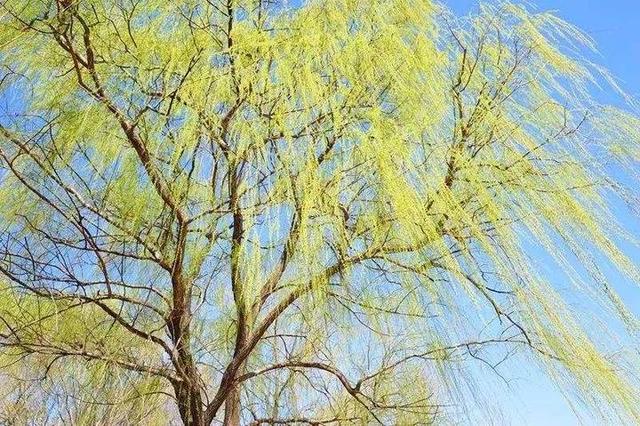
At the time of the Spring Equinox, with the rising of yang energy, the earthly gas in the willow branches fluctuated in the afternoon, and it could be vaguely seen from afar that the willows were turning green, marking the awakening of the willow buds. Every branch opened its eyes, telling people that spring was coming!
When the rainy season and the vernal equinox arrived, accompanied by drizzly winds and rain, willow buds adorned the branches, one willow tree after another, presenting a fresh green hue. This was the freehand artistry of early spring. In the fields, people began to engage in spring plowing, and in courtyards and along the village bank and riverbank, peach blossoms, plum blossoms, pear blossoms, and rapeseed flowers competed to open, and the arrival of spring was marked by a riot of color.
After the Spring Equinox, the willow trees' top branches were full of fresh green. The newly returned swallows were busy building nests among the willow branches, and soon they would hatch a clutch of swallow chicks. On the morning of the Qingming Festival, willow branches were displayed on door panels throughout the village, and young village boys wore hats woven from willow branches, blowing willow flutes, running and laughing, which disturbed the chickens and dogs in the village, prompting them to excitedly follow along. The roosters and hens flapped their wings, and the dogs barked and ran, creating a joyful scene.
With the passing of the Grain Rain Festival, the temperature rose day by day, and the willow catkins began to float in ponds, in villages, and in fields. Some mischievous willow catkins even flew into people's necks, hair, eyelashes, and even their noses and bowls. Countless wheat ears began to blossom and pollinate, and the cuckoo birds sang their melodies in the morning sunlight. The warm spring breeze brushed across the world, enveloping the entire village in a fairytale-like atmosphere.
After the Summer Solstice, the willow trees' foliage became lush and dense, turning a deep, dark green. The sun's rays cast dense willow shade in the afternoon. Villagers liked to rest under willow trees by the ponds, fanning themselves with fans while chatting and dozing. Cotton and corn fields were scorching in the summer heat, but the willow trees around the well-fields of the village stood guard, providing a cool respite. Villagers carried buckets of cool water from the well to quench their thirst, and as the wind blew through the willow branches, the laughter of elders, aunts, and young wives filled the air.
As autumn arrived, accompanied by frost and dew, the willow trees transformed into the fashionable long hair of young girls, and when bathed in the setting sun's golden light, they burned brilliantly. The autumn wind rustled through the willow branches, causing leaves to fall, and on the water surface, falling willow leaves drifted like small boats, heading towards the distance. The autumn moon shone through the willow branches, casting mottled shadows. Children didn't want to go to sleep, instead they played hide-and-seek, jumped rope, and killed lambs under the mottled tree shadows, and the joyful laughter and voices echoed throughout the village. The moon maiden looked at the happy children with a kind expression.
Until the heavy snow fell, the willow trees shed their last leaves, leaving only branches swaying in the cold wind. During the winter gloom, on the ninth day of the ninth month, the deep frost brought a biting cold. The north wind whipped through the willow branches, and the flexible branches fiercely resisted, even when frozen brown by the cold wind, as long as they remained connected to the main trunk, their veins would surge with blood, exhibiting unwavering resilience. When the new year and the Spring Equinox arrived, they would revive with vigor.
I marveled at the tenacious life force of the willow trees. As long as there was soil and moisture, they would always grow strong. Look, my hometown is located in the Yellow River Basin, and whether it's along ponds and canals, behind houses and courtyards, or along the riverbank and saline wasteland, willows are everywhere.
When I was 18 years old, I said goodbye to the large willow tree at the village entrance and stepped into the outside world. In the 30 years since, I have traveled through the mountains and rivers of China. I was once intoxicated by the beauty of West Lake in Hangzhou, lingering by the White Terrace's 'one willow tree, one peach blossom', and returning to 'Willow Wave, hear the warbler's song' with its lush, verdant foliage. I was also amazed by the imperial willows at the Summer Palace and Houhai Lake, which possessed a unique charm.
Last autumn, I participated in an art exhibition in Lhasa and had the opportunity to see Princess Wencun's hand-planted 'Princess Willow' behind Potala Palace. It's rare to see trees survive in the Qinghai-Tibet Plateau, but the Princess Willow has miraculously endured for over 1,300 years, accompanying Princess Wencun in history.
Last summer, I traveled to Huhongliao in Northeast Inner Mongolia, where I saw the Nine Bends and Eighteen Turns of the Ugal River flowing through the Urumqi grasslands, with willow trees growing on the right bank of the river. The willows in the Bingtan Township were also planted, and a local writer told me that it's the coldest place in winter, reaching -40 degrees Celsius, and only willows can withstand such extreme cold.
I also went to Pingli in Gansu Province and witnessed the Dao Willow planted by General Zuo Zongtang during the Western Campaign of the Qing Dynasty two to three hundred years ago. These willows thrived in the desolate Gobi desert. Locals called them 'Zuo Gong Willow'.
At the same time as Zuo Gong, Yang Changjun, a Qing official, wrote a poem: 'The chief general didn't hasten to return, the Southern Ming scholar full of mountains and rivers. Five willow trees planted three thousand miles, prompting the spring wind to pass through Jade Pass'