You are not wrong, just too weak: One inch is better than one foot

Life is a live broadcast with no retakes, everyone's time of existence is limited, so no one wants to be a loser buried in the dust. Those who don't want to be a loser will choose to make themselves stronger and stronger.

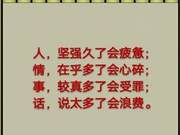
It's better to do one inch instead of one foot; it's better to do instead of dreaming; even the best wishes must be realized through action; even the best ideas must be tested through action.As the saying goes: 'Action is closer to success than dreams.' Yes, it's better to do one inch instead of one foot, heart moving is not action, even the best wishes must be realized through action, even the best ideas must be tested through action.
Lenovo's chairman, Xiaomi CEO Lei Jun, used his entrepreneurial experience to prove this saying.
Lei Jun was born in 1969 in Xianfeng, Hubei. In 1987, he was admitted to the Department of Computer Science at Wuhan University. Wuhan University was one of the earliest colleges in China to implement a credit system. As a freshman, Lei Jun set strict requirements for himself and took many advanced-level courses, so he only took two years to complete his studies and graduation design. Everyone must have thought that Lei Jun was always studying credits during his university years, but not at all. He wanted to start a business!
When he thought of it, he immediately did it! During his third year of summer vacation, he and his classmate Wang Quanjun and Li Ruhong, four people, established the company called 'Three Colors'. The company's main business was to sell a counterfeit version of Lenovo's Gold Card. They named their first startup company 'Three Colors' in the hope that the three primary colors red, yellow, and blue could create a colorful new world.
At the beginning, the four partners rented a room in a restaurant as an office, and everyone was busy and bustling during the day, running the market to promote and doing research and development at night. They were tired and went straight to the office to lie down. As they saw that their products had become somewhat promising, who knew that a large company copied their products and sold them at a slightly lower price, which caused 'Three Colors' to be in a difficult situation, and after six months, they had to reluctantly dissolve the company.
Although this entrepreneurial failure, Lei Jun gained a lot. During the establishment of 'Three Colors', Lei Jun collaborated with Wang Quanjun to write his first official work, BITLOK encryption software. He also wrote 'Immune 90' using Pascal, which won the Hubei Provincial University Science and Technology Achievement First Prize. This laid a solid foundation for Lei Jun's next venture.

After graduating from university, because of the downturn in the market, Lei Jun temporarily abandoned his entrepreneurial idea, just wandered around in the computer market, doing whatever he could make money, to accumulate some connections and popularity. In 1992, he and his colleagues wrote the book 'Deep DOS Programming' together, and later he widely explored encryption software, antivirus software, financial software and various small tools, and even did PCB design, and for a while he also did hacker. He struggled in the computer industry for several years, and Lei Jun got to know bosses of various computer companies, and he gained a little fame on Wuhan Electronic Street.
At this time, Lei Jun felt that it was time to join a company with promising development prospects and show his fists. So, in early 1992, he officially joined Lenovo, and successively served as Manager of Lenovo Beijing Development Department and General Manager of Lenovo Beijing Software Company.
In the 1990s, Lenovo was a landmark software enterprise in China. However, in 1996, Microsoft entered the Chinese market and released Office Chinese version, Lenovo's core product WPS was attacked by Microsoft and piracy, and almost closed down. However, 27-year-old Lei Jun had ideas and was very action-oriented. He insisted on doing WPS and mobilized all the excellent talents to do WPS, which led to the subsequent creation of Lenovo's (BaWang) – a powerful command-line tool, (DuBiBa) – a powerful decryption tool, and game. All of these were to earn enough money to support the WPS team.
Lei Jun entered Lenovo at 22, and spent 16 years in Lenovo, during which he completed Lenovo's IPO and listed work. In December 2007, Lei Jun resigned as CEO of Lenovo due to health reasons. But his influence in Lenovo always existed, so in 2011, the Lenovo Software Board of Directors nominated Lei Jun as Chairman, and more than 40-year-old Lei Jun returned brilliantly, taking over Lenovo Software, and founding Xiaomi Technology.
When starting Xiaomi, Lei Jun refused to accept any interviews or release any news, concentrating all his energy on how to make his products well. After two months, he found 100 users. But he was still grateful to these 100 customers, so the company not only added their names to the company's directory, but also wrote their names into the startup screen, and a miracle happened, everyone passed on to each other, Xiaomi mobile phone users quickly reached 15 million, MIUI users even exceeded 200 million. At this time, he realized that with a simple idea and a simple action, he had found the right person and the right thing, and achieved his own glorious life.
Under Lei Jun's leadership, Xiaomi mobile phones, which were affordable, swept across Asia, and he was elected 'Asia's Commercial Man of the Year 2014' by Forbes in 2014 with a fortune of 28 billion yuan.
2014“2014”280“”

“”