Are Harp Seals' Greeting Methods So Cute and Silly?
During the breeding season, harp seals will clap their hands, warning off competitors, and attracting potential mates.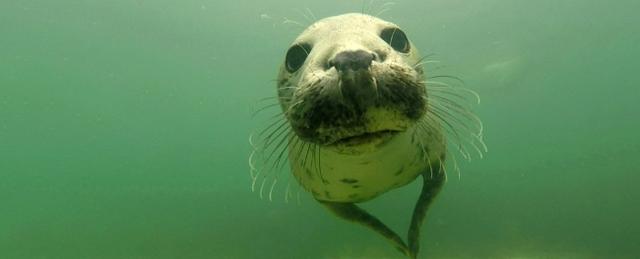
Wild harp seals clapping underwater. Photo by Ben Burvill
Have you ever clapped to get someone's attention?
The resulting '!' sound is hard to ignore, it can cut through all background noise.
But if you're clapping underwater, you're unlikely to achieve the same effect.
Surprisingly, a new study shows that during the breeding season, harp seals do this: they clap their hands, warning off competitors, and attracting potential mates.
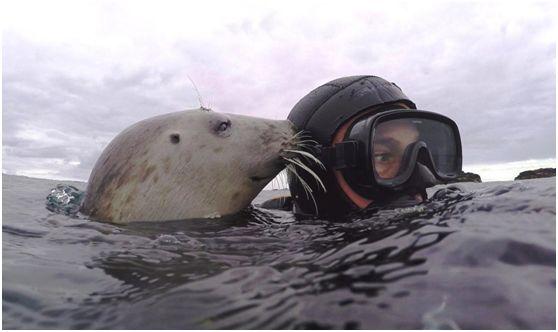
Ben Burville and a wild harp seal. Photo by Ben Burville
Why is this unusual?
Like their land relatives, marine mammals primarily communicate using sound, think of the whistles of dolphins or the famous songs of humpback whales. Harp seals are no exception, and in fact, their communication is diverse.
Besides the strange 'rup' and 'rupe' sounds that seals typically make in the wild, some captive animals are even trained to play 'Star Wars' theme!
Calls are only half the story. Many marine animals can also make slapping sounds, such as using fins or tails to slap the water. This typically happens at the surface and only with one fin at a time.
What sets harp seals apart is that, like humans, they can clap their hands, and do so entirely underwater.
It took 17 years to capture this behavior
It was no easy feat to record this moment in time, 'seal diver' Ben Burville used 17 years to capture the moment
Ben was not unfamiliar with clapping himself. He had heard this sound while diving with harp seals during their breeding season. Researchers also detected similar noises using underwater microphones, but they were mistakenly identified as vocal signals.
It wasn't until Ben actually saw a male harp seal making a 'hand-like' fin movement to 'clap,' that he finally confirmed the true source of the sound. However, the act of clapping is quick and difficult to capture: when he raised his camera, the act of clapping was already finished.
Years passed until October 2017, when Ben captured the behavior while diving near the Farnes Islands in the UK: a male harp seal clapped seven times in front of him.
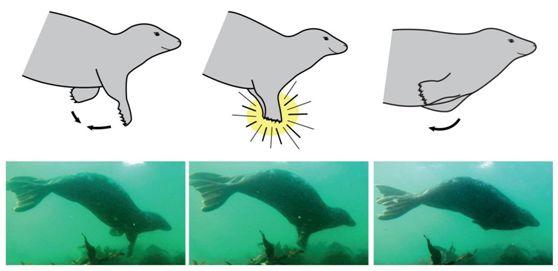
Photo courtesy of Ben Burville, simulation courtesy of David Hocking
Why do harp seals clap?
Initially, this discovery didn't seem strange. After all, seals are known for performing this behavior in zoos and aquariums. However, there's a key difference: captive animals (usually seals or sea lions) are trained to clap for entertainment, while harp seals do so for themselves and in the wild.
So, why do they do it?
Imagine being in a noisy room, with everyone talking. It can be difficult to get someone's attention unless you make a very formal announcement. That's why clapping is useful: a sharp, loud sound that stands out in a noisy background.
Males typically clap—sometimes alone, sometimes clapping to each other. Depending on the situation, clapping can help to ward off competitors or attract potential mates.
The basis for other species' display behaviors is similar. For example, imagine a male gorilla beating its chest, just like seals clap their hands, such movements convey two messages: 'I'm strong, stay away from me' and 'I'm strong, my genes are good.'
Do other marine animals clap?
The answer seems to be no, or at least, as far as we know, the answer is no. Clapping seems to be a novel way that has evolved only in seals. Perhaps larger species, like sea lions, cannot do this because of the increased resistance of the water.
Of course, it's possible that other species will clap, but it hasn't been shown in front of the camera
Even though clapping is unique to harp seals, it seems that this signal is important for many marine mammals. Several dolphins, whales and seals use the sounds produced by the tail slapping, even like gunshots. After all, the ocean is a noisy place, and standing out is important.
What can we learn from this?
The clapping seals tell us that we still know very little about the amazing marine mammals around us. Clapping seems to be a social behavior, so anything that disrupts it could affect breeding success and survival.
Well-known noise pollution interferes with the communication of other forms of marine mammals, including whale songs. Massive industrial noise can interfere with harp seals, and other species that rely on acoustic signals.
But if we don't know about this behavior, we can't address it
Better understanding of our surroundings can help us protect them and their way of life.
The five-line melody transcribed by sciencealert, translated by Clear Sky Flying Swallow, reprint requires authorization